Leidenfrost Effect: Water Drops Hover on Their Own Vapor
Short answer
On a very hot pan, a drop of water can skate instead of boiling away: the Leidenfrost effect. A 2021 paper in Nature Communications describes water drops on very hot surfaces that “do not boil, but instead hover on a cushion of their own vapor.” The underside of the drop keeps evaporating, and that vapor holds it off the surface and slows the flow of heat into it. The surface temperature that starts the effect is not one fixed number. A pan that hot is a burn and fire risk, so this page explains the physics, not a kitchen test.
Course list · 6 sections
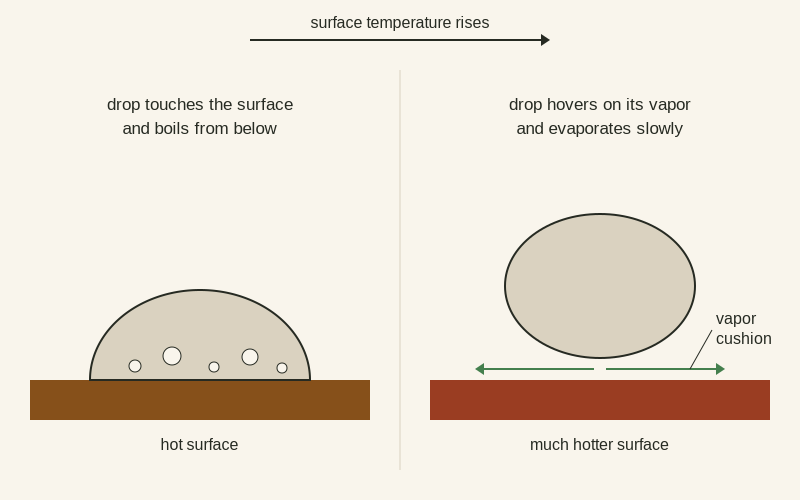
A schematic, not to scale. On a hot surface the drop touches it and boils from below. On a hotter one, vapor from the underside of the drop holds it clear, and the drop shrinks slowly as it evaporates.
"A water drop that touches and boils, and one that hovers on its vapor" by Molecule & Menu, https://moleculeandmenu.com/cooking-science/leidenfrost-effect/, licensed under CC BY 4.0 (https://creativecommons.org/licenses/by/4.0/)
Data: Concept from Graeber et al., Nat Commun 12:1727 (2021), CC BY 4.0, and Bouillant et al., PNAS 118(26):e2021691118 (2021); retrieved 2026-11-13; no measured values plotted
What is the Leidenfrost effect?
The Leidenfrost effect is a liquid floating on a layer of its own vapor above a surface hot enough to keep that layer going. The 2021 paper, by Gustav Graeber and colleagues at ETH Zurich, stresses that water on a hot plate is only the classic case. In its review of earlier work, the effect occurs with many liquids, surface materials and textures, and on cold surfaces as well as hot ones, whenever a stable, insulating layer of gas separates the liquid from the solid.
The cold version shows that the absolute temperature is not the point. A second 2021 study, by Ambre Bouillant and colleagues in Paris, notes that dry ice, which is solid carbon dioxide, turns straight to gas at −78 °C. Because of that, dry ice, which is cold enough to freeze skin on contact, floats in the Leidenfrost state even on a surface at room temperature. In both cases the surface is far warmer than the point at which the substance turns to vapor.
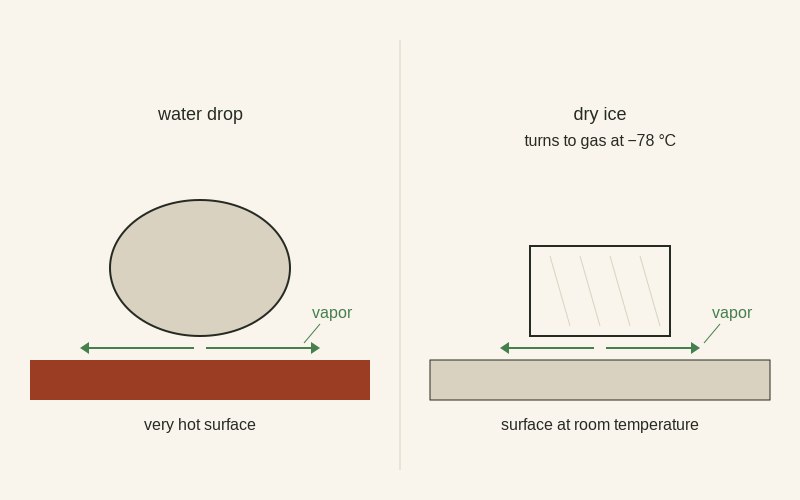
The same layer of vapor appears in hot and cold settings. A water drop rides it over a very hot surface; dry ice, which turns to gas at −78 °C, rides it over a surface at room temperature, as a 2021 study notes.
"The Leidenfrost effect over a hot surface and a room-temperature one" by Molecule & Menu, https://moleculeandmenu.com/cooking-science/leidenfrost-effect/, licensed under CC BY 4.0 (https://creativecommons.org/licenses/by/4.0/)
Data: Graeber et al., Nat Commun 12:1727 (2021), CC BY 4.0; Bouillant et al., PNAS 118(26):e2021691118 (2021); retrieved 2026-11-13
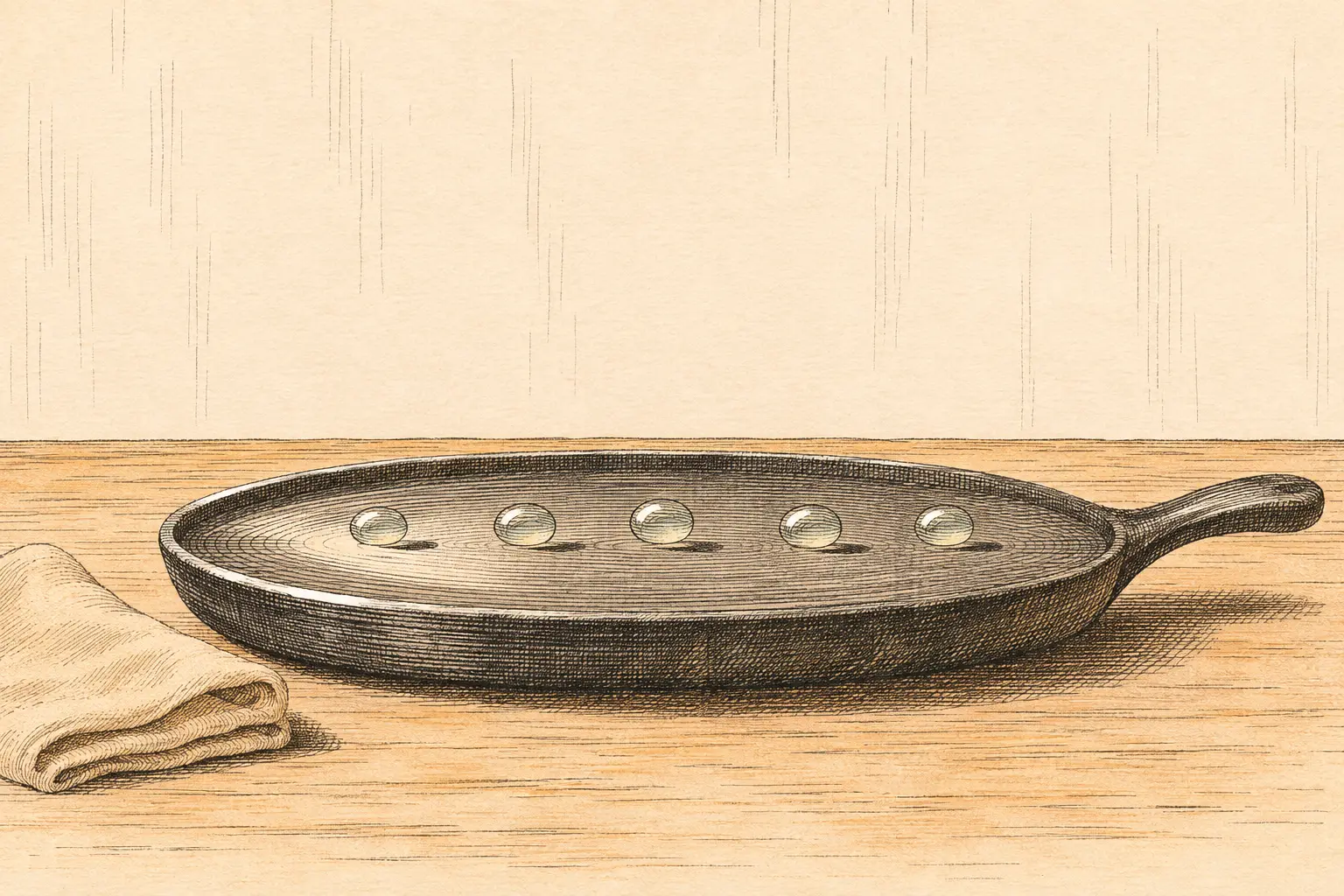
A schematic illustration of water drops on a very hot, dry pan. Each drop rides on a thin layer of its own vapor instead of boiling on contact.
Illustration: Molecule & Menu. Generated schematic illustration — not a photograph or historical record. Reuse: CC BY 4.0 (https://creativecommons.org/licenses/by/4.0/), to the extent Molecule & Menu holds rights in this image.
The effect matters well beyond the kitchen. According to the Graeber paper, the vapor layer can cut heat transfer between a drop and a surface, which is a problem in spray cooling and in nuclear reactors. The same layer can also be put to work, for example to move drops in a chosen direction or to reduce drag.
How does a drop ride on its own vapor?
Seen from the side, the drop sits a tiny distance above the hot surface, and the space underneath is filled with vapor that the drop itself is making. In the 2021 experiments, a water drop with a radius of 1.1 mm rested on a cushion about 0.02 mm thick. The paper takes that thickness from earlier work for a drop of this size. By this page's calculation, the drop's radius is about 55 times the cushion's thickness.
Vapor keeps leaving the underside of the drop and escapes sideways through that narrow gap. The 2021 paper describes the accepted picture as a balance between gravity, surface tension and the lift from this draining vapor. The Bouillant study is plainer: the pressure in the squeezed vapor cushion carries the weight of the drop.
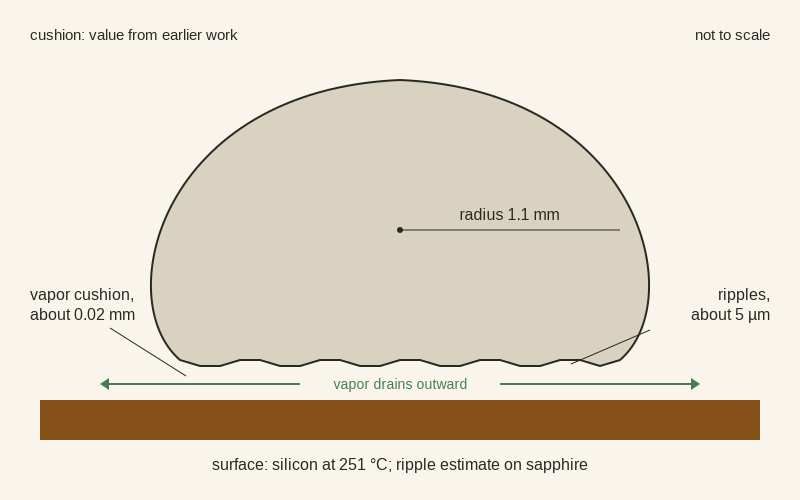
The drop radius and the smooth silicon wafer at 251 °C come from a 2021 experiment. The ripple height is the same study’s estimate from interference images of drops on heated sapphire, the cushion thickness is a figure the paper takes from earlier work for a drop of this size, and the drawing is not to scale.
"The vapor cushion under a Leidenfrost drop (not to scale)" by Molecule & Menu, https://moleculeandmenu.com/cooking-science/leidenfrost-effect/, licensed under CC BY 4.0 (https://creativecommons.org/licenses/by/4.0/)
Data: Values from Graeber et al., Nat Commun 12:1727 (2021), doi:10.1038/s41467-021-21981-z, CC BY 4.0, retrieved 2026-11-13
The cushion also insulates, which is why the drop lasts. The Graeber paper notes that the vapor layer reduces heat transfer between the drop and the surface. The Bouillant study calls the layer thermally insulating and says it keeps the liquid from boiling, so a drop on a very hot solid can survive for minutes. In that study, a water puddle about 8 mm in radius, held in a brass cone heated to about 350 °C, hot enough to burn skin on contact, took about five minutes to evaporate completely.
This is the paradox the Bouillant study points to. On a solid hot enough to make the cushion, the drop does not boil at all, and it outlasts what the heat of the surface would suggest.
Who described it in 1756, and what did a 2021 experiment add?
The Graeber paper credits Johann Gottlob Leidenfrost with the 1756 observation that water drops on very hot surfaces hover and slowly evaporate instead of boiling. His account appeared in a Latin treatise on the qualities of common water. An English translation, On the Fixation of Water in Diverse Fire, was published in 1966 in the International Journal of Heat and Mass Transfer. This page could read only the bibliographic record of the translation, so it does not summarize what Leidenfrost wrote.
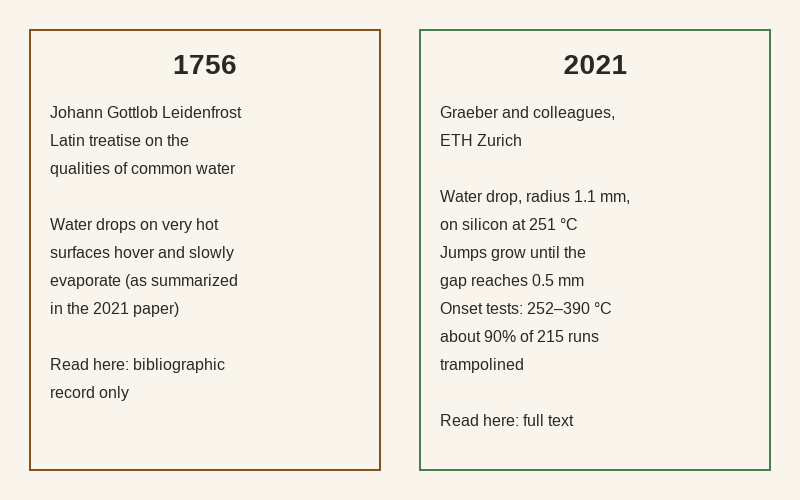
The 1756 account is known here only through a bibliographic record and the 2021 paper’s one-line summary of it. The 2021 values come from the paper’s full text.
"Leidenfrost's 1756 account and the 2021 trampolining experiment" by Molecule & Menu, https://moleculeandmenu.com/cooking-science/leidenfrost-effect/, licensed under CC BY 4.0 (https://creativecommons.org/licenses/by/4.0/)
Data: Values from Graeber et al., Nat Commun 12:1727 (2021), CC BY 4.0; bibliographic data from the Crossref record of Leidenfrost (1966); retrieved 2026-11-13
| 1756 | 2021 | |
|---|---|---|
| Who | Johann Gottlob Leidenfrost | Graeber and colleagues, ETH Zurich |
| What was observed | Water drops on very hot surfaces | A water drop of radius 1.1 mm on silicon at 251 °C |
| Reported result | Drops hover and slowly evaporate (the 2021 paper’s summary) | The drop bounces higher until the gap reaches 0.5 mm |
| What this page read | Bibliographic record only | Full text, CC BY 4.0 |
The 2021 team set out to test the textbook picture of a drop resting quietly on its cushion. They placed a water drop with a radius of 1.1 mm gently on a smooth silicon wafer heated to 251 °C, hot enough to burn skin on contact, and filmed it with a high-speed camera. The drop began to bob in place, then hopped, and each hop went higher until the gap under it reached about 0.5 mm. The authors named this Leidenfrost droplet trampolining.
Their explanation starts in the cushion. Draining vapor raises ripples on the underside of the drop, which the team estimated at about 5 µm high from interference images. Where a ripple dips toward the hot surface, the gap narrows, evaporation speeds up and the pressure rises, so the drop gets a push. Gravity pulls it back, it squeezes the cushion harder, and the cycle builds.
Across 215 experiments at surface temperatures from 252 to 390 °C, about 90% showed trampolining. The authors concluded that the surface only had to be hot enough to put the drop into the Leidenfrost state, and that heating it further did not change how the drop bounced. Size mattered more. Large drops wobbled without bouncing, and very small ones stopped.
| Value from the 2021 study | Value | Conditions |
|---|---|---|
| Radius of the water drop | 1.1 mm | Smooth silicon wafer at 251 °C, open air |
| Surface temperature in the demonstration | 251 °C | A test condition, not a threshold |
| Vapor cushion under a resting drop | about 0.02 mm | Value from earlier work cited by the paper |
| Ripples on the underside of the drop | about 5 µm | Estimated from interference images of drops on heated sapphire |
| Largest gap during jumps | 0.5 mm | Plateau after the jumps grew |
| Surface temperatures in onset tests | 252–390 °C | Range of test conditions |
| Experiments with trampolining | about 90% | Of 215 experiments |
Download the 2021 study values (CSV) (source and license notes) Data: Graeber et al., Leidenfrost droplet trampolining, Nat Commun 12:1727 (2021), CC BY 4.0, retrieved 2026-11-13
Why do Leidenfrost drops wander, spin and pulse?
With nothing touching the solid, a Leidenfrost drop is free to move. In the 2021 trampolining runs, the drop drifted slowly sideways while it bounced, and the team used slightly concave wafers so that drops would stay near the center. The Bouillant study lists other motions reported in earlier work. Drops at rest on a flat surface can start to rotate and even propel themselves, and on hot surfaces cut with ratchet-like teeth they travel in a direction set by the pattern.
Large drops can also pulse into star shapes, a behavior the Bouillant study traces to reports from the 19th century. In its setup, a water puddle sat in a brass cone heated to 350 °C, a burn hazard on contact. One puddle, 7.4 mm in radius at the start, began to ripple after a few seconds at rest. As it shrank, it oscillated with eight lobes at 16 s, six lobes at 30 s and four lobes at 90 s.
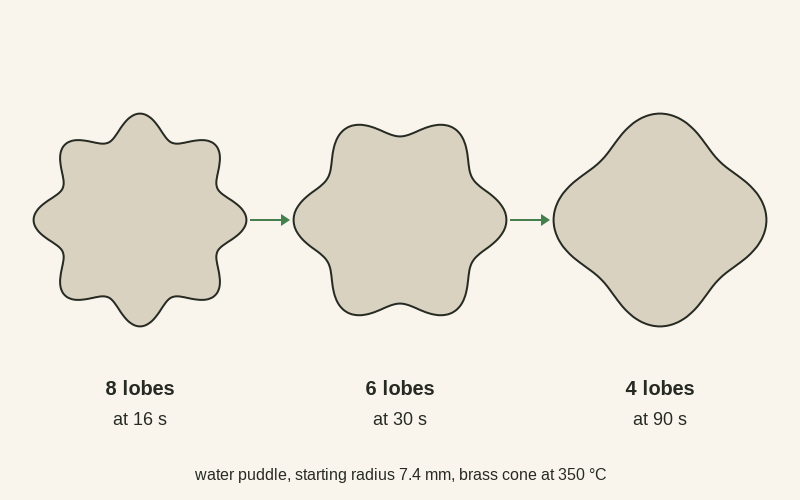
Star shapes reported in a 2021 study for a water puddle that started at a radius of 7.4 mm, in a brass cone at 350 °C. The outlines are drawn from a simple formula to show the lobe counts and times; they are not traced from the study’s photographs.
"Star-shaped oscillations of a Leidenfrost puddle: eight, six and four lobes" by Molecule & Menu, https://moleculeandmenu.com/cooking-science/leidenfrost-effect/, licensed under CC BY 4.0 (https://creativecommons.org/licenses/by/4.0/)
Data: Lobe counts and times reported in Bouillant et al., Self-excitation of Leidenfrost drops and consequences on their stability, PNAS 118(26):e2021691118 (2021), retrieved 2026-11-13; drawing is independent
The study’s explanation again points to the cushion. With disks of dry ice resting on a heated balance, the measured weight oscillated at around 300 times a second, which the authors read as the vapor layer vibrating on its own. They argue that this vibration can set the surface of a drop into waves, and they note that stars appear only when the surface is hot enough, typically above 300 °C. Dry ice and a surface that hot can both injure skin on contact.
Is there a single Leidenfrost temperature?
Some cooking pages give one temperature at which water starts to skate on a pan. None of the research read for this page supports a single number. The surface temperature at which hovering sets in is called the Leidenfrost temperature. The evidence here says it depends on the surface.
A 2023 preprint by Yuki Wakata and colleagues measured the Leidenfrost temperature on solids with different thermal diffusivities and different surface roughness. Thermal diffusivity describes how quickly heat spreads through a material. From those results, the authors built a model that accounts for the thermal diffusivity of the solid and links roughness to the thickness of the vapor film. They report that data for other liquids and solids support it.
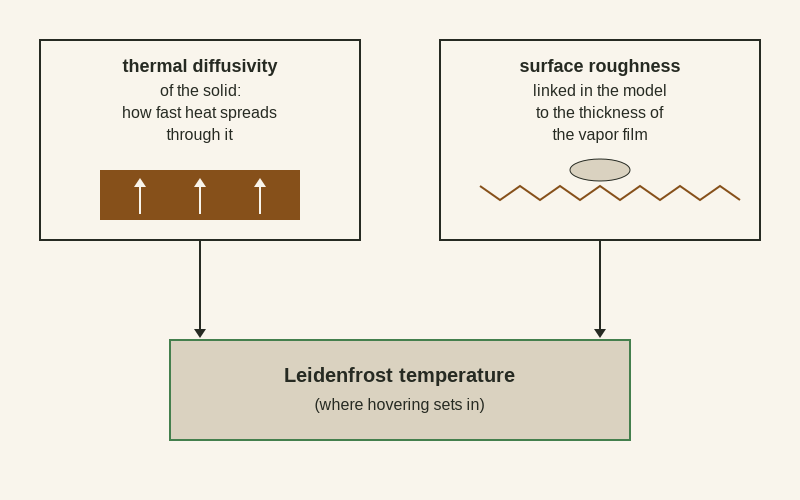
The two surface properties studied in a 2023 preprint on the Leidenfrost temperature, read here from its abstract only. The diagram shows which properties matter, not how much or in which direction.
"Two surface properties studied for the Leidenfrost temperature" by Molecule & Menu, https://moleculeandmenu.com/cooking-science/leidenfrost-effect/, licensed under CC BY 4.0 (https://creativecommons.org/licenses/by/4.0/)
Data: Concept from the abstract of Wakata et al., arXiv:2305.13767 (2023), retrieved 2026-11-13; no values plotted
This page read only the abstract of that preprint, so it gives none of the measured temperatures and does not say which way each property moves the onset. The 2021 figures fit the same caution. Water drops hovered on silicon at 251 °C and on sapphire at 250 °C, and the onset tests ran from 252 to 390 °C. These are conditions the team chose, not the lowest temperature at which a drop will hover.
Call the pan surface the invisible ingredient here. No recipe lists it, yet the material under the drop, how fast that material moves heat and how rough its face is help set the temperature at which water stops boiling on contact and starts to hover.
What does the effect mean at the stove?
A wet surface and a very hot, dry one give water opposite roles. While a film of water is boiling on a surface, that water cannot climb past its boiling point. NIST gives 99.87 °C for the boiling point at 30.5 m above sea level and an altimeter pressure of 1013 hPa.
That ceiling is why browning stays slow until a surface dries, as the Maillard reaction page explains. On a far hotter, dry surface, the same water forms a drop that hovers, insulated by its own vapor.
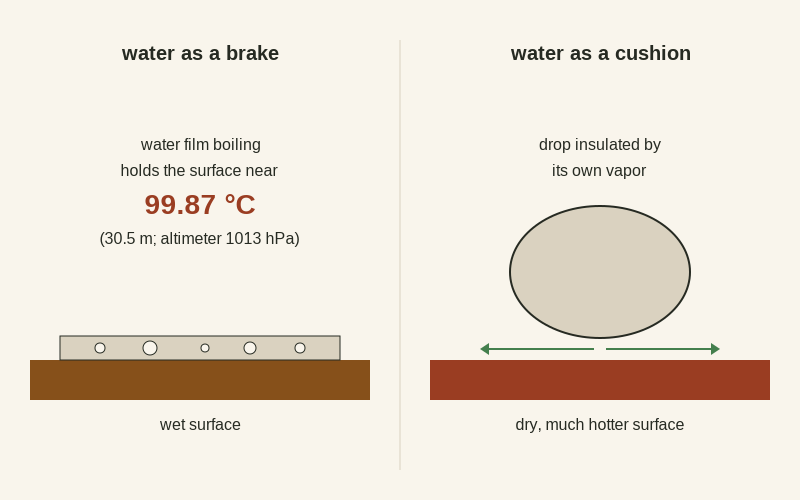
Water plays two roles on a hot surface. The boiling point shown is the NIST figure for 30.5 m above sea level at an altimeter pressure of 1013 hPa, and the hovering drop matches the 2021 silicon experiment.
"Water as a brake on a wet surface and as a cushion on a dry, hotter one" by Molecule & Menu, https://moleculeandmenu.com/cooking-science/leidenfrost-effect/, licensed under CC BY 4.0 (https://creativecommons.org/licenses/by/4.0/)
Data: NIST, Mercury Thermometer Alternatives: steam point; Graeber et al., Nat Commun 12:1727 (2021), CC BY 4.0; retrieved 2026-11-13
Sugar on a hot pan follows another path again. On the caramelization page, even the point at which sugar crystals give way shifts with how fast they are heated. Hot sugar burns skin on contact.
Hot oil is a fire risk, not a demonstration
Nothing on this page is a test to try at the stove. The effect described here involves water on a dry, very hot surface, and oil or grease, once hot, is a fire risk of its own. The U.S. Fire Administration’s cooking safety flyer states the rule plainly: “Never try to stop a grease or oil fire with water.”
The agency’s cooking safety page, last reviewed on September 28, 2026, adds a warning about grease: “If you see any smoke or the grease starts to boil, turn the burner off.” It also says: “Keep a pan lid or baking sheet nearby. Use it to cover the pan if it catches on fire.”
Sources
- Graeber, G., Regulagadda, K., Hodel, P., Küttel, C., Landolf, D., Schutzius, T. M., & Poulikakos, D. (2021). Leidenfrost droplet trampolining. Nature Communications, 12, 1727. https://doi.org/10.1038/s41467-021-21981-z https://pmc.ncbi.nlm.nih.gov/articles/PMC7979863/Read: full text.
- Bouillant, A., Cohen, C., Clanet, C., & Quéré, D. (2021). Self-excitation of Leidenfrost drops and consequences on their stability. Proceedings of the National Academy of Sciences, 118(26), e2021691118. https://doi.org/10.1073/pnas.2021691118 https://doi.org/10.1073/pnas.2021691118Read: full text, paraphrased.
- Wakata, Y., Chen, X., Zhu, N., Lyu, S., Chao, X., & Sun, C. (2023). How roughness and thermal properties of a solid substrate determine the Leidenfrost temperature: Experiments and a model. arXiv:2305.13767 [physics.flu-dyn]. https://doi.org/10.48550/arXiv.2305.13767 https://arxiv.org/abs/2305.13767Read: abstract only.
- Leidenfrost, J. G. (1966). On the fixation of water in diverse fire. International Journal of Heat and Mass Transfer, 9(11), 1153–1166 (English translation of De Aquae Communis Nonnullis Qualitatibus Tractatus, 1756). https://doi.org/10.1016/0017-9310(66)90111-6 https://doi.org/10.1016/0017-9310(66)90111-6Read: bibliography only.
- National Institute of Standards and Technology. Mercury Thermometer Alternatives: Verification Methods for Alternative Thermometers (section “Measurement at the steam point”). https://www.nist.gov/pml/sensor-science/thermodynamic-metrology/mercury-thermometer-alternatives/mercury-thermometer-7Read: full page.
- U.S. Fire Administration. Cook Safely: Watch What You Heat! (Fire Is Everyone's Fight cooking safety flyer). https://www.usfa.fema.gov/downloads/fief/handouts/fief_cooking_safety_flyer.pdfRead: full text.
- U.S. Fire Administration. Cooking Fire Safety. Page last reviewed: Sept. 28, 2026. https://www.usfa.fema.gov/prevention/home-fires/prevent-fires/cooking/Read: full page.
Cite this page
“Leidenfrost Effect: Water Drops Hover on Their Own Vapor.” Molecule & Menu. Published November 14, 2026. https://moleculeandmenu.com/cooking-science/leidenfrost-effect/. Accessed on the date you read it.
How pages here are checked · All corrections · Report an error on this page (contact@moleculeandmenu.com)
Second helping:
- Why does bread rise: Gas from yeast starts the rise, and in the oven heat takes over.
- Espresso crema: Another cushion of gas, this time carbon dioxide from the roast, forced into the water by pressure.
More from Cooking Science
Cooking Science
Maillard Reaction: Browning Has No Starting Temperature
The Maillard reaction has no on-switch: a 2025 review cites it in frozen storage. This page's Arrhenius estimates show how much faster it runs from 60 to 180°C.
Picture credit
"Stilleven met een zoutvat (Still Life with a Salt Cellar)" by Pieter Claesz — https://commons.wikimedia.org/wiki/File:Stilleven_met_een_zoutvat,_SK-A-4839.jpg — CC0 1.0 (https://creativecommons.org/publicdomain/zero/1.0/)
Cooking Science
Caramelization: A 2011 Study Tied Sugar Melting to Heat Rate
Caramelization browns sugar without amino acids. In a 2011 study, sugar’s apparent melting point shifted with heating rate; a 2012 comment and reply followed.
Picture credit
"Boiling caramel in a pot" by Personal Creations — https://commons.wikimedia.org/wiki/File:Boiling_caramel_in_a_pot_(15092657599).jpg — CC BY 2.0 (https://creativecommons.org/licenses/by/2.0/)
Cooking Science
Why Does Bread Rise? Gas From Yeast, Then Heat Takes Over
Why does bread rise? Yeast fills dough with CO2; in the oven, heat swells the gas and adds steam until the pores open and the dough sets, per 2025–2026 studies.
Picture credit
"Sourdough bread with decorative scores" by SueRostvold — https://commons.wikimedia.org/wiki/File:Sourdough_bread_with_decorative_scores.jpg — CC BY 4.0 (https://creativecommons.org/licenses/by/4.0/)