Caramelization: A 2011 Study Tied Sugar Melting to Heat Rate
Short answer
Sugar crystals can give way at different temperatures, depending on how fast they are heated. That finding comes from a 2011 thermal-analysis study of sucrose, glucose and fructose, whose authors traced the shift to the sugar breaking down as it heats, a process they linked to caramelization. They called the change “apparent melting.” Other scientists published a comment on the work in 2012, and the authors replied. Caramelization itself is the browning of sugar heated without amino acids or proteins, the partners the Maillard reaction needs.
Course list · 6 sections
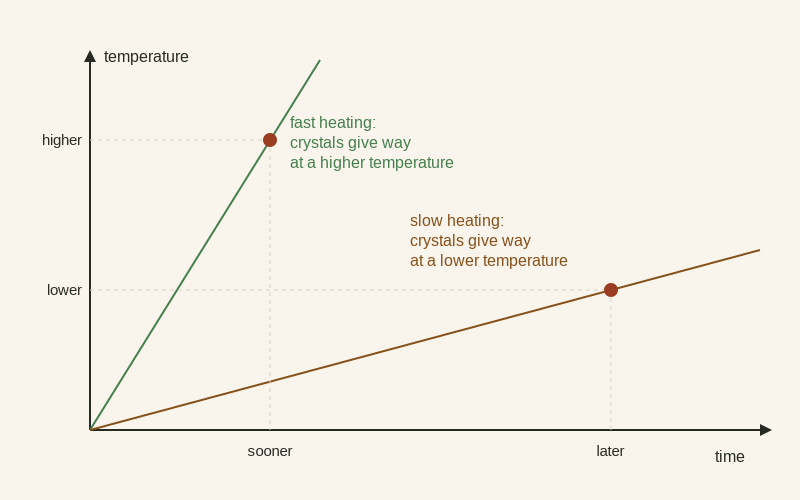
A concept sketch with no measured values. It shows the pattern described in the abstracts of the 2011 study: the temperature at which sugar crystals give way depends on how fast the sample is heated, which the authors attribute to a breakdown that needs both heat and time.
"Heating rate and the apparent melting of sugar (concept sketch)" by Molecule & Menu, https://moleculeandmenu.com/cooking-science/caramelization/, licensed under CC BY 4.0 (https://creativecommons.org/licenses/by/4.0/)
Data: Concept from the abstracts of Lee, Thomas & Schmidt, J. Agric. Food Chem. 59(2):684–701 (2011) and Lee et al., 59(2):702–712 (2011), retrieved 2026-11-13; no measured values plotted
What is caramelization?
Caramelization is what happens when sugar is heated on its own until it browns. A 2014 review of food caramels by Sengar and Sharma describes it as the reactions of sugars heated without nitrogen compounds, such as amines and proteins. The sugar first loses water. The fragments then condense or polymerize into larger molecules, some of them brown.
The same review sorts the products into two groups. Large brown molecules that do not evaporate give the color, and small volatile compounds, including furans and 5-hydroxymethylfurfural (5-HMF), are listed as the flavor compounds of caramel. The review cites an 1858 technical study of caramel color by the French chemist Gelis. According to the review, that work found three main products in caramelized sucrose: caramelan, caramelen and caramelin.
Conditions steer the result. The review calls caramelization a pyrolysis reaction of sugars, meaning a breakdown driven by heat, and says its course depends on the pH and on which sugar is heated. Manufacturers add food-grade acids, alkalis or salts to promote it, and heating syrup with sodium bicarbonate gives a stronger type of caramelization with a different flavor. Syrup hot enough to caramelize burns skin on contact.
The other browning route in cooking is the Maillard reaction, which a 2025 review by El Hosry and colleagues defines as a reaction between amino acid residues and reducing sugars. That amino group is the dividing line: the Maillard reaction needs one, and caramelization does not. Pyrazines show the difference in a single molecule. They carry nitrogen in their ring, and the 2025 review traces them to reactions between amino acids and sugars, so pyrazines come from Maillard browning, not from sugar heated alone.
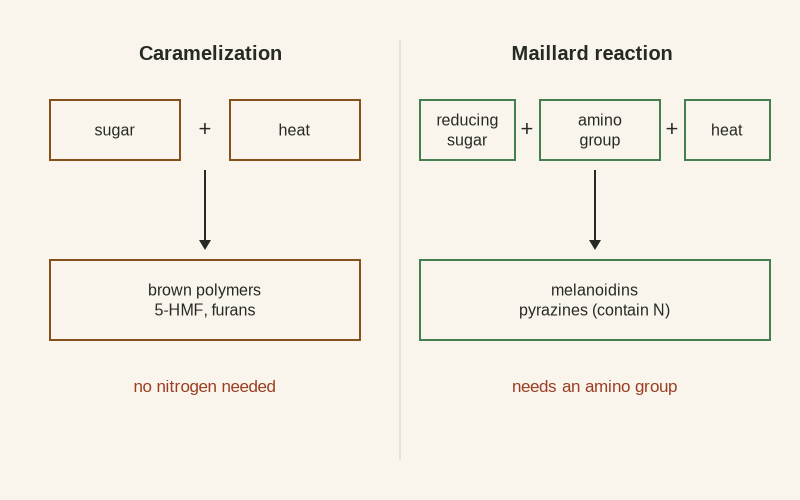
Inputs and typical products of the two browning routes. Caramelization needs only sugar and heat. The Maillard reaction also needs an amino group, which is why its products include pyrazines, which contain nitrogen.
"Caramelization and the Maillard reaction: what each needs" by Molecule & Menu, https://moleculeandmenu.com/cooking-science/caramelization/, licensed under CC BY 4.0 (https://creativecommons.org/licenses/by/4.0/)
Data: Sengar & Sharma, Food caramels: a review, J. Food Sci. Technol. 51(9):1686–1696 (2014); El Hosry et al., Foods 14(11):1881 (2025), CC BY 4.0; both retrieved 2026-11-13
| Caramelization | Maillard reaction | |
|---|---|---|
| What reacts | Sugar alone, with heat | A reducing sugar and an amino group, with heat |
| Nitrogen in the products | None | Yes, for example in pyrazines |
| Brown products | Caramelan, caramelen and caramelin, in an 1858 analysis | Melanoidins, brown polymers |
| Small aroma molecules | 5-HMF, furans | Strecker aldehydes, pyrazines; furans too |
| Present in a bread crust | Yes | Yes |
Both are non-enzymatic browning, meaning no enzyme drives the reaction. The 2025 review uses that label for the Maillard reaction and names caramelization as the other non-enzymatic browning reaction in baking.
Does sugar melt?
Reference tables give sugars a melting point, as if sucrose turned liquid at one fixed temperature. The 2011 study began from a problem with those tables. The abstract of its first paper notes that true melting happens at a single temperature that does not depend on time. Yet published melting values for sucrose, glucose and fructose vary widely.
The study measured each sugar in a differential scanning calorimeter. This instrument records how much heat a sample absorbs as its temperature rises. According to the abstract, the melting values depended strongly on the heating rate. A true melting point should not move that way, so the authors took the shift as a sign of a process that needs time, which they call a kinetic process.
Their answer was that the sugar starts to decompose, and that this breakdown, rather than ordinary melting, is what destroys the crystal. For comparison they tested indium and mannitol, two materials that melt in the textbook way, and the sugars behaved differently. They proposed the term “apparent melting” for the sugar’s change. This page gives no temperatures for it, because only the abstracts could be read and the measured values sit in the full papers.
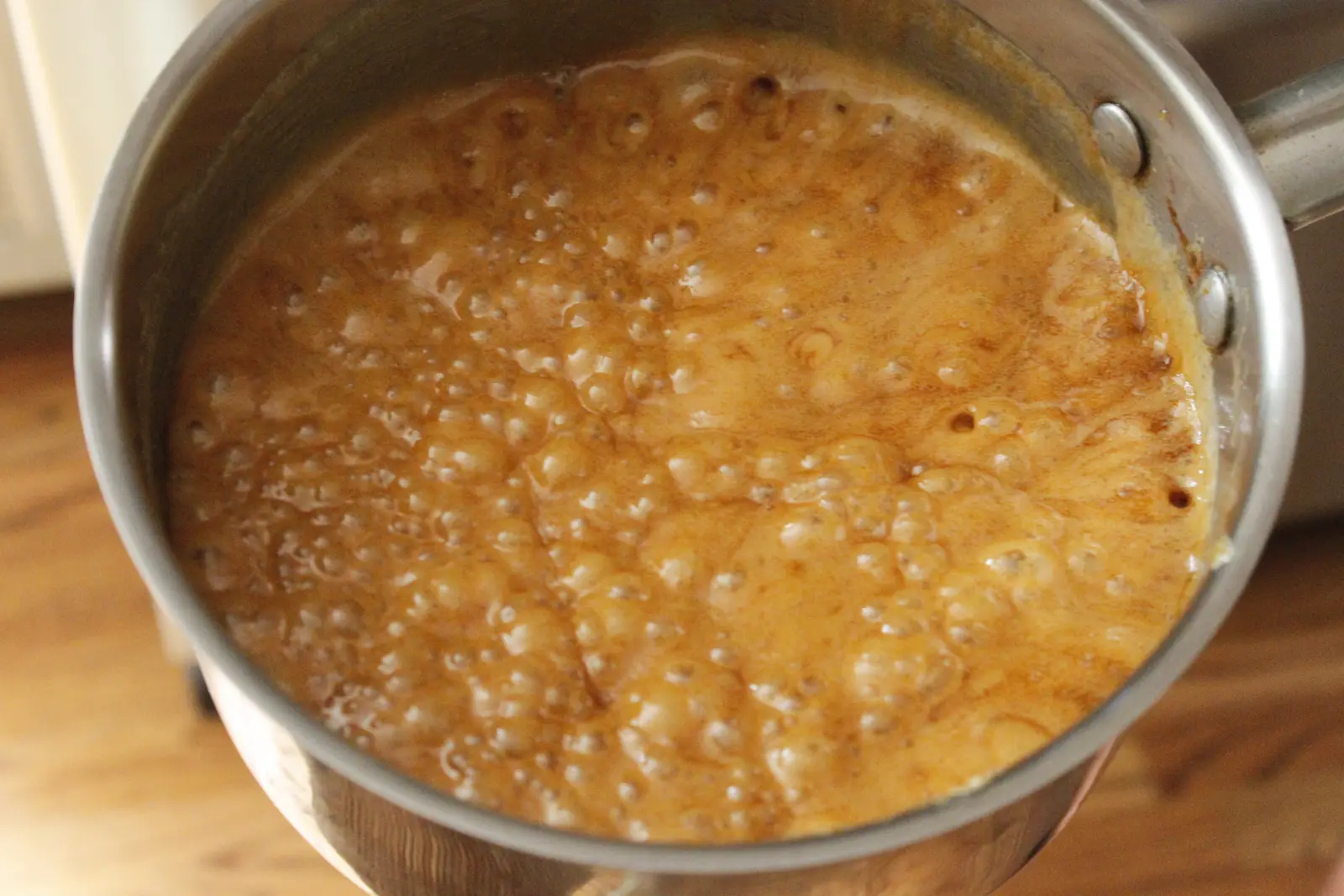
Caramel boiling in a saucepan. The photograph does not record the recipe or the temperature, so it shows the color, not a measurement.
"Boiling caramel in a pot" by Personal Creations — https://commons.wikimedia.org/wiki/File:Boiling_caramel_in_a_pot_(15092657599).jpg — CC BY 2.0 (https://creativecommons.org/licenses/by/2.0/)
The logic of that reading is about time. A chemical breakdown needs time as well as heat. A sample heated quickly reaches a high temperature before much has happened to it. A sample heated slowly spends longer at each step, so the breakdown shows up at a lower reading on the thermometer.
On this reading, the melting value a table prints depends partly on how the measurement was made.
What did the 2011 study measure?
The study's second paper looked for chemical traces of breakdown in sucrose, which is table sugar. It used liquid chromatography, a method that separates the compounds in a sample and measures each one. Sucrose is built from one glucose unit and one fructose unit, so free glucose is an early sign that it is coming apart. 5-HMF is one of the caramel compounds named in the 2014 review.
With fast heating in a standard calorimeter run, the abstract reports glucose at 0.365% and 5-HMF at 0.003% in the sucrose sample. Both turned up at the onset of the first endothermic peak, where the sample starts to take in extra heat. A slow method held the sample at set temperatures step by step; there, glucose at 0.411% and 5-HMF at 0.003% turned up at a 50-minute hold, when the heat capacity began to rise. In both runs, breakdown products the authors could not identify formed before the crystals were fully gone.
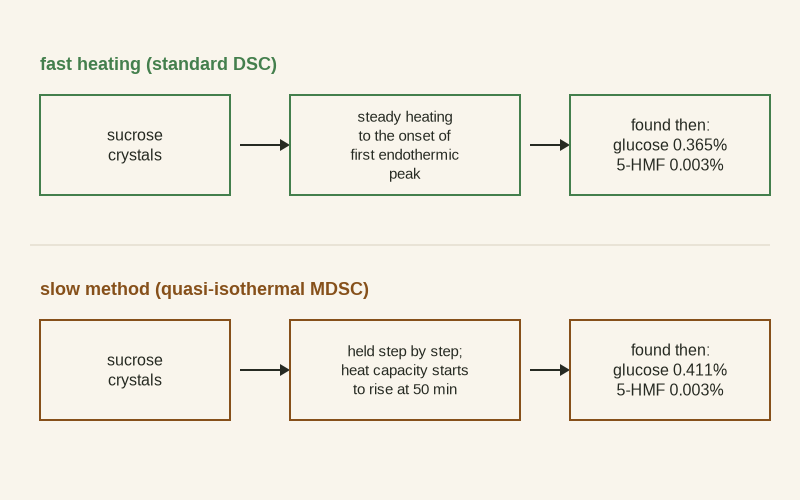
The two heating methods in the study's second paper and what each found in sucrose, as reported in its abstract. Percentages are as the abstract gives them for the sucrose sample. The temperature of each step is given in the full paper, which this page could not read.
"Breakdown products found in sucrose under fast and slow heating" by Molecule & Menu, https://moleculeandmenu.com/cooking-science/caramelization/, licensed under CC BY 4.0 (https://creativecommons.org/licenses/by/4.0/)
Data: Values from the abstract of Lee et al., J. Agric. Food Chem. 59(2):702–712 (2011), doi:10.1021/jf104235d, retrieved 2026-11-13
The abstract concludes that the loss of crystal structure in sucrose comes from thermal breakdown and depends on a combination of time and temperature. It adds that caramelization can happen well below the melting temperatures reported in the literature, if the sugar is held for longer.
These sources give no single caramelization temperature. They describe conditions rather than a threshold. The 2011 abstracts tie the change to time as well as heat, and the 2014 review ties its course to the pH, the kind of sugar and any added acids or alkalis.
Call the heating rate the invisible ingredient here. No recipe for caramel lists it, yet in these results it decides how long the sugar spends at each temperature, and that time helps set when the crystals give way. The point rests on two abstracts, and the full papers' figures could not be checked.
The 2012 comment, and why it matters
Nine scientists led by Yrjö Roos published a comment on the papers in the same journal in 2012, titled Comment on the Melting and Decomposition of Sugars. Three of the original authors, Shelly Schmidt, Leonard Thomas and Joo Won Lee, replied in the same issue. This page could read only the bibliographic records of the comment and the reply, so it does not summarize either side's argument.
What that leaves is a finding with a published comment and reply attached. The heating-rate effect and the breakdown products both come from one research group's experiments, read here through abstracts. The claim that breakdown, not melting, explains the effect is that group's interpretation. What the 2012 comment says about it could not be read here.
That is why this page speaks of a melting point that shifts, not of a melting point that does not exist. A reader who needs a number for sugar should ask how it was measured and how fast the sample was heated. A reader who needs the final word on the mechanism will have to read the full papers, the comment and the reply, which this page could not.
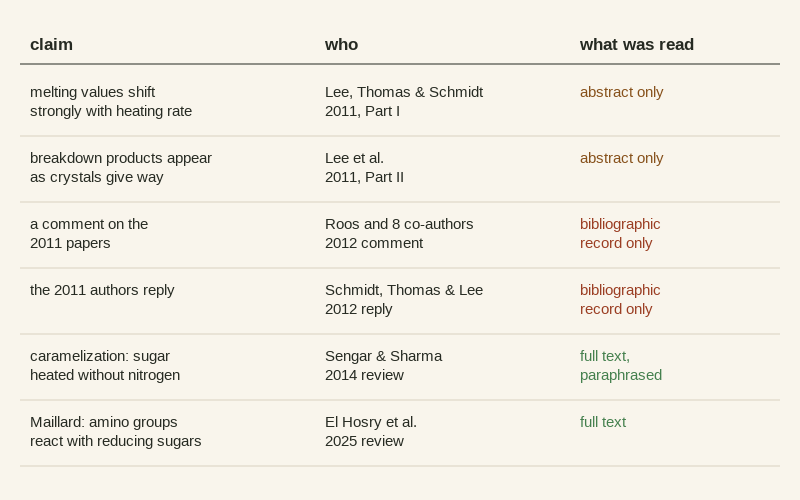
Who made each claim on this page and how much of the source could be read. The 2012 comment and reply are known here only from their bibliographic records.
"Claims about caramelization, who made them, and what was read" by Molecule & Menu, https://moleculeandmenu.com/cooking-science/caramelization/, licensed under CC BY 4.0 (https://creativecommons.org/licenses/by/4.0/)
Data: Bibliographic data from Europe PMC and Crossref records of the 2011 papers, the 2012 comment and the 2012 reply, retrieved 2026-11-13
| Claim | Who | Year | What was read |
|---|---|---|---|
| Melting values of sucrose, glucose and fructose shift strongly with heating rate | Lee, Thomas and Schmidt (Part I) | 2011 | Abstract only |
| Glucose and 5-HMF appear in sucrose as its crystals give way | Lee and colleagues (Part II) | 2011 | Abstract only |
| A comment on the 2011 papers | Roos and eight co-authors (comment) | 2012 | Bibliographic record only |
| The original authors respond | Schmidt, Thomas and Lee (reply) | 2012 | Bibliographic record only |
| Caramelization is sugar heated without nitrogen compounds | Sengar and Sharma (review) | 2014 | Full text, paraphrased |
| The Maillard reaction joins amino groups and reducing sugars | El Hosry and colleagues (review) | 2025 | Full text |
Where do caramelization and Maillard browning meet?
Bread crust is the plainest case of the two routes running side by side. The 2025 review describes baking in three phases: dough expansion, surface drying and crust browning. In its account, crust browning typically occurs at around 160°C, and the Maillard reaction and caramelization are the two browning reactions behind the crust's color and aroma.
The 2025 review splits the Maillard side into roughly three stages. The early stage is colorless and odorless: the sugar's carbonyl group joins an amino group and rearranges into an Amadori product, or a Heyns product when the sugar is a ketose such as fructose. In the middle stage, Strecker degradation breaks down amino acids and releases volatile Strecker aldehydes, which the review links to aroma, while pyrazines form alongside. The final stage builds melanoidins, the brown polymers of the Maillard reaction.
The review does not divide the crust's color between the two routes, and this page does not either. What the chemistry does settle is which products can come from which route. Anything with nitrogen built in, such as a pyrazine, points to the Maillard side. 5-HMF and the caramel polymers can come from sugar alone.
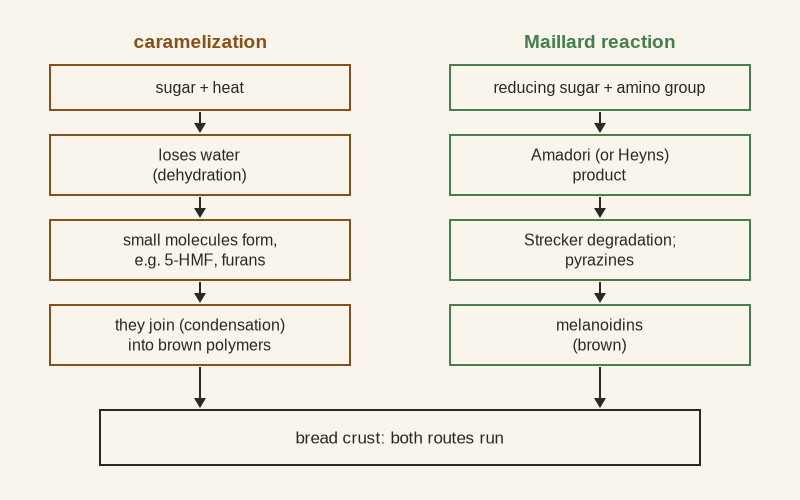
Simplified steps of the two browning routes, from the 2014 caramel review and the 2025 Maillard review. In a baking bread crust, both run at once.
"Two browning routes: caramelization and the Maillard reaction" by Molecule & Menu, https://moleculeandmenu.com/cooking-science/caramelization/, licensed under CC BY 4.0 (https://creativecommons.org/licenses/by/4.0/)
Data: Sengar & Sharma, Food caramels: a review, J. Food Sci. Technol. 51(9):1686–1696 (2014); El Hosry et al., Foods 14(11):1881 (2025), CC BY 4.0; both retrieved 2026-11-13
How a loaf grows before that crust sets is a separate story, told in why bread rises: gas from the dough first, then heat in the oven.
Is caramel color the same as caramelized sugar?
The “caramel color” on drink and food labels is a manufactured family of colorings, not simply sugar browned in a pan. The 2014 review counts four classes, numbered I to IV and coded E150a to E150d in Europe: plain caramel, caustic sulfite caramel, ammonia caramel and sulfite-ammonia caramel. It notes that a European Union colors directive treats all four as colorings, separate from the burnt or caramelized sugars used for flavor.
Two of the classes cross the line drawn earlier on this page. Ammonia caramel forms in what the review calls a Maillard-type reaction, in which carbonyl compounds from the sugar react with ammonia or amino groups, so nitrogen is part of the recipe. In the Food Chemicals Codex specifications the review reproduces, total nitrogen is below 0.1% for plain caramel but ranges from 1.3 to 6.8% for ammonia caramel and from 0.5 to 7.5% for sulfite-ammonia caramel.
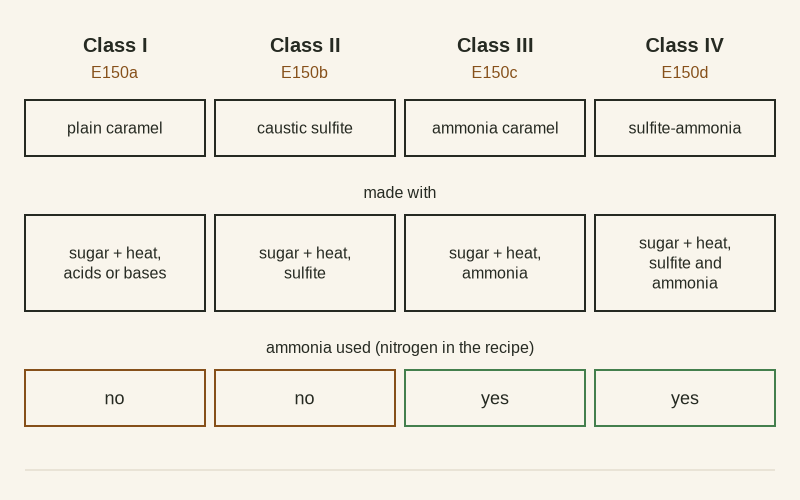
The four classes of caramel color as listed in the 2014 caramel review. Classes III and IV are made with ammonia compounds, which puts them on the Maillard side of the line drawn on this page.
"The four classes of caramel color" by Molecule & Menu, https://moleculeandmenu.com/cooking-science/caramelization/, licensed under CC BY 4.0 (https://creativecommons.org/licenses/by/4.0/)
Data: Sengar & Sharma, Food caramels: a review, J. Food Sci. Technol. 51(9):1686–1696 (2014), retrieved 2026-11-13
| Class | Code in Europe | Name | Made with ammonia | Total nitrogen (Food Chemicals Codex) |
|---|---|---|---|---|
| I | E150a | Plain caramel | No | Below 0.1% |
| II | E150b | Caustic sulfite caramel | No | Below 0.2% |
| III | E150c | Ammonia caramel | Yes | 1.3–6.8% |
| IV | E150d | Sulfite-ammonia caramel | Yes | 0.5–7.5% |
Plain caramel, made by heating sugar with acids or bases, is the class closest to caramelization in the strict sense used here. The word caramel on a label therefore says little about the chemistry behind a given color. This page covers only how the classes are made and sorted; it does not discuss their safety.
Sources
- Lee, J. W., Thomas, L. C., & Schmidt, S. J. (2011). Investigation of the Heating Rate Dependency Associated with the Loss of Crystalline Structure in Sucrose, Glucose, and Fructose Using a Thermal Analysis Approach (Part I). Journal of Agricultural and Food Chemistry, 59(2), 684–701. https://doi.org/10.1021/jf1042344Read: abstract only.
- Lee, J. W., Thomas, L. C., Jerrell, J., Feng, H., Cadwallader, K. R., & Schmidt, S. J. (2011). Investigation of Thermal Decomposition as the Kinetic Process That Causes the Loss of Crystalline Structure in Sucrose Using a Chemical Analysis Approach (Part II). Journal of Agricultural and Food Chemistry, 59(2), 702–712. https://doi.org/10.1021/jf104235dRead: abstract only.
- El Hosry, L., Elias, V., Chamoun, V., Halawi, M., Cayot, P., Nehme, A., & Bou-Maroun, E. (2025). Maillard Reaction: Mechanism, Influencing Parameters, Advantages, Disadvantages, and Food Industrial Applications: A Review. Foods, 14(11), 1881. https://doi.org/10.3390/foods14111881 https://pmc.ncbi.nlm.nih.gov/articles/PMC12154226/Read: full text. License: CC BY 4.0.
- Sengar, G., & Sharma, H. K. (2014). Food caramels: a review. Journal of Food Science and Technology, 51(9), 1686–1696. https://doi.org/10.1007/s13197-012-0633-z https://pmc.ncbi.nlm.nih.gov/articles/PMC4152495/Read: full text, paraphrased.
- Roos, Y. H., Franks, F., Karel, M., Labuza, T. P., Levine, H., Mathlouthi, M., Reid, D., Shalaev, E., & Slade, L. (2012). Comment on the Melting and Decomposition of Sugars. Journal of Agricultural and Food Chemistry, 60(41), 10359–10362; reply by Schmidt, S. J., Thomas, L. C., & Lee, J. W., 10363–10371. https://doi.org/10.1021/jf3002526Read: bibliography only.
Cite this page
“Caramelization: A 2011 Study Tied Sugar Melting to Heat Rate.” Molecule & Menu. Published November 14, 2026. https://moleculeandmenu.com/cooking-science/caramelization/. Accessed on the date you read it.
How pages here are checked · All corrections · Report an error on this page (contact@moleculeandmenu.com)
Second helping:
- Maillard reaction: Add an amino group to hot sugar and browning takes a different route, one with no starting temperature either.
- Leidenfrost effect: Why a water drop on a very hot pan can hover on its own vapor instead of boiling away. A pan that hot, and its steam, can burn skin.
More from Cooking Science
Cooking Science
Maillard Reaction: Browning Has No Starting Temperature
The Maillard reaction has no on-switch: a 2025 review cites it in frozen storage. This page's Arrhenius estimates show how much faster it runs from 60 to 180°C.
Picture credit
"Stilleven met een zoutvat (Still Life with a Salt Cellar)" by Pieter Claesz — https://commons.wikimedia.org/wiki/File:Stilleven_met_een_zoutvat,_SK-A-4839.jpg — CC0 1.0 (https://creativecommons.org/publicdomain/zero/1.0/)
Cooking Science
Why Does Bread Rise? Gas From Yeast, Then Heat Takes Over
Why does bread rise? Yeast fills dough with CO2; in the oven, heat swells the gas and adds steam until the pores open and the dough sets, per 2025–2026 studies.
Picture credit
"Sourdough bread with decorative scores" by SueRostvold — https://commons.wikimedia.org/wiki/File:Sourdough_bread_with_decorative_scores.jpg — CC BY 4.0 (https://creativecommons.org/licenses/by/4.0/)
Cooking Science
Sourdough Starter: Its Bacteria Usually Outnumber Its Yeasts
In counts a 2022 review cites, a mature sourdough starter’s lactic acid bacteria outnumber its yeasts 10 to 100 times. Who makes the acid? Does place matter?
Picture credit
"Sliced loaf of sourdough bread" by Nutrition, Food Safety & Health (Flickr) — https://commons.wikimedia.org/wiki/File:Sliced_loaf_of_sourdough_bread.jpg — CC0 1.0 (https://creativecommons.org/publicdomain/zero/1.0/); modified: cropped to remove appliances and a brand mark at upper left