Pyrazines: Roasting Builds Part of Coffee’s Roasty Smell
Short answer
Pyrazines are nitrogen-containing ring molecules that form when coffee roasts and smell roasty and nutty. A 2022 paper and a 2026 review trace them to the Maillard reaction between amino acids and sugars. In coffee, 2,3,5-trimethylpyrazine occurs at 1 to 6.7 mg/kg, and its odor threshold is about 50 ng per liter of air: figures the 2022 paper takes from earlier measurements rather than its own.
Course list · 4 sections
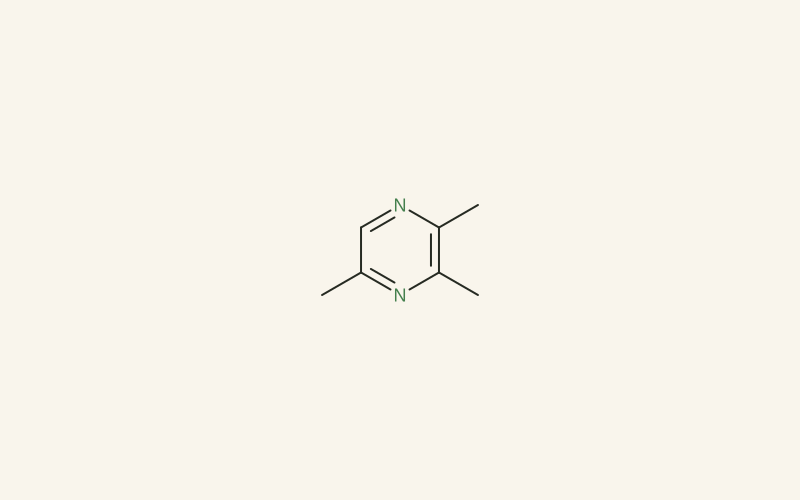
2,3,5-trimethylpyrazine, which a 2022 paper calls a key flavor compound of roasted coffee. The two nitrogen atoms sit opposite each other in the ring. Structural diagram, not to scale. Structure data: ChEBI (CHEBI:190131), CC BY 4.0.
"2,3,5-trimethylpyrazine, structural diagram" by Molecule & Menu, https://moleculeandmenu.com/roast-and-steep/pyrazines/, licensed under CC BY 4.0 (https://creativecommons.org/licenses/by/4.0/)
Data: Structure data: ChEBI (CHEBI:190131), CC BY 4.0
Open a bag of freshly roasted beans and the first smell is roasty. Part of that smell has a chemical name. The 2022 paper, by Liang and colleagues, describes pyrazines as one of the most important compound classes behind earthy, nutty and roasty odors, and says they “substantially contribute to the aroma of coffee.”
What is a pyrazine?
A pyrazine is a six-atom ring with two nitrogen atoms set opposite each other. The 2022 paper defines the class as “aromatic heterocycles with nitrogen in the 1- and 4 position.” A heterocycle is a ring that contains atoms other than carbon. Aromatic, in this chemical sense, names a kind of ring bonding, not a smell.
Different pyrazines carry different side groups on that ring. 2,3,5-trimethylpyrazine, shortened to TMP in the 2022 paper, has three methyl groups (CH3) on ring positions 2, 3 and 5. Its ChEBI entry, CHEBI:190131, gives the formula C7H10N2 and an average mass of 122.171 g/mol.
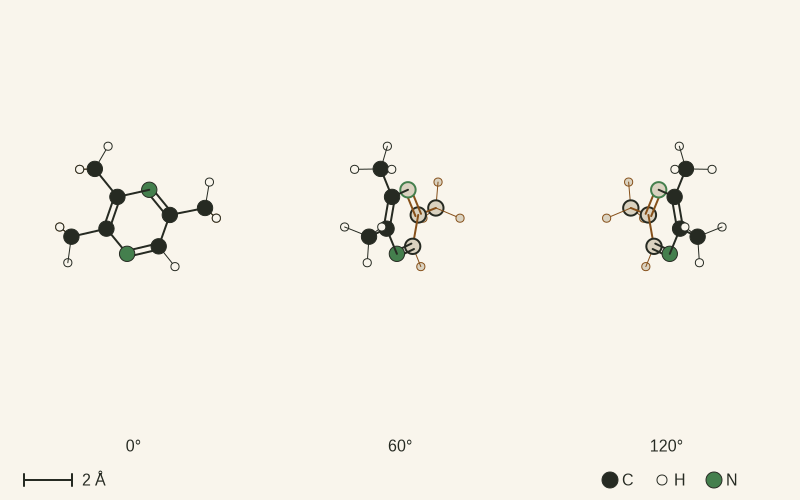
The same molecule in three views, turned 60 degrees each time. Computed 3D conformer generated by Molecule & Menu from the ChEBI SMILES (RDKit 2026.09.2), not an experimentally measured shape. Structure data: ChEBI (CHEBI:190131), CC BY 4.0.
"2,3,5-trimethylpyrazine, computed 3D conformer" by Molecule & Menu, https://moleculeandmenu.com/roast-and-steep/pyrazines/, licensed under CC BY 4.0 (https://creativecommons.org/licenses/by/4.0/)
Data: Structure data: ChEBI (CHEBI:190131), CC BY 4.0
Where does the roasty smell come from?
Green coffee carries the raw materials. A 2021 review of coffee chemistry by Bastian and colleagues lists proteins, free amino acids and carbohydrates among the bean's components and says some of them are “precursors to the flavor development of volatile and semi-volatile compounds in coffee during roasting,” pyrazines included. The same review reports that coffee processing shifts that stock before roasting. Free amino acids differ between washed and natural coffee, and honey-processed beans hold more sucrose.
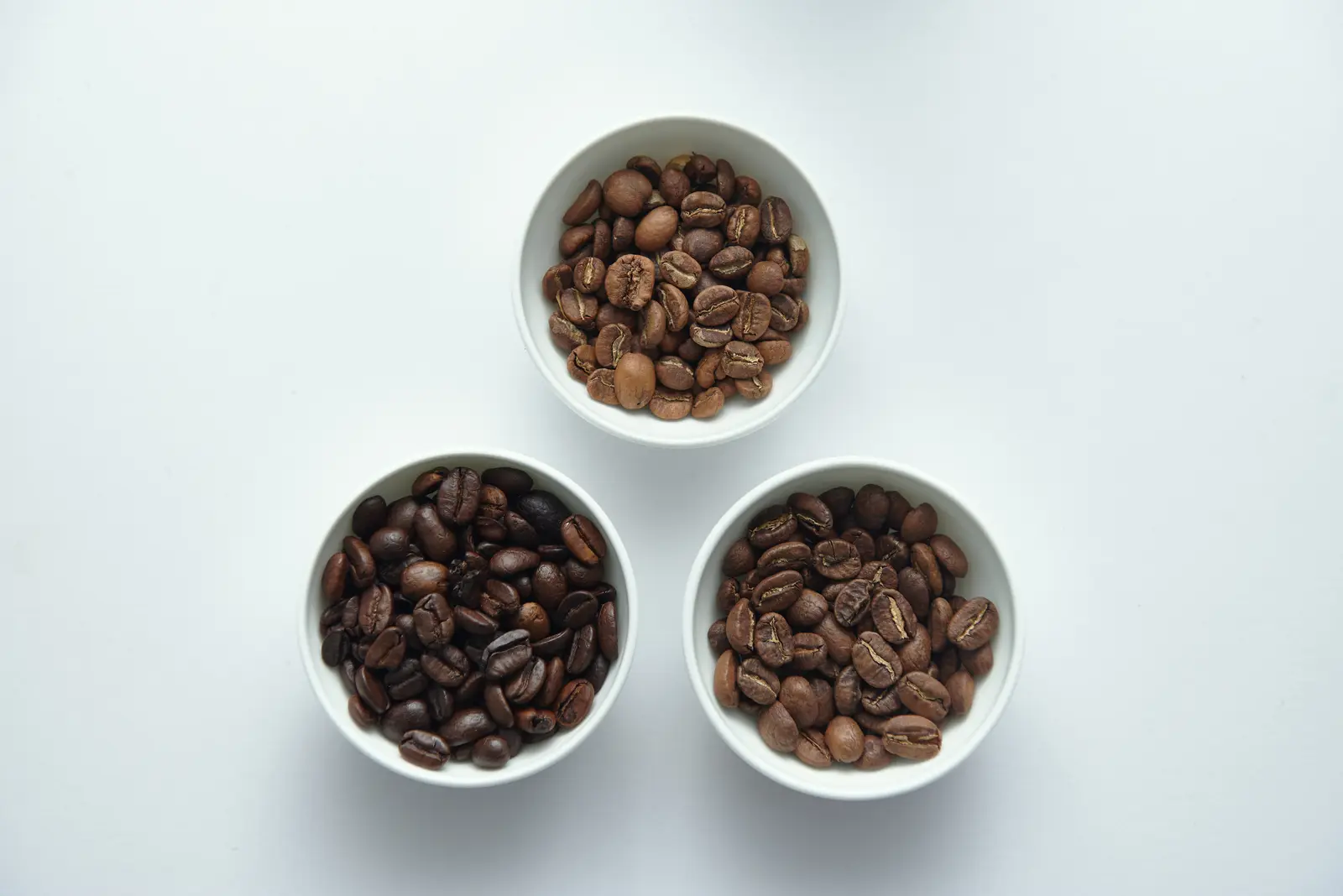
Coffee beans roasted to three different degrees, from a photograph titled for 15 grams of coffee. The picture shows color only: it records no roast temperature, time or pyrazine measurement.
"15 grams of coffee roasted to different degrees" by Alorin — https://commons.wikimedia.org/wiki/File:15_grams_of_coffee_roasted_to_different_degrees.jpg — CC BY 4.0 (https://creativecommons.org/licenses/by/4.0/)
Roasting supplies the heat. The 2022 paper says pyrazines are “naturally formed during nonenzymatic browning (Maillard) reaction from amino acids and reducing sugars upon heating.” A 2025 review by El Hosry and colleagues places their formation in the intermediate stage of the Maillard reaction. The 2022 paper also notes that pyrazines in foods can come from microbes, for example during fermentation, so heat is one route to them, not the only one.
A 2026 review of pyrazine chemistry by Wang and colleagues calls the following sequence the most common route in sugar and amino acid systems:
- A reducing sugar and an amino acid join and rearrange into an Amadori product, which breaks down into reactive fragments called α-dicarbonyls.
- In Strecker degradation, an amino acid reacts with one of those fragments and releases a Strecker aldehyde and an α-aminoketone.
- Two α-aminoketones condense into a dihydropyrazine.
- Oxidation turns the dihydropyrazine into a pyrazine.
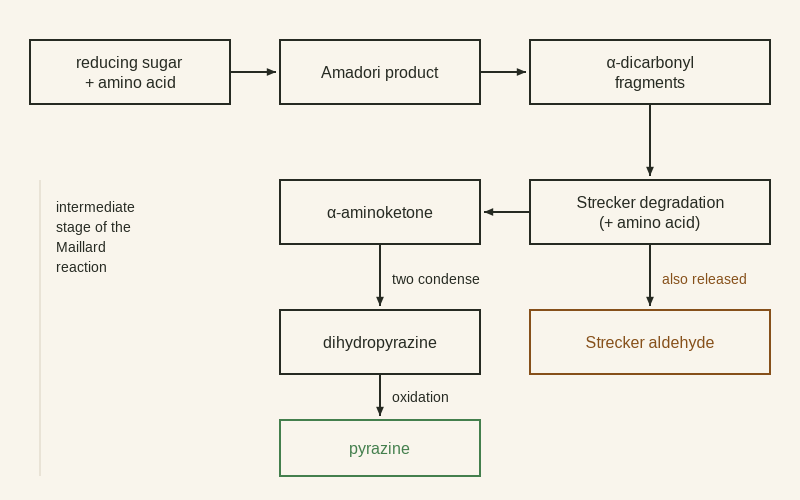
The most common route from sugar and amino acid to a pyrazine, as summarized in a 2026 review; the same review describes radical and other routes. Schematic boxes, not structural formulas.
"From sugar and amino acid to a pyrazine, schematic" by Molecule & Menu, https://moleculeandmenu.com/roast-and-steep/pyrazines/, licensed under CC BY 4.0 (https://creativecommons.org/licenses/by/4.0/)
The review's summary says temperatures above 100 °C are generally needed to start the reaction well. In one model study it reports, virtually no pyrazines formed below 100 °C, and yields rose quickly between 100 and 150 °C. Another heated Amadori compounds from 60 to 180 °C and could already detect 2,5-dimethylpyrazine at 60 °C, while most alkylpyrazines peaked at 140 °C. So the studies do not share one starting temperature.
How little does it take?
By weight, pyrazines are a small part of roasted coffee. The 2022 paper reports total pyrazine concentrations of 82.1–211.6 mg/kg in commercial roast coffee powder, which by this page's arithmetic is at most about 0.02% of the powder's weight. In those figures, 2-methylpyrazine was the most abundant, followed by 2,5- and 2,6-dimethylpyrazine.
For TMP, the paper gives two numbers in one sentence: in coffee it “occurs in concentrations between 1 and 6.7 mg/kg and has an odor threshold of ∼50 ng/L air.” Both are cited from earlier work, a 2013 analysis of pyrazines in coffee by Pickard and colleagues and a 1999 study of alkylpyrazine odors by Wagner and colleagues. This page read the 2022 citation, not those two studies.
The two numbers measure different things. The concentration is milligrams of TMP per kilogram of coffee. An odor threshold is the lowest concentration at which a smell can be detected, and the one cited in the 2022 paper is given per liter of air, so this page does not convert one into the other. Fifty nanograms is 50 billionths of a gram.
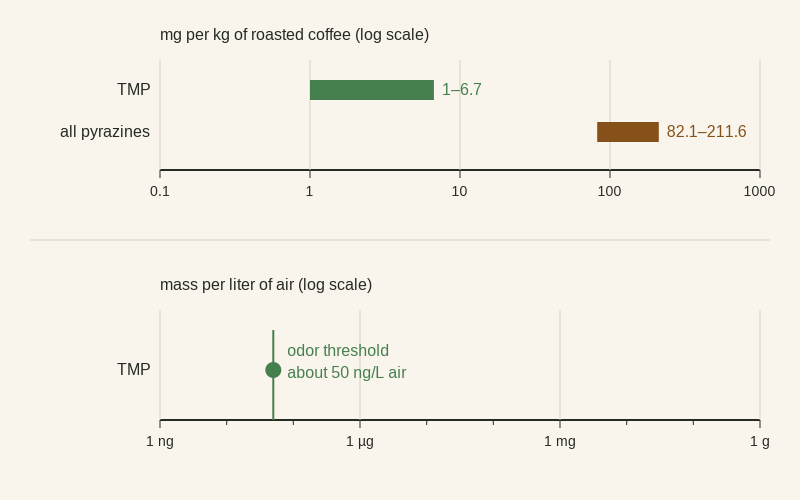
TMP and all pyrazines in coffee (top, mg per kg) and TMP's odor threshold (bottom, mass per liter of air), as reported in a 2022 paper citing earlier measurements. The two scales use different units and are not converted into each other.
"Trimethylpyrazine and all pyrazines in coffee, and the odor threshold of trimethylpyrazine" by Molecule & Menu, https://moleculeandmenu.com/roast-and-steep/pyrazines/, licensed under CC BY 4.0 (https://creativecommons.org/licenses/by/4.0/)
| Quantity | Value | Measured in | Cited by the 2022 paper from |
|---|---|---|---|
| TMP concentration | 1–6.7 mg/kg | coffee | Pickard et al. 2013; Wagner et al. 1999 |
| TMP odor threshold | about 50 ng/L | air | Pickard et al. 2013; Wagner et al. 1999 |
| All pyrazines | 82.1–211.6 mg/kg | commercial roast coffee powder | Pickard et al. 2013 |
Download the pyrazine figures (CSV) (source and license notes) Data: Liang et al. 2022, J Agric Food Chem 70:15134, CC BY 4.0, https://pmc.ncbi.nlm.nih.gov/articles/PMC9733599/
TMP is not unusual in this respect. Citing reviews by Maga, the 2026 review notes that the odor thresholds of alkyl-substituted pyrazines can be as low as the microgram or even nanogram per liter level. The 2022 paper puts it in five words: “Pyrazines have low odor thresholds.”
Does a darker roast mean more pyrazine smell?
Not in one 2024 study. Obando and Figueroa roasted Catimor arabica beans from Ecuador to four levels on the Specialty Coffee Association scale, from very light (RL85) to extremely dark (RL25). The roaster was preheated to 160 °C, each batch took about 7.5 to 8 minutes to reach 180 °C, and then stayed in for 1, 2, 3 or 4 more minutes depending on the level. Four trained panelists rated each aroma compound as it left a gas chromatograph, a method called GC-olfactometry, on a scale from 1 (low) to 3 (high).
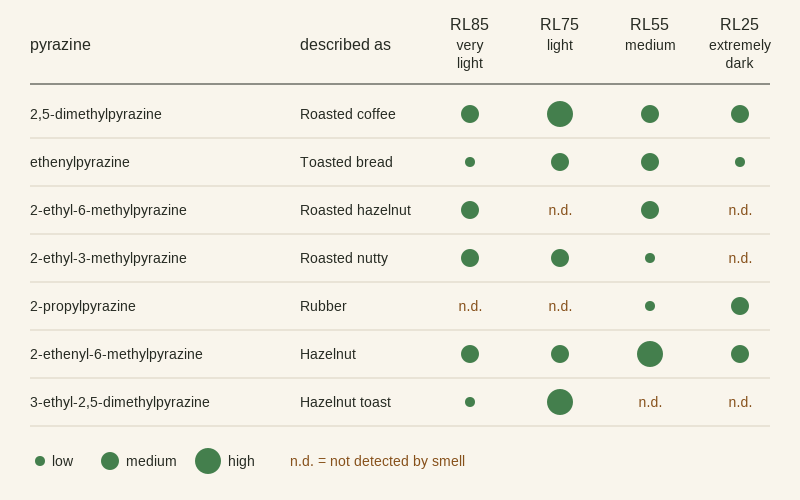
Odor intensity of seven aroma-active pyrazines at four roast levels in one 2024 study, rated 3 high, 2 medium, 1 low; n.d. means not detected by smell. Intensity at the sniffing port is not a concentration.
"Aroma-active pyrazines at four coffee roast levels" by Molecule & Menu, https://moleculeandmenu.com/roast-and-steep/pyrazines/, licensed under CC BY 4.0 (https://creativecommons.org/licenses/by/4.0/)
Seven pyrazines registered as aroma-active, and their pattern does not track roast color. 2,5-dimethylpyrazine, described as roasted coffee, was smelled at every level and most strongly in the light roast. 3-ethyl-2,5-dimethylpyrazine was smelled only at the two lightest levels, while 2-propylpyrazine, described as rubber, appeared only at the two darkest. The authors write that the extremely dark roast “was marked by undesirable odors including burnt notes, putrid, and sulfurous scents.”
| Pyrazine | Described as | RL85 very light | RL75 light | RL55 medium | RL25 extremely dark |
|---|---|---|---|---|---|
| 2,5-dimethylpyrazine | Roasted coffee | 2 | 3 | 2 | 2 |
| ethenylpyrazine | Toasted bread | 1 | 2 | 2 | 1 |
| 2-ethyl-6-methylpyrazine | Roasted hazelnut | 2 | n.d. | 2 | n.d. |
| 2-ethyl-3-methylpyrazine | Roasted nutty | 2 | 2 | 1 | n.d. |
| 2-propylpyrazine | Rubber | n.d. | n.d. | 1 | 2 |
| 2-ethenyl-6-methylpyrazine | Hazelnut | 2 | 2 | 3 | 2 |
| 3-ethyl-2,5-dimethylpyrazine | Hazelnut toast | 1 | 3 | n.d. | n.d. |
Download the roast-level table (CSV) (source and license notes) Data: Obando & Figueroa 2024, Molecules 29:4723, CC BY 4.0, https://pmc.ncbi.nlm.nih.gov/articles/PMC11477549/
This is one sample lot and one panel. It shows that roast level changes which pyrazines can be smelled. It does not show a rule that holds for every coffee.
Molecule card
| Name | trimethylpyrazine |
|---|---|
| Molecular formula | C7H10N2 |
| Molar mass | 122.171 g/mol |
| Shape | Computed 3D conformer generated by Molecule & Menu from the ChEBI SMILES (RDKit ETKDG), not an experimentally measured shape |
| Where you meet it | Roasted coffee, at 1 to 6.7 mg/kg in earlier measurements cited by a 2022 paper |
| ChEBI ID | CHEBI:190131 |
This card as data (CSV) · Source and license notes
Data: Structure data: ChEBI (CHEBI:190131), CC BY 4.0; Liang et al. 2022, J Agric Food Chem 70:15134, CC BY 4.0, https://pmc.ncbi.nlm.nih.gov/articles/PMC9733599/
Sources
- Liang, D., Dirndorfer, S., Somoza, V., Krautwurst, D., Lang, R., & Hofmann, T. (2022). Metabolites of Key Flavor Compound 2,3,5-Trimethylpyrazine in Human Urine. Journal of Agricultural and Food Chemistry, 70(48), 15134–15142. https://doi.org/10.1021/acs.jafc.2c06418 https://pmc.ncbi.nlm.nih.gov/articles/PMC9733599/Read: full text; only the abstract's first sentences and the introduction are used. License: CC BY 4.0.
- Wang, B., Zhao, Y., Zhao, L., Zhu, W., & Ren, J. (2026). Advances in the biomimetic and Maillard route synthesis and regulation of pyrazine flavour compounds. RSC Advances, 16(48), 63783–63795. https://doi.org/10.1039/d6ra07015a https://pmc.ncbi.nlm.nih.gov/articles/PMC13688884/Read: full text; sections 1, 2, 3.1, 4.1, 5.2 and 6 used. License: CC BY 3.0.
- Obando, A. M., & Figueroa, J. G. (2024). Effect of Roasting Level on the Development of Key Aroma-Active Compounds in Coffee. Molecules, 29(19), 4723. https://doi.org/10.3390/molecules29194723 https://pmc.ncbi.nlm.nih.gov/articles/PMC11477549/Read: full text; abstract, results on pyrazines, Table 1 and the methods for samples, roasting and olfactometry used. License: CC BY 4.0.
- El Hosry, L., Elias, V., Chamoun, V., Halawi, M., Cayot, P., Nehme, A., & Bou-Maroun, E. (2025). Maillard Reaction: Mechanism, Influencing Parameters, Advantages, Disadvantages, and Food Industrial Applications: A Review. Foods, 14(11), 1881. https://doi.org/10.3390/foods14111881 https://pmc.ncbi.nlm.nih.gov/articles/PMC12154226/Read: full text. License: CC BY 4.0.
- Bastian F, Hutabarat OS, Dirpan A, Nainu F, Harapan H, Emran TB, Simal-Gandara J. From Plantation to Cup: Changes in Bioactive Compounds during Coffee Processing. Foods. 2021;10(11):2827. doi:10.3390/foods10112827 https://pmc.ncbi.nlm.nih.gov/articles/PMC8620865/Read: full text. License: CC BY 4.0.
- ChEBI entry CHEBI:190131, trimethylpyrazine (Chemical Entities of Biological Interest, EMBL-EBI). https://www.ebi.ac.uk/chebi/CHEBI:190131Read: entry record (structure, formula, identifiers). License: CC BY 4.0.
- Pickard, S., Becker, I., Merz, K.-H., & Richling, E. (2013). Determination of the alkylpyrazine composition of coffee using stable isotope dilution–gas chromatography–mass spectrometry (SIDA-GC-MS). Journal of Agricultural and Food Chemistry, 61, 6274–6281. https://doi.org/10.1021/jf401223wRead: bibliography only.
- Wagner, R., Czerny, M., Bielohradsky, J., & Grosch, W. (1999). Structure-odour-activity relationship of alkylpyrazines. Zeitschrift für Lebensmitteluntersuchung und -Forschung A, 208, 308–316. https://doi.org/10.1007/s002170050422Read: bibliography only.
Cite this page
“Pyrazines: Roasting Builds Part of Coffee’s Roasty Smell.” Molecule & Menu. Published November 14, 2026. https://moleculeandmenu.com/roast-and-steep/pyrazines/. Accessed on the date you read it.
How pages here are checked · All corrections · Report an error on this page (contact@moleculeandmenu.com)
Second helping:
- Espresso crema: the same roast leaves carbon dioxide in the beans, and brewing pressure forces it into the shot.
- Carvone: another aroma molecule, and a test of whether noses can tell its two mirror-image forms apart.
More from Roast & Steep
Roast & Steep
Coffee Processing: Washed Coffee Is Fermented, Too
Washed coffee sits in closed containers for 12 to 72 hours in one 2024 review's figures. How washed, natural and honey processing differ, layer by layer.
Picture credit
"Coffea arabica, plate 106 of Köhler's Medizinal-Pflanzen" by Franz Eugen Köhler, Köhler's Medizinal-Pflanzen — https://commons.wikimedia.org/wiki/File:Coffea_arabica_-_K%C3%B6hler%E2%80%93s_Medizinal-Pflanzen-189.jpg — Public domain (Public domain in the US (Köhler's Medizinal-Pflanzen, published in Germany in 1887-1898, before 1931) and in the EU (Commons tags the plate PD-old, life plus 70 years, and marks it with the Public Domain Mark; this basis rests on those two tags and the 1887-1898 publication, not on any artist's or editor's death year))
Roast & Steep
Swiss Water Process: Decaf Is Made Before the Roast
Decaf loses its caffeine as a green bean, before roasting. How the Swiss Water process and solvent and CO2 methods work, per two 2025 papers.
Picture credit (illustration)
Illustration: Molecule & Menu. Generated schematic illustration — not a photograph or historical record. Reuse: CC BY 4.0 (https://creativecommons.org/licenses/by/4.0/), to the extent Molecule & Menu holds rights in this image.
Roast & Steep
Espresso Crema: The Foam Comes From Gas Made in Roasting
Espresso crema is a foam whose bubbles hold mainly CO2 from the roast. How brewing pressure forces that gas into the water, per a 2021 review, and why it fades.
Picture credit (illustration)
Illustration: Molecule & Menu. Generated schematic illustration — not a photograph or historical record. Reuse: CC BY 4.0 (https://creativecommons.org/licenses/by/4.0/), to the extent Molecule & Menu holds rights in this image.