Coffee Processing: Washed Coffee Is Fermented, Too
Short answer
Coffee processing turns a ripe cherry into a dry green seed, and every main method involves fermentation. In washed coffee, the pulped beans are kept in closed containers for 12 to 72 hours in one 2024 review's figures (a 2021 review gives 6 to 48 hours of fermentation) before the loosened mucilage is rinsed away. Natural coffee dries inside the whole fruit, which can take up to 2–4 weeks, per the 2021 review. Honey coffee is pulped but dried with part of its mucilage still on.
Course list · 5 sections
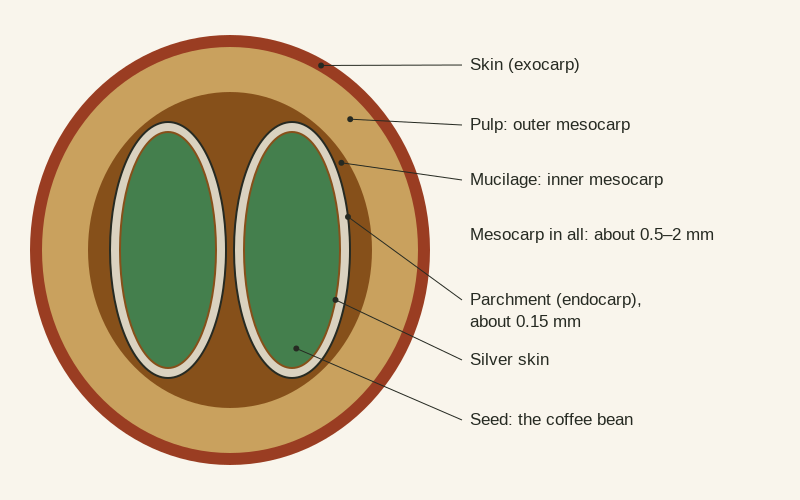
A coffee cherry in cross-section, schematic and not to scale. The three processing methods differ in how many of these layers are still on the seed when drying begins. Layer names and the thickness figures follow a 2021 review.
"Layers of a coffee cherry, schematic" by Molecule & Menu, https://moleculeandmenu.com/roast-and-steep/coffee-processing/, licensed under CC BY 4.0 (https://creativecommons.org/licenses/by/4.0/)
A ripe coffee cherry is usually a red fruit, and the bean is its seed. In some cultivars the skin stays yellow, the 2021 review notes. The skin, the flesh and the parchment all have to come off before roasting, and the order in which they come off is what the names washed, natural and honey describe.
A coffee bean is a seed inside a fruit
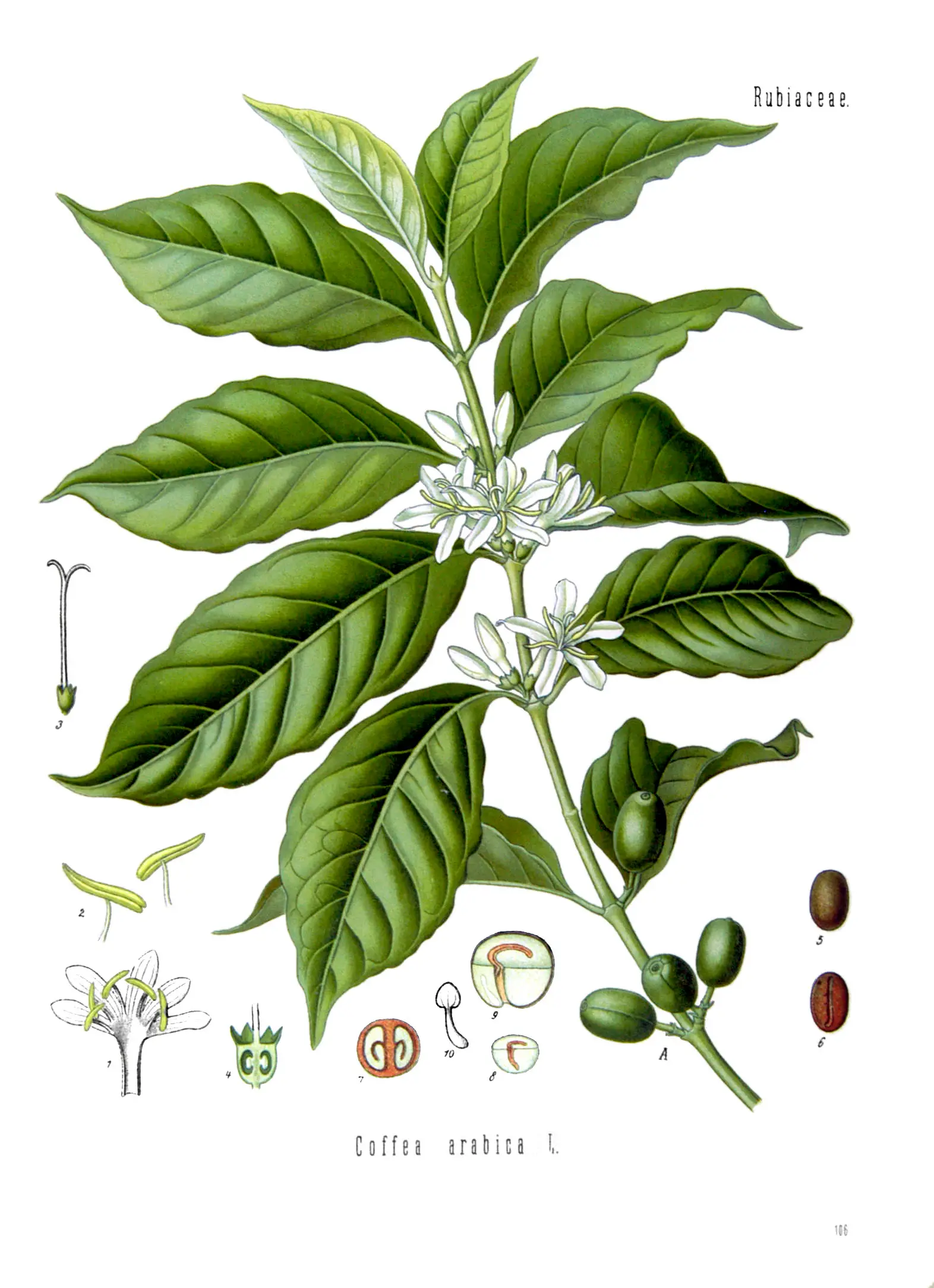
Coffea arabica in Köhler's Medizinal-Pflanzen. Figure 7 at the bottom shows a fruit cut across, with two seeds facing each other inside the red flesh; figures 5 and 6 are single beans.
“Coffea arabica, plate 106 of Köhler's Medizinal-Pflanzen” by Franz Eugen Köhler — PD
Full credit
"Coffea arabica, plate 106 of Köhler's Medizinal-Pflanzen" by Franz Eugen Köhler, Köhler's Medizinal-Pflanzen — https://commons.wikimedia.org/wiki/File:Coffea_arabica_-_K%C3%B6hler%E2%80%93s_Medizinal-Pflanzen-189.jpg — Public domain (Public domain in the US (Köhler's Medizinal-Pflanzen, published in Germany in 1887-1898, before 1931) and in the EU (Commons tags the plate PD-old, life plus 70 years, and marks it with the Public Domain Mark; this basis rests on those two tags and the 1887-1898 publication, not on any artist's or editor's death year))
A 2021 review of coffee chemistry by Bastian and colleagues lists the layers from the outside in. The skin, or exocarp, is a single layer of cells. Under it lies the mesocarp, the flesh, which the review says is “composed of sugars, sucrose, and water” and is around 0.5–2 mm thick.
The review divides the mesocarp into external and internal parts. In processing, the bulk of the flesh is called the pulp, and the slippery layer still clinging to the next layer is called the mucilage. That next layer is the endocarp, called parchment: a hard, lignified hull around 0.15 mm thick. Inside it, a thin silver skin wraps the seed itself, the part that will be roasted.
In the plate's cross-section, one fruit holds two seeds facing each other. Ripeness changes that fruit before any processing starts. The 2021 review describes green cherries as unripe and firmer than ripe ones, and says that at the end of ripening volatile esters, aldehydes, ketones and alcohols increase while astringency decreases. It adds that harvested cherries must be processed as quickly as possible to avoid spoilage or unwanted mold growth.
The fruit is also full of water. The 2021 review gives about 65% water for a ripe cherry. A 2026 review of coffee drying, by Duque-Dussán and colleagues, puts freshly harvested beans at 50–60% moisture on a wet basis and the safe storage level at 10–12%. Drying closes that gap, and the same review explains why it matters: water left in the bean allows enzyme activity, microbial growth and molds that can produce ochratoxin A.
The 2026 review describes three dominant pathways, natural, honey and washed: “Each method differs in handling of the cherry and mucilage, yet all converge on drying.” The older names are useful to know, because papers still use them:
- Washed is also called the wet process or fully washed.
- Natural is also called the dry process or sun-dried.
- Honey is also called semi-dry processing or pulped natural.
Washed: pulp, ferment, then wash
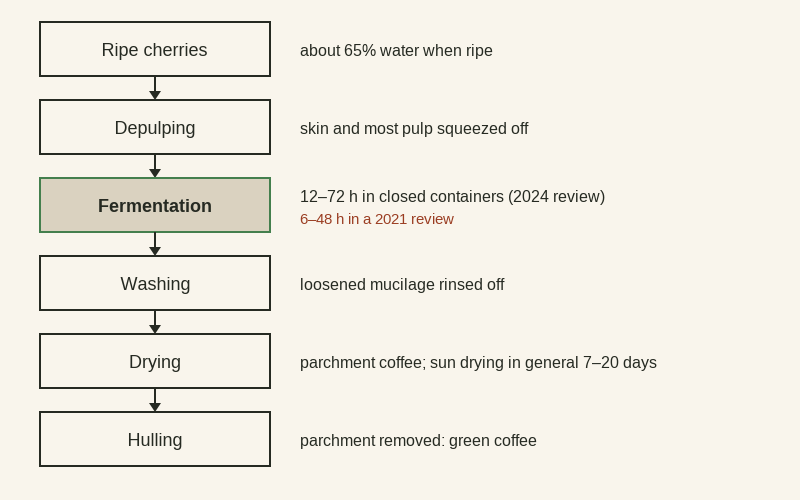
The washed method step by step. The fermentation times are ranges reported in two reviews, not measurements from any one farm; the patio drying time comes from a 2026 review and applies to sun drying in general.
"Washed coffee processing, step by step" by Molecule & Menu, https://moleculeandmenu.com/roast-and-steep/coffee-processing/, licensed under CC BY 4.0 (https://creativecommons.org/licenses/by/4.0/)
The name suggests a rinse. Water alone does not finish the job. In the wet process, according to the 2021 review, a depulping machine squeezes off most of the fruit flesh, yet “significant amounts of fruit flesh remain attached to the parchment.” That sticky residue is the mucilage, and microbes break it down.
How long that takes depends on which review is read. A 2024 review of fermentation equipment by Hurtado Cortés and colleagues describes the pulped coffee being “kept in closed containers for 12 to 72 h to remove the mesocarp (mucilage).” The 2021 review describes cherries that are “pulped, fermented for 6–48 h, then washed.” Both are summary ranges drawn from earlier studies, so this page gives both instead of picking one.
Call fermentation time the invisible ingredient of washed coffee. The inputs are only fruit and water, but the hours in the tank decide when the mucilage comes loose. The 2021 review notes that in the wet process, “water, time, and other conditions are more controlled to minimize the growth of unwanted microbes.”
Inside the tank
The 2021 review summarizes one study that followed the sugars through a wet fermentation. Sucrose rose at 8 hours and then fell. Organic acids such as malic and citric acid rose after 24 hours, and fructose and glucose rose after 36 hours.
The review gives two reasons for those shifts:
- The fruit's own enzyme. Invertase, an enzyme from the coffee itself, splits sucrose into fructose and glucose.
- Bacteria. Lactic acid bacteria, especially Leuconostoc mesenteroides, turn fructose into mannitol, lactic acid and glycerol.
Yeasts do part of the work too. The review reports that yeasts isolated from wet fermentations had high pectinolytic activity, meaning they make enzymes that break down pectin, a gel-forming carbohydrate in the pulp and mucilage. It names Hanseniaspora, Candida and Pichia as the predominant yeasts in the wet process.
Bacteria from wet fermentations have been isolated since 1945, the review says, and Lactococcus, Leuconostoc, Acinetobacter and Enterobacter are among the predominant ones. A mixed crew of bacteria and yeasts is also how a sourdough starter works, where the bacteria usually outnumber the yeasts.
Fermentation does more than loosen the mucilage. The review cites a finding that unfermented coffee has fewer volatile compounds and gives off an unpleasant sulfur odor, and it notes that metabolites released by the microbes spread into the beans. It also says plainly that the actual role of each microbial group is still unclear.
The seed is still alive
A ripe cherry holds enough water for a seed to start growing, and the 2021 review explains what holds it back: a germination inhibitor, abscisic acid, keeps the seed from sprouting while the pulp covers it. In the wet process, germination starts right after depulping.
The review cites work by Selmar and colleagues that tracked isocitrate lyase (ICL), an enzyme that marks the start of germination in seeds rich in fat. In wet-processed seeds, its expression was detected on the first day and peaked on the second, when fermentation ended. In dry-processed seeds, the peak came about one week after processing began.
The review links germination to higher levels of some free amino acids, including glutamate, aspartate and alanine, in wet-processed beans. Amino acids and sugars matter later: the review names them among the aroma precursors that roasting transforms, the starting point for roast aromas such as the pyrazines.
Natural: drying inside the fruit
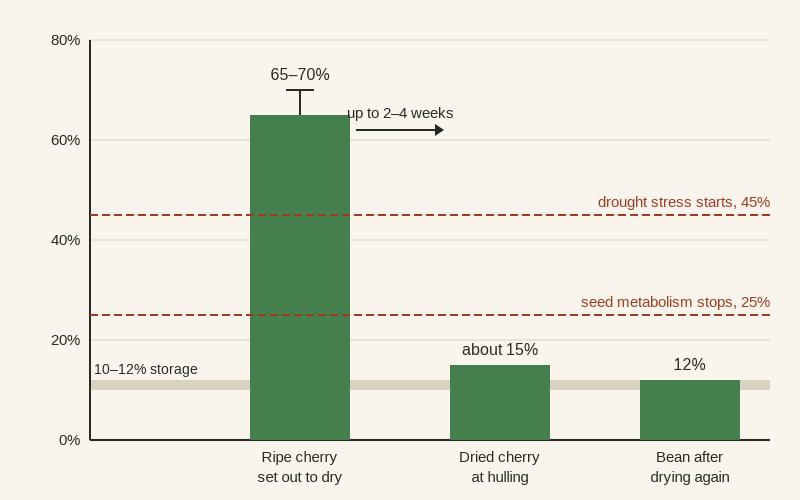
Moisture in the natural method, as given in a 2021 review: ripe cherry, dried cherry at hulling, bean dried again. Dashed lines mark where drought stress starts and seed metabolism stops; the shaded band is a 2026 review's 10–12% wet-basis storage level (the 2021 review states no basis).
"Moisture through natural processing" by Molecule & Menu, https://moleculeandmenu.com/roast-and-steep/coffee-processing/, licensed under CC BY 4.0 (https://creativecommons.org/licenses/by/4.0/)
The natural method skips the tank. The 2021 review says the cherries “are instantly set to dry with sunshine.” With a starting water content of about 65–70%, “the drying process might take up to 2–4 weeks,” depending on the weather. The 2026 review adds that the whole cherries dry “with pulp and mucilage intact” and that the process “can extend over three weeks under favorable climatic conditions.”
The cherries are dried to about 15% water before the hull is removed. The 2021 review explains the window: if the cherries are still wet they are hard to hull, and if they are too dry the beans crack. The beans are then dried again to 12%.
Fermentation happens here too, out in the open. According to the 2021 review, the microbial population is higher in the dry process than in the wet or semi-dry ones. Bacteria dominate at first, mostly Bacillus, which secretes enzymes that break down pectin. Yeasts peak around the eighth day in some studies, and filamentous fungi rise toward the end.
In dry-process studies the review cites, the predominant yeasts (Debaryomyces, Candida and Pichia) reached their highest counts, around 106 colony-forming units per gram, on days 14–18. Debaryomyces and Pichia, along with Arxula, secreted enzymes that degraded the pectin in the pulp and mucilage.
The slow drying also stresses the seed. The review gives two thresholds from an earlier study: drought stress starts at 45% moisture, and the seed's metabolism shuts down at 25%. Natural coffee takes longer to cross that zone, so it builds up more γ-aminobutyric acid (GABA), a compound plants make under stress, while wet-processed beans accumulate only small amounts.
Download the moisture and layer measurements (CSV) (source and license notes) Data: Bastian et al. 2021, Foods 10:2827, CC BY 4.0, https://pmc.ncbi.nlm.nih.gov/articles/PMC8620865/; Duque-Dussán et al. 2026, Foods 15:1737, CC BY 4.0, https://pmc.ncbi.nlm.nih.gov/articles/PMC13205183/
Honey: drying with the mucilage on
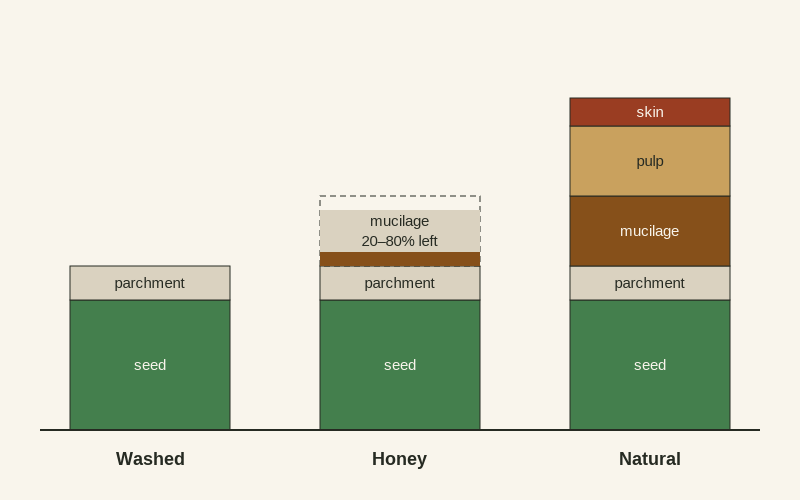
What each method puts on the drying bed, schematic. Washed coffee arrives as seed in parchment; honey coffee keeps part of its mucilage; natural coffee keeps the whole fruit. The 20–80% figure is from a 2021 review.
"What washed, honey and natural coffee put on the drying bed" by Molecule & Menu, https://moleculeandmenu.com/roast-and-steep/coffee-processing/, licensed under CC BY 4.0 (https://creativecommons.org/licenses/by/4.0/)
Honey processing sits between the other two. In the 2021 review's description, the fruits are “mechanically pulped and proceed to dry without removal of the mucilage.” The depulper leaves a variable share of mucilage on the parchment, from 20% to 80%. The review says the method is called the honey process because the mucilage is dried along with the beans.
That mucilage is mostly carbohydrate. The review lists polysaccharides, pectin and simple sugars, including glucose, mannose, xylose, arabinose, galactose and fructose. The 2026 review adds that producers sort honey coffee into grades such as yellow, red or black honey by how much mucilage is retained, and that each grade dries and resists microbes differently.
Honey coffee still ferments. According to the 2021 review, the pulped beans and their mucilage are fermented and dried until the moisture falls to 12%, and Pichia yeasts predominate, as they do in the other two methods. The 2026 review says honey coffees dry faster than naturals but need thin layers, frequent turning and good airflow to prevent clumping and localized fermentation.
The 2021 review also reports chemical differences for honey (semi-dry) coffee:
- Chlorogenic acid: lower than in dry-processed coffee.
- Trigonelline: lower than in both wet and dry processing.
- Sucrose: higher than in both.
Three methods side by side
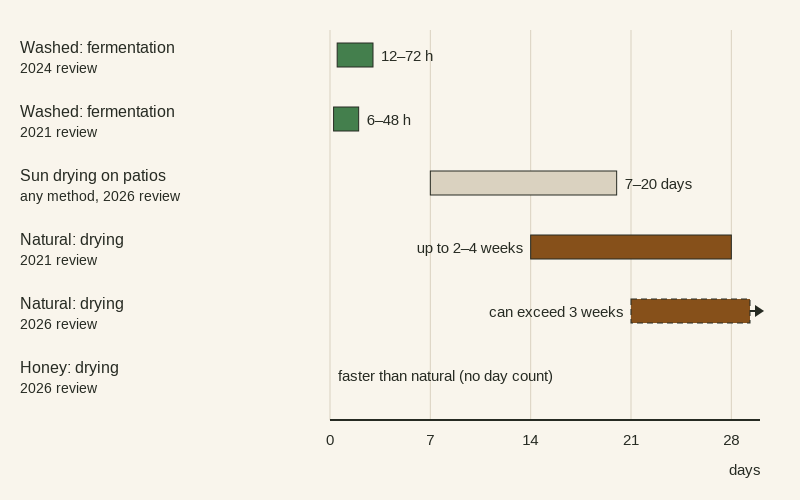
Reported times on one scale of days, as given in reviews, not measurements by this page. The natural bars show how long drying may take (up to 2–4 weeks) or can extend (over three weeks), not a minimum; the honey row has no bar because neither drying review gives a day count for it.
"Reported fermentation and drying times for washed, natural and honey coffee" by Molecule & Menu, https://moleculeandmenu.com/roast-and-steep/coffee-processing/, licensed under CC BY 4.0 (https://creativecommons.org/licenses/by/4.0/)
| Method | Layers on the seed when drying starts | Fermentation | Drying time reported | Source |
|---|---|---|---|---|
| Washed | Parchment and silver skin | Pulped coffee kept in closed containers 12–72 h (2024 review), or fermented 6–48 h (2021 review); then washed | Patio sun drying 7–20 days for coffee in general (2026 review) | Hurtado Cortés et al. 2024; Bastian et al. 2021; Duque-Dussán et al. 2026 |
| Natural | Skin, pulp, mucilage and parchment | On the drying bed, inside the fruit; higher microbial population than wet processing (2021 review) | Up to 2–4 weeks (2021 review); can extend over three weeks (2026 review) | Bastian et al. 2021; Duque-Dussán et al. 2026 |
| Honey | Parchment plus 20–80% of the mucilage | Pulped beans and mucilage ferment while drying (2021 review) | No day count given; faster than natural (2026 review) | Bastian et al. 2021; Duque-Dussán et al. 2026 |
Download the processing times table (CSV) (source and license notes) Data: Bastian et al. 2021, Foods 10:2827, CC BY 4.0, https://pmc.ncbi.nlm.nih.gov/articles/PMC8620865/; Hurtado Cortés et al. 2024, J Food Sci Technol 61:2223, CC BY 4.0, https://pmc.ncbi.nlm.nih.gov/articles/PMC11486863/; Duque-Dussán et al. 2026, Foods 15:1737, CC BY 4.0, https://pmc.ncbi.nlm.nih.gov/articles/PMC13205183/
Read across the rows and the times track how much fruit stays on the seed, as far as the reviews give numbers. Washed coffee concentrates fermentation into a tank and a matter of hours to days; natural coffee spreads it over weeks on the drying bed. The 2021 review says the dry process takes longer to dry than the wet one, and the 2026 review says honey coffee dries faster than natural, though neither gives honey a day count. In all three methods, drying aims for the 10–12% storage moisture, on a wet basis, given in the 2026 review.
Where all three meet: the drying bed
The 2026 review calls drying the decisive stage for quality and safety in all three pathways. On patios of cement, brick or asphalt, coffee is spread 2–5 cm deep and turned from time to time. Raised beds, also called African beds, hold a 2–4 cm layer on mesh 0.8–1.2 m off the ground, so air can pass underneath.
Sun drying is uneven by nature. The review explains that beans can lose water quickly at midday and take some back at night or in humid weather, which is why a full sun-drying cycle can last 7 to 20 days depending on climate and processing method. Washed beans, though less prone to fermentation defects, are vulnerable to reabsorbing moisture in humid air.
A risk the review returns to again and again is mold. In tropical regions where relative humidity often exceeds 70% during harvest, it says, delays and rain raise the risk of fungal growth if moisture stays above 12% on a wet basis. The fungi it names, Aspergillus and Penicillium species, include ones that can produce ochratoxin A.
What changes, and what this page leaves out
The reviews also describe how cups from each method differ in flavor, body and acidity. This page stops before that point, because flavor talk without chemistry is literature. What the processing method changes in the bean, per the 2021 review, is measurable: free amino acids, GABA, sugars, chlorogenic acid and trigonelline. The review counts all of these except GABA among the precursors that roasting later turns into flavor and aroma compounds.
Questions about coffee processing
Is natural coffee fermented?
Yes, in the sense the reviews use the word: microbes break down the pulp and mucilage while the whole cherry dries. The 2021 review reports a higher microbial population in the dry process than in wet or semi-dry processing, with bacteria first and yeasts and fungi later.
How long does washed coffee ferment?
The reviews give ranges, not one number: 12 to 72 hours in closed containers (Hurtado Cortés et al. 2024) and 6 to 48 hours (Bastian et al. 2021). The fermentation step ends when the loosened mucilage is washed off and the parchment coffee goes to dry.
What is honey process coffee?
Coffee that is pulped by machine and then dried with part of its mucilage still on, 20% to 80% of it in the 2021 review's figures. Producers grade it as yellow, red or black honey by how much mucilage is retained, per the 2026 review.
What moisture is green coffee dried to?
The 2026 review gives 10–12% on a wet basis as the safe storage level. The 2021 review gives 12% for natural beans dried again after hulling.
Reaction card
| Type | Microbial fermentation of the mucilage on pulped coffee (washed process), helped by the fruit's own invertase |
|---|---|
| Reactants | Mucilage sugars (sucrose, glucose, fructose) and pectin |
| First described | Not traced; bacteria from wet-process fermentation have been isolated since 1945, per a 2021 review |
| Stages | Sucrose rose at 8 h, then fell; organic acids rose after 24 h; fructose and glucose rose after 36 h (one study cited by a 2021 review); loosened mucilage then washed off |
| Speeds up with | Not quantified in the reviews used for this page |
| Slows with | Drying: lower water activity suppresses microbial growth (2026 review) |
| Not the same as | A plain rinse: in the fermentation route described here, washing removes the mucilage after fermentation has loosened it |
| The invisible ingredient | Fermentation time: 12-72 h in closed containers (2024 review) or 6-48 h (2021 review) |
This card as data (CSV) · Source and license notes
Data: Bastian et al. 2021, Foods 10:2827, CC BY 4.0, https://pmc.ncbi.nlm.nih.gov/articles/PMC8620865/; Hurtado Cortés et al. 2024, J Food Sci Technol 61:2223, CC BY 4.0, https://pmc.ncbi.nlm.nih.gov/articles/PMC11486863/; Duque-Dussán et al. 2026, Foods 15:1737, CC BY 4.0, https://pmc.ncbi.nlm.nih.gov/articles/PMC13205183/
Sources
- Bastian F, Hutabarat OS, Dirpan A, Nainu F, Harapan H, Emran TB, Simal-Gandara J. From Plantation to Cup: Changes in Bioactive Compounds during Coffee Processing. Foods. 2021;10(11):2827. doi:10.3390/foods10112827 https://pmc.ncbi.nlm.nih.gov/articles/PMC8620865/Read: full text. License: CC BY 4.0.
- Hurtado Cortés V, Bahamón Monje AF, Bustos Vanegas JD, Gutiérrez Guzmán N. Challenges in coffee fermentation technologies: bibliometric analysis and critical review. J Food Sci Technol. 2024;61(12):2223–2234. doi:10.1007/s13197-024-06054-5 https://pmc.ncbi.nlm.nih.gov/articles/PMC11486863/Read: full text; only the fermentation-time sentence is used. License: CC BY 4.0.
- Duque-Dussán E, Figueroa-Varela PA, Cruz-Ospina V, Banout J. Advances in Coffee Drying: A Comprehensive Review of Traditional, Solar, Mechanical, Hybrid, and Emerging Methods. Foods. 2026;15(10):1737. doi:10.3390/foods15101737 https://pmc.ncbi.nlm.nih.gov/articles/PMC13205183/Read: full text; introduction and section 2 used. License: CC BY 4.0.
Cite this page
“Coffee Processing: Washed Coffee Is Fermented, Too.” Molecule & Menu. Published November 14, 2026. https://moleculeandmenu.com/roast-and-steep/coffee-processing/. Accessed on the date you read it.
How pages here are checked · All corrections · Report an error on this page (contact@moleculeandmenu.com)
Second helping:
- Swiss Water Process: decaf is also made on the green seed, before any roasting.
- Espresso crema: the gas a roast leaves in the bean ends up as foam on top of the cup.
More from Roast & Steep
Roast & Steep
Swiss Water Process: Decaf Is Made Before the Roast
Decaf loses its caffeine as a green bean, before roasting. How the Swiss Water process and solvent and CO2 methods work, per two 2025 papers.
Picture credit (illustration)
Illustration: Molecule & Menu. Generated schematic illustration — not a photograph or historical record. Reuse: CC BY 4.0 (https://creativecommons.org/licenses/by/4.0/), to the extent Molecule & Menu holds rights in this image.

Roast & Steep
Espresso Crema: The Foam Comes From Gas Made in Roasting
Espresso crema is a foam whose bubbles hold mainly CO2 from the roast. How brewing pressure forces that gas into the water, per a 2021 review, and why it fades.
Picture credit (illustration)
Illustration: Molecule & Menu. Generated schematic illustration — not a photograph or historical record. Reuse: CC BY 4.0 (https://creativecommons.org/licenses/by/4.0/), to the extent Molecule & Menu holds rights in this image.
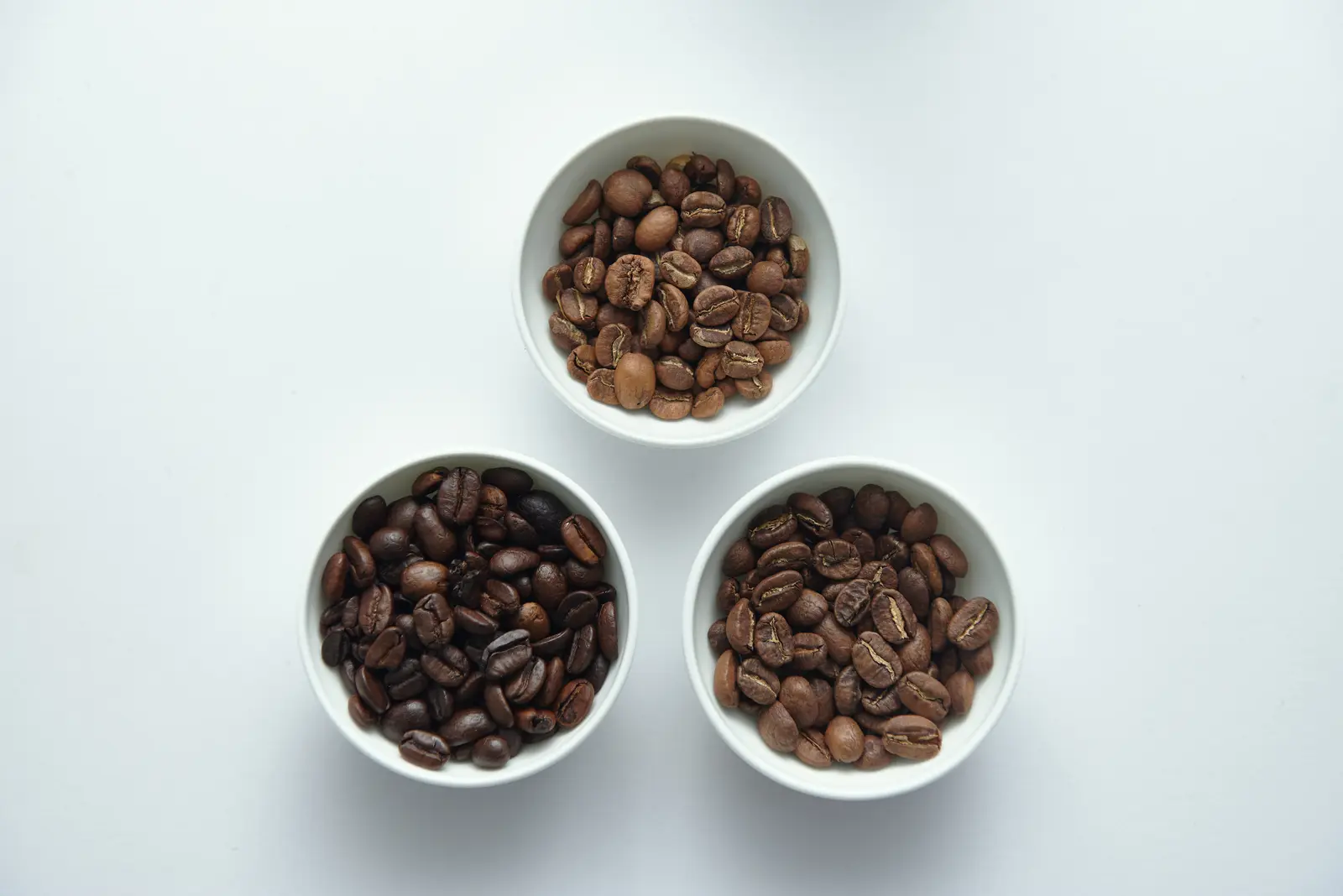
Roast & Steep
Pyrazines: Roasting Builds Part of Coffee’s Roasty Smell
Pyrazines form as coffee roasts. One, 2,3,5-trimethylpyrazine, is put at 1 to 6.7 mg/kg in coffee and about 50 ng per liter of air to smell, per earlier work.
Picture credit
"15 grams of coffee roasted to different degrees" by Alorin — https://commons.wikimedia.org/wiki/File:15_grams_of_coffee_roasted_to_different_degrees.jpg — CC BY 4.0 (https://creativecommons.org/licenses/by/4.0/)