Sourdough Starter: Its Bacteria Usually Outnumber Its Yeasts
Short answer
A jar of sourdough starter holds bacteria and yeasts, and the bacteria usually outnumber the yeasts. In published counts cited by a 2022 review, lactic acid bacteria reach about 100 million per gram of sourdough, while the yeasts in a mature starter run one to two logarithmic cycles lower: 10 to 100 times fewer. The review credits the bacteria with the acid and the yeasts with most of the gas. A 2021 study of 500 home starters found little evidence that a starter’s location shapes its microbes.
Course list · 5 sections
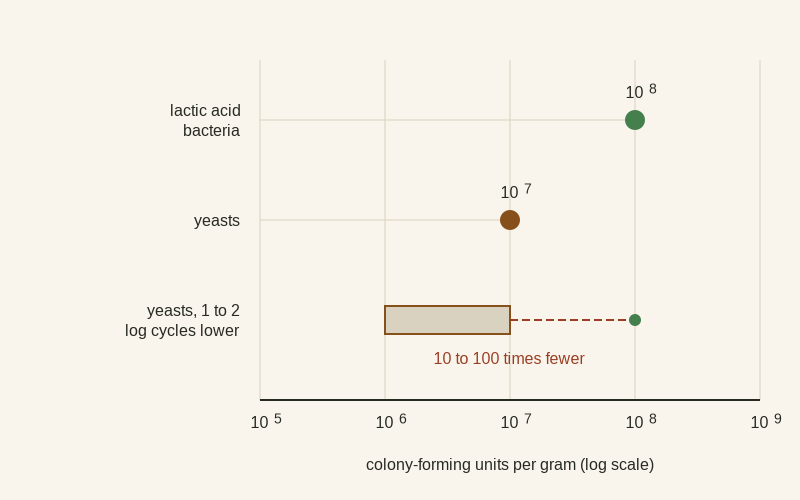
Typical counts in sourdough as cited by a 2022 review from earlier studies: lactic acid bacteria near 100 million and yeasts near 10 million colony-forming units per gram. The shaded band is the review’s other wording, yeasts one to two log cycles below the bacteria. Each grid step is a factor of ten.
"Lactic acid bacteria and yeast counts in sourdough" by Molecule & Menu, https://moleculeandmenu.com/cooking-science/sourdough-starter-microbes/, licensed under CC BY 4.0 (https://creativecommons.org/licenses/by/4.0/)
Data: Pérez-Alvarado et al. 2022, Frontiers in Microbiology 13:969460 (doi:10.3389/fmicb.2022.969460), CC BY 4.0, retrieved 2026-11-13
What lives in a sourdough starter?
A starter is flour and water fermented by lactic acid bacteria and yeasts. According to a 2022 review by Pérez-Alvarado and colleagues in Frontiers in Microbiology, these microbes arrive mainly with the flour and the surroundings. Bakers call the upkeep backslopping. Part of the last batch goes into fresh flour and water, and the cycle repeats.
A survey of household starters, published in eLife in 2021 by Landis and colleagues, read the microbial DNA of 500 starters from four continents. Of these, 429 came from the United States, 29 from Canada, 24 from Europe, 17 from Australia and New Zealand and 1 from Thailand. Across the survey, starters held a median of three species of lactic or acetic acid bacteria and one yeast species. Saccharomyces cerevisiae, the species also sold as baker’s yeast, made up more than half of the fungal DNA reads in 77% of the samples.
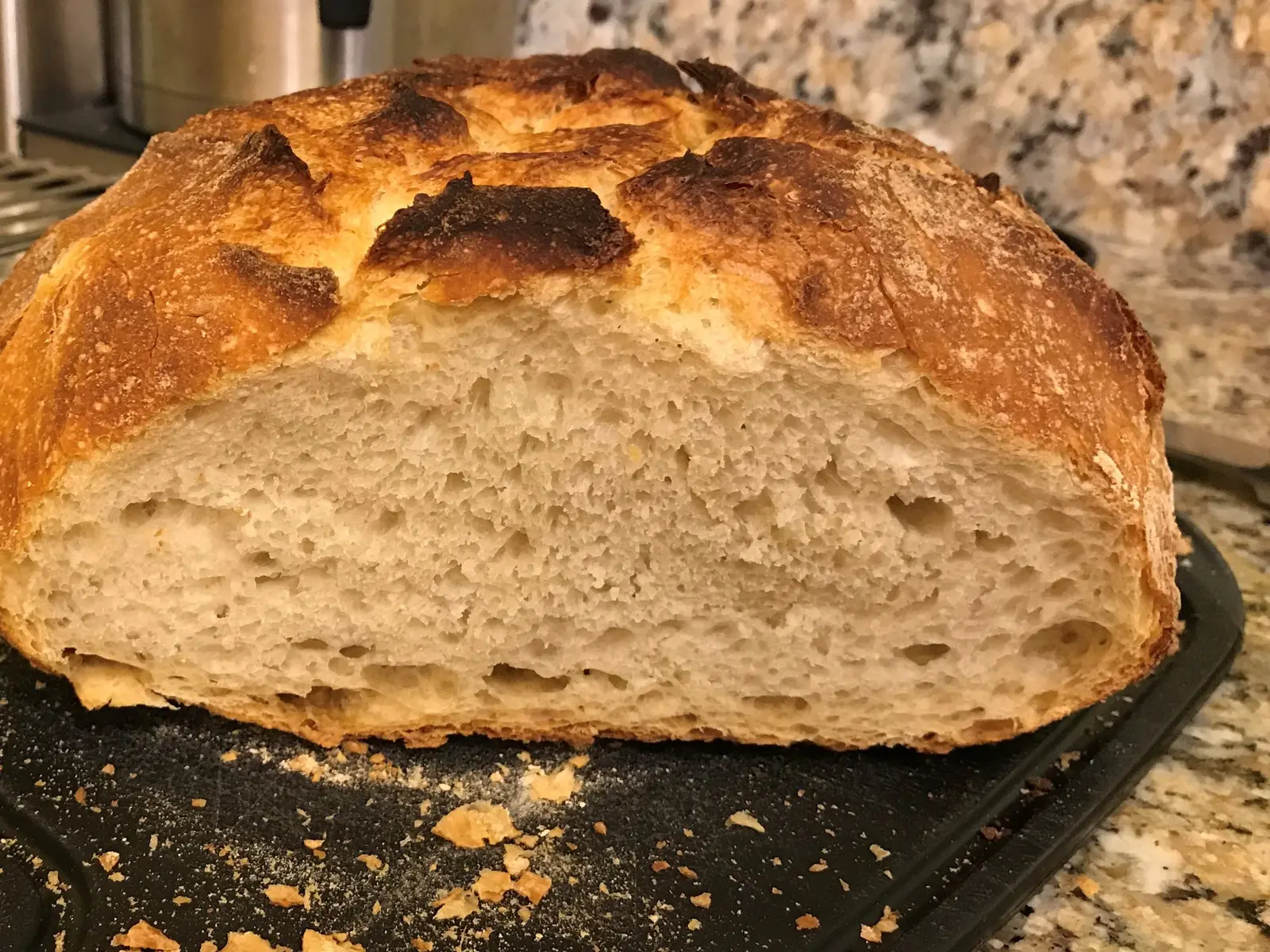
A finished sourdough loaf, cut open. The microbes described on this page do their work earlier, in the starter and then in the dough; the photo shows the result after baking.
"Sliced loaf of sourdough bread" by Nutrition, Food Safety & Health (Flickr) — https://commons.wikimedia.org/wiki/File:Sliced_loaf_of_sourdough_bread.jpg — CC0 1.0 (https://creativecommons.org/publicdomain/zero/1.0/); modified: cropped to remove appliances and a brand mark at upper left
Most of the DNA came from the fermenting groups. On average, lactic and acetic acid bacteria made up over 97% of the bacterial reads, and yeasts over 70% of the fungal reads. The rest were molds, plant microbes and microbes linked to skin, drinking water and soil. The authors left these out of later analyses.
The survey also counted a third group. Acetic acid bacteria were present at more than 1% relative abundance in 147 of the 500 starters. The authors call them “a mostly overlooked group of sourdough microbes.” They suggest that earlier studies missed them because these bacteria need special growing conditions in the laboratory.
Not every sourdough relies on a jar like this. The 2022 review sorts sourdough into four types. In the industrial types II and III, fermented in tanks with chosen strains of lactic acid bacteria, the culture mainly sours and flavors the dough. Baker’s yeast is then added for the rise.
Why do bacteria outnumber the yeasts?
A starter raises bread, so the yeasts might be expected to run the jar. By count, they are the minority. The 2022 review describes sourdough as “an environment with a low pH, high carbohydrate concentration, oxygen limitation, and a LAB cell count exceeding that of yeasts,” where LAB stands for lactic acid bacteria. Yeasts that tolerate the acid reach about 10 million colony-forming units per gram, against about 100 million for the bacteria, figures the review cites from a 2014 study.
Neither source pins the gap on one measured cause. The review describes the setting instead: an acidic, sugar-rich, low-oxygen paste, renewed again and again. According to the review, repeated backslopping “results in the prevalence of the species/strains best adapted to the SD ecosystem.”
The 2021 study tested how the two groups share that space. It grew four bacteria and four yeasts from the survey in pairs, in a liquid flour medium moved to fresh medium every 48 hours, six times over. A yeast and a bacterium both persisted in 8 of 16 pairings. Two yeasts, or two bacteria, both persisted in only 3 of 12.
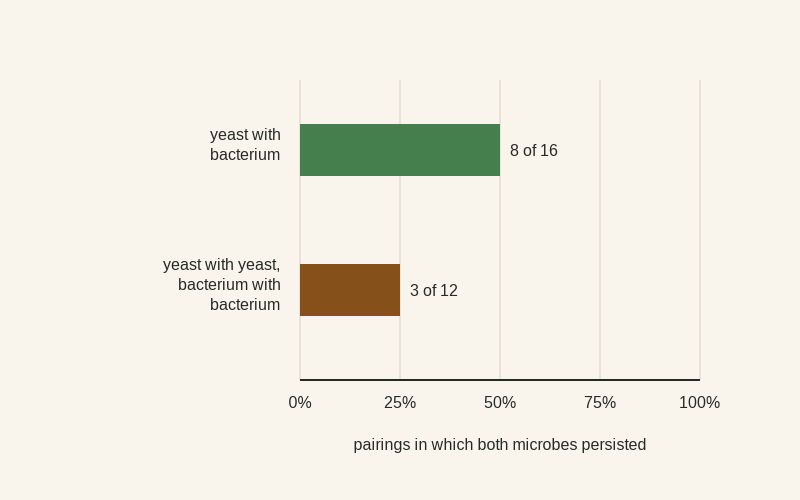
Pairwise competition in a liquid flour medium, six transfers of 48 hours each, from the 2021 study of 500 starters. A pairing counts when both microbes stayed above 1% of the mix. Eight isolates were tested: four bacteria and four yeasts.
"Yeast and bacterium pairs that persisted together" by Molecule & Menu, https://moleculeandmenu.com/cooking-science/sourdough-starter-microbes/, licensed under CC BY 4.0 (https://creativecommons.org/licenses/by/4.0/)
Data: Landis et al. 2021, eLife 10:e61644 (doi:10.7554/eLife.61644), CC BY 4.0, retrieved 2026-11-13
Some partners showed up together in both the survey and the pairing test. The bacterium Lactobacillus sanfranciscensis tended to occur with the yeast Kazachstania humilis and apart from S. cerevisiae. In the pairing test, it persisted only when grown with K. humilis.
One caution about the numbers. Plate counts, the method behind the review’s colony figures, count the colonies that grow on a dish. The 2021 survey measured something else: the share of DNA reads within the bacteria and within the fungi. Its figures compare bacteria with bacteria and yeasts with yeasts, so they cannot say which group is larger.
Where does the sour taste come from?
The sour comes from the bacteria. The 2022 review splits the starter’s main jobs this way: “acidification (LAB), flavor formation (LAB and yeasts), and leavening,” the last done by yeasts and heterofermentative LAB. It credits lactic acid with “fresh acidity” and acetic acid with “sharp acidity.”
Lactic acid bacteria come in two working types. Homofermentative species turn glucose into lactic acid alone. Heterofermentative species, which the review calls the dominant organisms in sourdough, make lactic acid plus carbon dioxide, acetic acid and/or ethanol. Yeasts make carbon dioxide and ethanol, and only low levels of acids such as acetic and succinic acid.
| Microbe group | Products listed by the 2022 review |
|---|---|
| Homofermentative lactic acid bacteria | Lactic acid |
| Heterofermentative lactic acid bacteria | Lactic acid, CO2, acetic acid and/or ethanol |
| Yeasts | CO2 and ethanol; low levels of acetic and succinic acid |
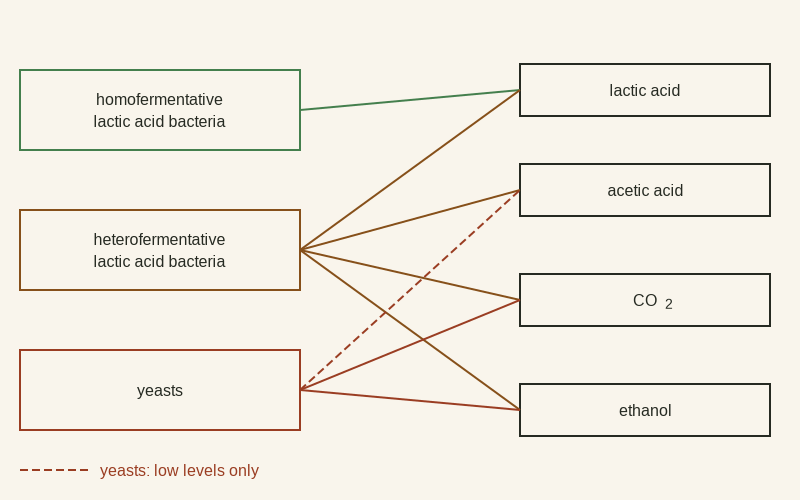
Who makes what in sourdough, as listed by the 2022 review. Solid lines are main products; the dashed line marks the low levels of acetic acid made by yeasts. The diagram shows products only, not amounts.
"Who makes what in sourdough" by Molecule & Menu, https://moleculeandmenu.com/cooking-science/sourdough-starter-microbes/, licensed under CC BY 4.0 (https://creativecommons.org/licenses/by/4.0/)
Data: Pérez-Alvarado et al. 2022, Frontiers in Microbiology 13:969460 (doi:10.3389/fmicb.2022.969460), CC BY 4.0, retrieved 2026-11-13
The gas that raises the dough comes mostly from the yeasts, which the review names as the main source of leavening, with help from heterofermentative bacteria. Starters differ in how fast they do it. In the 2021 study, 40 starters were each mixed into sterilized flour and water, and the doughs rose at 0.1 to 1.5 millimeters per hour. Which starter was used explained 42% of the variation in rise rate.
Once a loaf enters the oven, heat takes over the rise, a stage covered on the page about why bread rises.
Aroma comes from both groups. The review says yeasts turn some amino acids into higher alcohols and their esters. It credits the bacteria with 2-acetyl-1-pyrroline, a compound it links to the aroma of the crust, formed through the Maillard reaction from the amino acid ornithine. The same bacteria, per the review, help amino acids such as glutamate build up in the dough, and it ties glutamate to umami taste.
The 2021 study measured how far starters differ in smell. Across its 40 starters, gas analysis found 123 volatile compounds, a median of 85 per starter, among them 3-methyl-1-butanol, ethanol, acetic acid and ethyl acetate. An expert panel reported 14 dominant notes, including yeasty, vinegar, green apple, fermented sour and solvent-like.
Does a starter taste of its place?
Bread producers often credit the local environment for a loaf’s character, the 2021 study notes, and it names San Francisco sourdough as the famous example. The study tested that idea with distance. If place mattered, starters made close together should hold more similar microbes. Across the continental United States, where most samples came from, the correlation between distance and microbial makeup was reported as 0.0 for both bacteria and yeasts.
Worldwide, yeasts showed a weak link (0.07). The link rose to 0.23 when molds and other non-yeast fungi were added. The authors suggest that this may reflect local ingredients or surroundings.
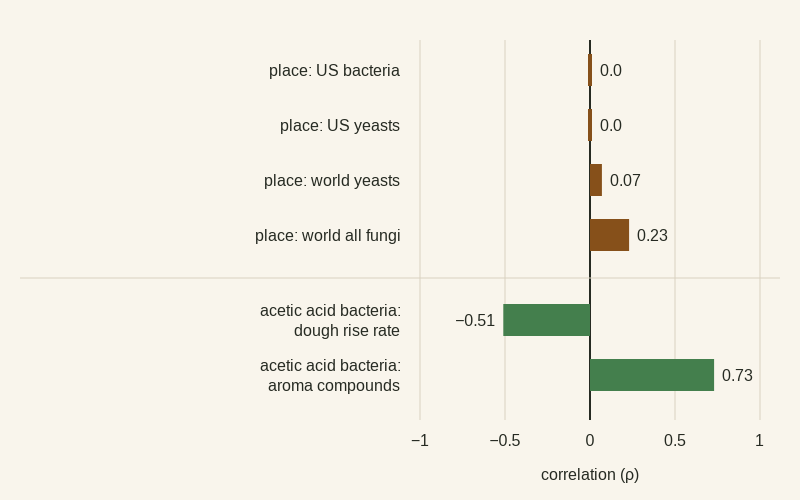
Correlations reported by the 2021 study. Top four bars: how well distance between starters predicted their microbes (Mantel tests). Bottom two: how the share of acetic acid bacteria tracked dough rise rate and the mix of aroma compounds in 40 starters. Zero means no correlation; 1 or −1 means a perfect one.
"Place versus acetic acid bacteria in 500 sourdough starters" by Molecule & Menu, https://moleculeandmenu.com/cooking-science/sourdough-starter-microbes/, licensed under CC BY 4.0 (https://creativecommons.org/licenses/by/4.0/)
Data: Landis et al. 2021, eLife 10:e61644 (doi:10.7554/eLife.61644), CC BY 4.0, retrieved 2026-11-13
| Comparison in the 2021 study | Test | Value |
|---|---|---|
| Distance vs bacteria, continental United States | Mantel ρ | 0.0 (p > 0.05) |
| Distance vs yeasts, continental United States | Mantel ρ | 0.0 (p > 0.05) |
| Distance vs yeasts, all 500 starters | Mantel ρ | 0.07 (p < 0.01) |
| Distance vs all fungi, all 500 starters | Mantel ρ | 0.23 (p ≤ 0.001) |
| Acetic acid bacteria share vs dough rise rate, 40 starters | ρ | −0.51 (p < 0.001) |
| Acetic acid bacteria share vs aroma compounds, 40 starters | Mantel ρ | 0.73 (p < 0.001) |
Download the study figures (CSV) (source and license notes) Data: Pérez-Alvarado et al. 2022, Frontiers in Microbiology 13:969460 (doi:10.3389/fmicb.2022.969460), CC BY 4.0, retrieved 2026-11-13; Landis et al. 2021, eLife 10:e61644 (doi:10.7554/eLife.61644), CC BY 4.0, retrieved 2026-11-13
The authors’ summary is blunt: “we found little evidence for biogeographic patterns in starter communities.” They suggest two reasons. Bakers share and sell starters across long distances, and flour, a major potential source of microbes for new starters, is shipped across large regions too. Even the bacterium named for San Francisco, L. sanfranciscensis, was tied in the survey to a starter’s history: it was abundant in the 73 starters acquired from a bakery or other business, and often found in older starters.
What did track aroma was one group of microbes. The study’s abstract states: “Variation in dough rise rates and aromas were largely explained by acetic acid bacteria.” In the 40 starters tested further, a higher share went with slower rising dough and with a stronger vinegar note from the expert panel. For the slower rise, the authors suggest acetic acid, or the slowing of yeast and lactic acid bacteria, as possible reasons.
The authors add that the pattern “was not seen in all samples.” Two further limits apply. The sample was mostly American. The DNA method sorted microbes to species, not to strains, which the authors say could still show regional patterns.
The invisible ingredient: temperature and time between feedings
A starter recipe’s ingredient list names flour and water, not the conditions they ferment under. Call temperature and the interval between feedings the invisible ingredient of a starter. The 2022 review states that the maturing of a starter’s microbes “depends on various factors such as temperature, the chemical and enzymatic composition of the flour, redox potential, water content, and time.” For the yeasts in particular, it names dough hydration, the type of cereal and the leavening temperature.
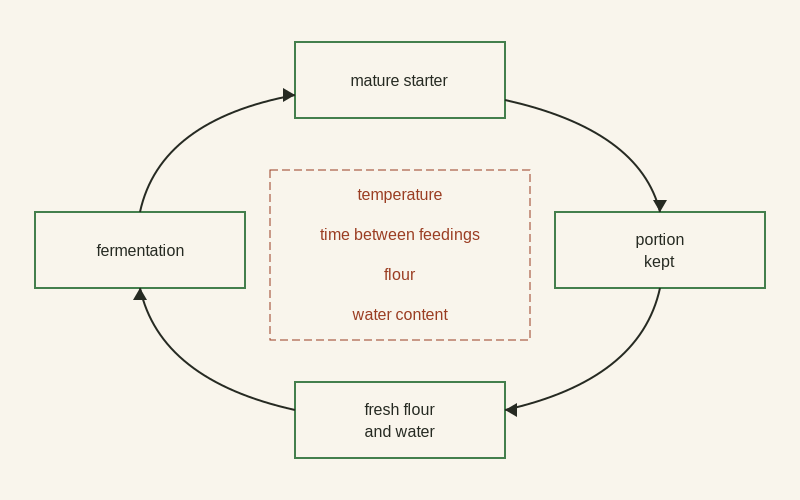
The backslopping cycle that keeps a starter alive, with the conditions the 2022 review lists as shaping its microbes. The diagram shows the conditions only and gives no settings.
"The backslopping cycle and its conditions" by Molecule & Menu, https://moleculeandmenu.com/cooking-science/sourdough-starter-microbes/, licensed under CC BY 4.0 (https://creativecommons.org/licenses/by/4.0/)
Data: Pérez-Alvarado et al. 2022, Frontiers in Microbiology 13:969460 (doi:10.3389/fmicb.2022.969460), CC BY 4.0, retrieved 2026-11-13
Time also works on a longer scale. In the 2021 survey, younger starters were often dominated by Lactobacillus plantarum and L. brevis, while older ones more often held L. sanfranciscensis. Starters begun from scratch with flour and water were more often marked by L. brevis.
The household survey could not show how much each condition matters at home. Its participants reported 33 kinds of detail, including starter age, storage place, feed frequency, grain and local climate. Together, those factors explained less than 10% of the variation in which microbes a starter held: 8.3% for bacteria and 7.5% for fungi across all locations.
The authors note that home bakers may change their methods over time and keep imperfect records. The study’s plain-language digest still concludes that the mix of microbes “likely depends more on how the starter culture was made and how it is maintained over time” than on location. This page gives no temperatures or feeding schedules. The 2022 review mentions ranges for craft-style sourdough only in passing, and the household survey recorded feeding habits without testing them.
Reaction card
| Type | Mixed microbial fermentation: lactic acid bacteria and yeasts, with acetic acid bacteria in some starters |
|---|---|
| Reactants | Flour carbohydrates such as glucose, in a paste of flour and water |
| First described | Not covered by the sources read for this page; no date is given |
| Stages | Repeated cycle: fresh flour and water, fermentation, a portion kept to start the next batch |
| Speeds up with | Not measured as a change in rate by the sources read; the 2022 review lists temperature, flour, redox potential, water content and time as factors in how the microbes mature |
| Slows with | In 40 starters, a higher share of acetic acid bacteria went with slower dough rise (rho -0.51), not in every sample |
| Not the same as | Leavening by baker's yeast alone: Saccharomyces cerevisiae often dominates a starter's yeasts, but in the published counts cited by the 2022 review, lactic acid bacteria outnumber the yeasts 10 to 100 times |
| The invisible ingredient | Temperature and the interval between feedings, as conditions only; no settings given |
This card as data (CSV) · Source and license notes
Data: Pérez-Alvarado et al. 2022, Frontiers in Microbiology 13:969460 (doi:10.3389/fmicb.2022.969460), CC BY 4.0, retrieved 2026-11-13; Landis et al. 2021, eLife 10:e61644 (doi:10.7554/eLife.61644), CC BY 4.0, retrieved 2026-11-13
Sources
- Pérez-Alvarado O, Zepeda-Hernández A, Garcia-Amezquita LE, Requena T, Vinderola G, García-Cayuela T. Role of lactic acid bacteria and yeasts in sourdough fermentation during breadmaking: Evaluation of postbiotic-like components and health benefits. Front Microbiol. 2022;13:969460. doi:10.3389/fmicb.2022.969460 https://pmc.ncbi.nlm.nih.gov/articles/PMC9524358/Read: full text; the introduction and the sections on the roles of lactic acid bacteria and yeasts are used. License: CC BY 4.0.
- Landis EA, Oliverio AM, McKenney EA, Nichols LM, Kfoury N, Biango-Daniels M, Shell LK, Madden AA, Shapiro L, Sakunala S, Drake K, Robbat A, Booker M, Dunn RR, Fierer N, Wolfe BE. The diversity and function of sourdough starter microbiomes. eLife. 2021;10:e61644. doi:10.7554/eLife.61644 https://pmc.ncbi.nlm.nih.gov/articles/PMC7837699/Read: full text; supplementary data files not used. License: CC BY 4.0.
Cite this page
“Sourdough Starter: Its Bacteria Usually Outnumber Its Yeasts.” Molecule & Menu. Published November 14, 2026. https://moleculeandmenu.com/cooking-science/sourdough-starter-microbes/. Accessed on the date you read it.
How pages here are checked · All corrections · Report an error on this page (contact@moleculeandmenu.com)
Second helping:
- Coffee processing: coffee seeds go through a microbial fermentation too, even the ones sold as washed.
- Pyrazines: the roasty smell that coffee gets from a roaster’s heat rather than from microbes.
More from Cooking Science
Cooking Science
Maillard Reaction: Browning Has No Starting Temperature
The Maillard reaction has no on-switch: a 2025 review cites it in frozen storage. This page's Arrhenius estimates show how much faster it runs from 60 to 180°C.
Picture credit
"Stilleven met een zoutvat (Still Life with a Salt Cellar)" by Pieter Claesz — https://commons.wikimedia.org/wiki/File:Stilleven_met_een_zoutvat,_SK-A-4839.jpg — CC0 1.0 (https://creativecommons.org/publicdomain/zero/1.0/)
Cooking Science
Caramelization: A 2011 Study Tied Sugar Melting to Heat Rate
Caramelization browns sugar without amino acids. In a 2011 study, sugar’s apparent melting point shifted with heating rate; a 2012 comment and reply followed.
Picture credit
"Boiling caramel in a pot" by Personal Creations — https://commons.wikimedia.org/wiki/File:Boiling_caramel_in_a_pot_(15092657599).jpg — CC BY 2.0 (https://creativecommons.org/licenses/by/2.0/)
Cooking Science
Why Does Bread Rise? Gas From Yeast, Then Heat Takes Over
Why does bread rise? Yeast fills dough with CO2; in the oven, heat swells the gas and adds steam until the pores open and the dough sets, per 2025–2026 studies.
Picture credit
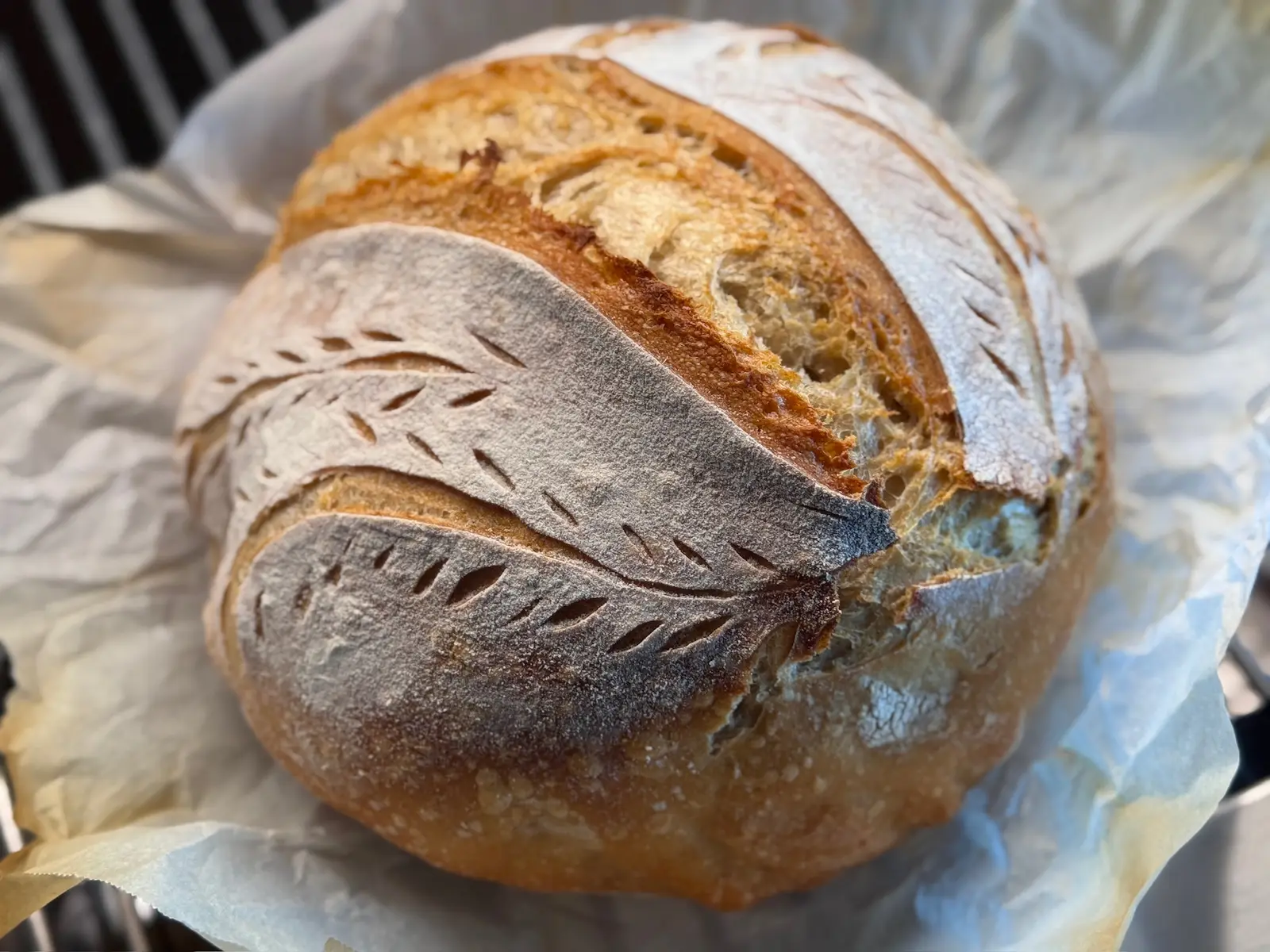
"Sourdough bread with decorative scores" by SueRostvold — https://commons.wikimedia.org/wiki/File:Sourdough_bread_with_decorative_scores.jpg — CC BY 4.0 (https://creativecommons.org/licenses/by/4.0/)