Maillard Reaction: Browning Has No Starting Temperature
Short answer
The Maillard reaction has no starting temperature: a 2025 review cites Maillard chemistry measured in frozen storage. Heat sets the speed instead. At the hot end, the same review gives two conditions: above 140°C, an asparagine–glucose system forms a high level of pyrazines and thiazoles, and bread crust typically browns at around 160°C. By this page's Arrhenius calculation, the reaction runs about 130 to 650 times faster at 160°C than at 100°C.
Course list · 5 sections
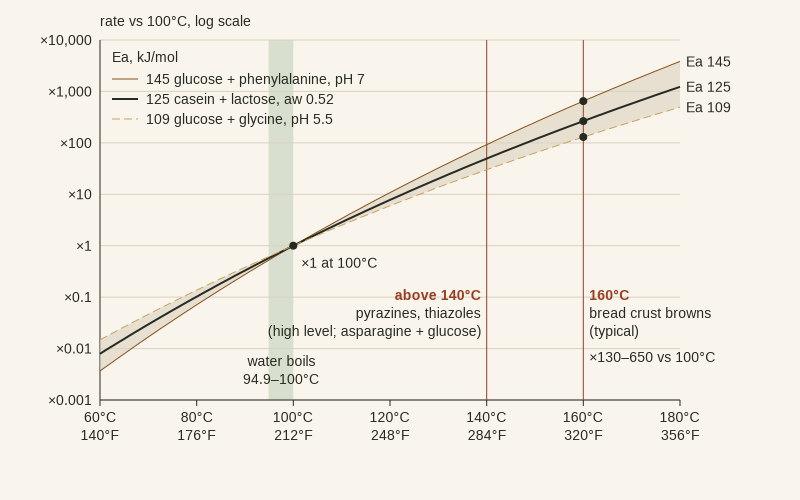
Relative speed of the Maillard reaction from 60 to 180°C in this page's calculation, using the Arrhenius equation and three activation energies compiled in a 2025 review. The green band is water's boiling range from 1,524 m (5,000 ft) to sea level; the two marked lines are the review's conditions at 140°C and 160°C. Model arithmetic, not cooking times.
"How much faster the Maillard reaction runs from 60 to 180°C" by Molecule & Menu, https://moleculeandmenu.com/cooking-science/maillard-reaction-temperature/, licensed under CC BY 4.0 (https://creativecommons.org/licenses/by/4.0/)
Data: Activation energies: El Hosry et al. 2025, Foods 14:1881, CC BY 4.0, https://doi.org/10.3390/foods14111881; Boiling band: steam point values from the National Institute of Standards and Technology (NIST)
Wet chicken skin in a hot pan hisses long before it turns brown. The Maillard reaction, the reaction between sugars and amino groups that browns crusts, roasts and coffee, does not wait for a set temperature to begin. The hissing skin is simply slow. While water is still boiling off, the surface is held near 100°C (212°F) at sea level.
What happens in the Maillard reaction, step by step
The reaction begins when the carbonyl group of a reducing sugar (such as glucose, fructose or lactose) meets the amino group of an amino acid, peptide or protein. The French chemist Louis-Camille Maillard described the browning in 1912, after heating a solution of a sugar and an amino acid. In 1953, J. E. Hodge published a paper on the chemistry of browning reactions in model systems.
A 2025 review in the journal Foods (El Hosry et al.) splits what follows into three stages:
- Early stage. Sugar and amino group condense. They then rearrange into a more stable sugar–amine compound called an Amadori product. A ketose sugar such as fructose gives a Heyns product instead. This stage is colorless and odorless.
- Intermediate stage. The Amadori product breaks into reactive fragments. A step called Strecker degradation breaks amino acids down into aroma-carrying aldehydes, and other routes form pyrazines, the compounds behind roasted, nutty notes.
- Final stage. Fragments link into melanoidins, the brown polymers that finally become visible.
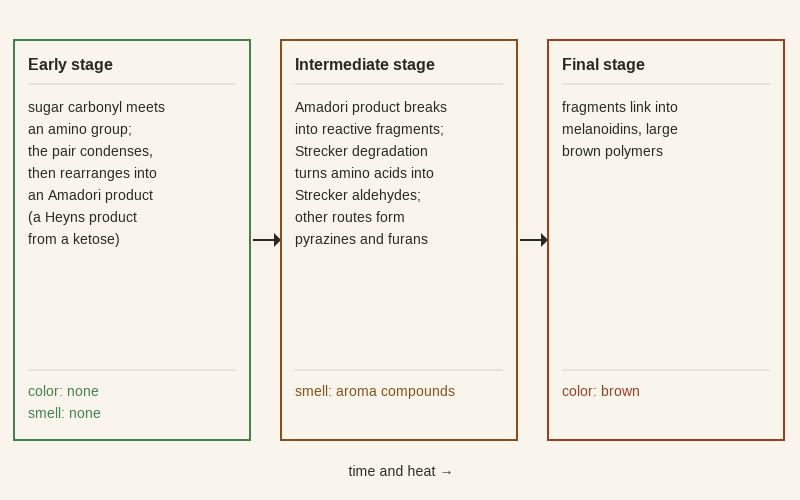
The three stages of the Maillard reaction as a 2025 review describes them: the early stage has no color or smell, the intermediate stage gives aroma compounds, and the final stage forms brown melanoidins.
"The three stages of the Maillard reaction" by Molecule & Menu, https://moleculeandmenu.com/cooking-science/maillard-reaction-temperature/, licensed under CC BY 4.0 (https://creativecommons.org/licenses/by/4.0/)
Data: Stages: El Hosry et al. 2025, Foods 14:1881, CC BY 4.0, https://doi.org/10.3390/foods14111881
That first stage matters for the temperature question. The chemistry is under way before anything changes color or smell, so a brown crust is a late checkpoint, not the start line.
The sugar's shape also limits the pace. In water, the review notes, only about 0.0026% of glucose is in the open-chain form that carries the reactive carbonyl group; the rest is closed in a ring. Table sugar (sucrose) has no open-chain form at all. It is not a direct Maillard reactant until it splits into glucose and fructose.
At what temperature does the Maillard reaction start?
The 2025 review takes on one popular idea: that the reaction takes place only at high temperatures. It calls that idea “a common misconception.” The evidence it gathers runs far below boiling:
- Royal jelly stored at 4°C (39°F) for 12 months gained furosine, a recognized marker of Maillard progress.
- Frozen meat stored at −4°C and −20°C (25°F and −4°F) changed color, which the review attributes to Maillard reactions between ribose and lysine side chains in proteins.
- Meatballs held at −18°C (0°F) for 30 to 120 days showed significant rises in two advanced Maillard products, known as CML and CEL.
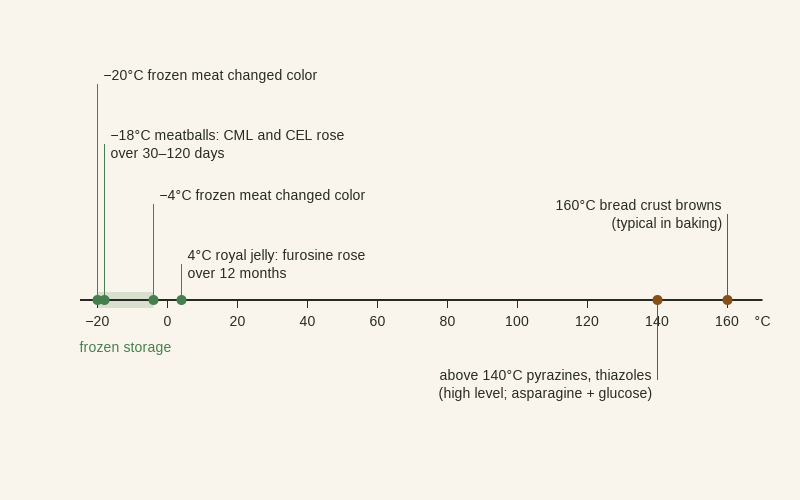
Temperatures at which a 2025 review cites Maillard chemistry: storage evidence at 4°C, −4°C, −18°C and −20°C, and two conditions at the hot end, pyrazines and thiazoles above 140°C in an asparagine–glucose system and bread crust browning at around 160°C.
"From frozen storage to bread crust: Maillard evidence by temperature" by Molecule & Menu, https://moleculeandmenu.com/cooking-science/maillard-reaction-temperature/, licensed under CC BY 4.0 (https://creativecommons.org/licenses/by/4.0/)
Data: Temperatures and conditions: El Hosry et al. 2025, Foods 14:1881, CC BY 4.0, https://doi.org/10.3390/foods14111881
None of that is browning a cook could use. It shows that the reaction keeps a speed even in cold storage, and that the speed falls steeply as food gets colder.
At the hot end, the review gives conditions rather than a threshold. Citing a study of asparagine with glucose, it reports few volatile flavor compounds at lower temperatures and “a high level of pyrazine and thiazole compounds” above 140°C. Describing baking, it places crust browning at around 160°C, after the dough has expanded and the surface has dried.
Popular version: Browning starts once food reaches a set high temperature.
What the evidence shows: The reaction has been detected at 4°C and in frozen storage from −4°C to −20°C, in storage studies lasting up to 12 months (El Hosry et al. 2025). The review's 140°C and 160°C figures describe conditions under which particular products form or crusts brown, not a point where the reaction begins. Heat sets the speed. It does not flip a switch.
How much faster is browning at 160°C than at 100°C?
To put numbers on “faster,” this page applies the simplified kinetic model the review describes. The model uses the Arrhenius equation. In it, a reaction's rate climbs steeply with temperature, at a pace set by its activation energy (Ea): the energy barrier the reaction has to clear. The review lists three measured values:
- 109 kJ/mol for glucose with glycine in water at pH 5.5
- 125 kJ/mol for a powdered casein–lactose mixture at water activity 0.52 (water activity measures how much of a food's water is available for reactions) and pH 6.5
- 145 kJ/mol for glucose with phenylalanine in water at pH 7
Method. Relative rate = exp[(Ea/R) × (1/T_ref − 1/T)], with R = 8.314462618 J/(mol·K), temperatures in kelvin and T_ref = 100°C (373.15 K). The “time to match” column divides the 160°C rate by the rate at each temperature. The table is model arithmetic, not cooking times.
| Temperature | Rate vs. 100°C (Ea 109–145 kJ/mol) | Time to match 1 minute at 160°C |
|---|---|---|
| 60°C (140°F) | 0.004–0.015× | about 6 to 123 days |
| 80°C (176°F) | 0.07–0.14× | about 16 hours to 6 days |
| 94.9°C (202.8°F), NIST steam point at 5,000 ft (1013 hPa) | 0.52–0.61× | about 3.5 to 21 hours |
| 100°C (212°F) | 1× | about 2.2 to 10.8 hours |
| 140°C (284°F) | 30–92× | about 4 to 7 minutes |
| 160°C (320°F) | 130–650× | 1 minute |
| 180°C (356°F) | 490–3,800× | about 10 to 16 seconds |
Download the rate table (CSV) (source and license notes) Data: Activation energies: El Hosry et al. 2025, Foods 14:1881, CC BY 4.0, https://doi.org/10.3390/foods14111881; Steam point at 1,524 m: National Institute of Standards and Technology (NIST)
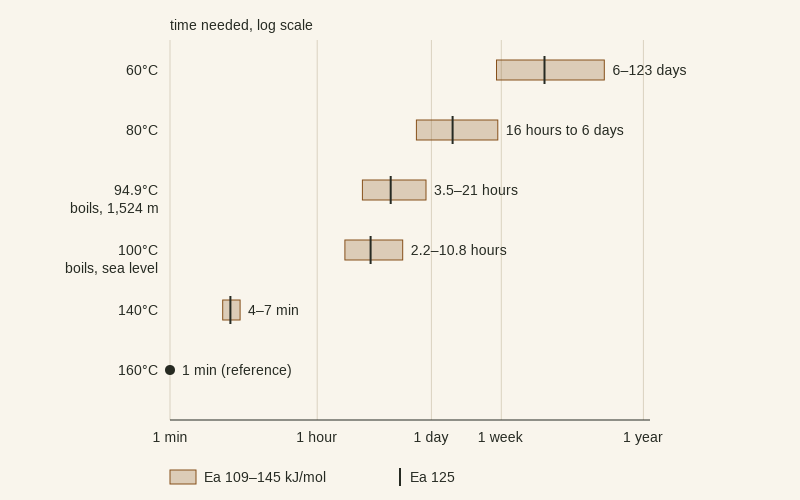
Time needed at each temperature to match one minute at 160°C in this page's calculation; bars span the three activation energies (109–145 kJ/mol) and the tick marks 125 kJ/mol. Model arithmetic, not cooking times.
"Time to match one minute of Maillard chemistry at 160°C" by Molecule & Menu, https://moleculeandmenu.com/cooking-science/maillard-reaction-temperature/, licensed under CC BY 4.0 (https://creativecommons.org/licenses/by/4.0/)
Data: Activation energies: El Hosry et al. 2025, Foods 14:1881, CC BY 4.0, https://doi.org/10.3390/foods14111881
Two patterns stand out. Between 140 and 170°C, each 10°C step multiplies the rate by about 2 to 2.7. One minute of browning chemistry at 160°C would need roughly 2 to 11 hours at a steady 100°C.
Where the model breaks down
These figures are orders of magnitude, not cooking times. The three activation energies come from model systems, while real foods mix many sugars and amino acids at shifting water levels. The review also notes that at elevated temperatures, protein aggregation and the loss of amino groups can hold the reaction back, so the curve can overstate the hot end for some foods.
Why won't a wet surface brown?
Water is the brake. Liquid water boils near 100°C at sea level. NIST's steam-point figures give 99.87°C (211.77°F) at 30.5 m (100 ft), and show that ceiling dropping with altitude, to 94.89°C (202.80°F) at 1,524 m (5,000 ft), at an altimeter pressure of 1013 hPa. While a surface stays wet, evaporation keeps it at or below that ceiling.
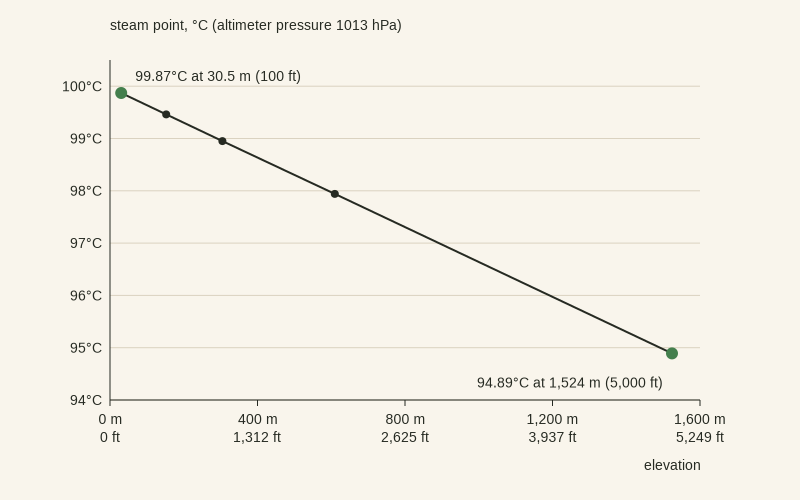
Steam point by elevation at an altimeter pressure of 1013 hPa, from NIST: 99.87°C at 30.5 m, 99.46°C at 152.4 m, 98.95°C at 304.8 m, 97.94°C at 609.6 m and 94.89°C at 1,524 m.
"Steam point of water by elevation" by Molecule & Menu, https://moleculeandmenu.com/cooking-science/maillard-reaction-temperature/, licensed under CC BY 4.0 (https://creativecommons.org/licenses/by/4.0/)
Data: Steam point values: National Institute of Standards and Technology (NIST), Mercury Thermometer Alternatives: Verification Methods for Alternative Thermometers
Meat simmered in an open pot cannot get hotter than the water around it, and that water cannot rise above its boiling point. At best, the meat stays at the table's slow 100°C row. Water also slows the chemistry directly: the review places the fastest Maillard rates at a water activity of about 0.6 to 0.7, with rates dropping past that peak as extra water dilutes the reactants. Water on a far hotter pan is a different case, covered on the Leidenfrost effect page.
The invisible ingredient
Here the invisible ingredient is drying time. It appears in no ingredient list. Yet the surface has to lose its free water before its temperature can leave the 100°C band and reach the range where the table's multipliers run into the hundreds.
The familiar advice to dry a surface before browning fits both mechanisms above. None of the cited sources tested that advice directly on steak or chicken, so it is a mechanism-based expectation, not a measured result.
What else speeds up or slows down browning?
Temperature and water are not the only dials. The review lists alkaline conditions (pH 7 and above) as speeding the reaction. Acidic conditions, it says, slow it. At pH 5 or below, it adds, the reaction can be stopped during moderate heating at or below 100°C for less than 24 hours.
Ovens follow the wet-surface rule too. The review describes baking in three phases: the dough expands, the surface dries, then the crust browns, typically at around 160°C. The page on why bread rises covers what happens inside the loaf before that crust forms.
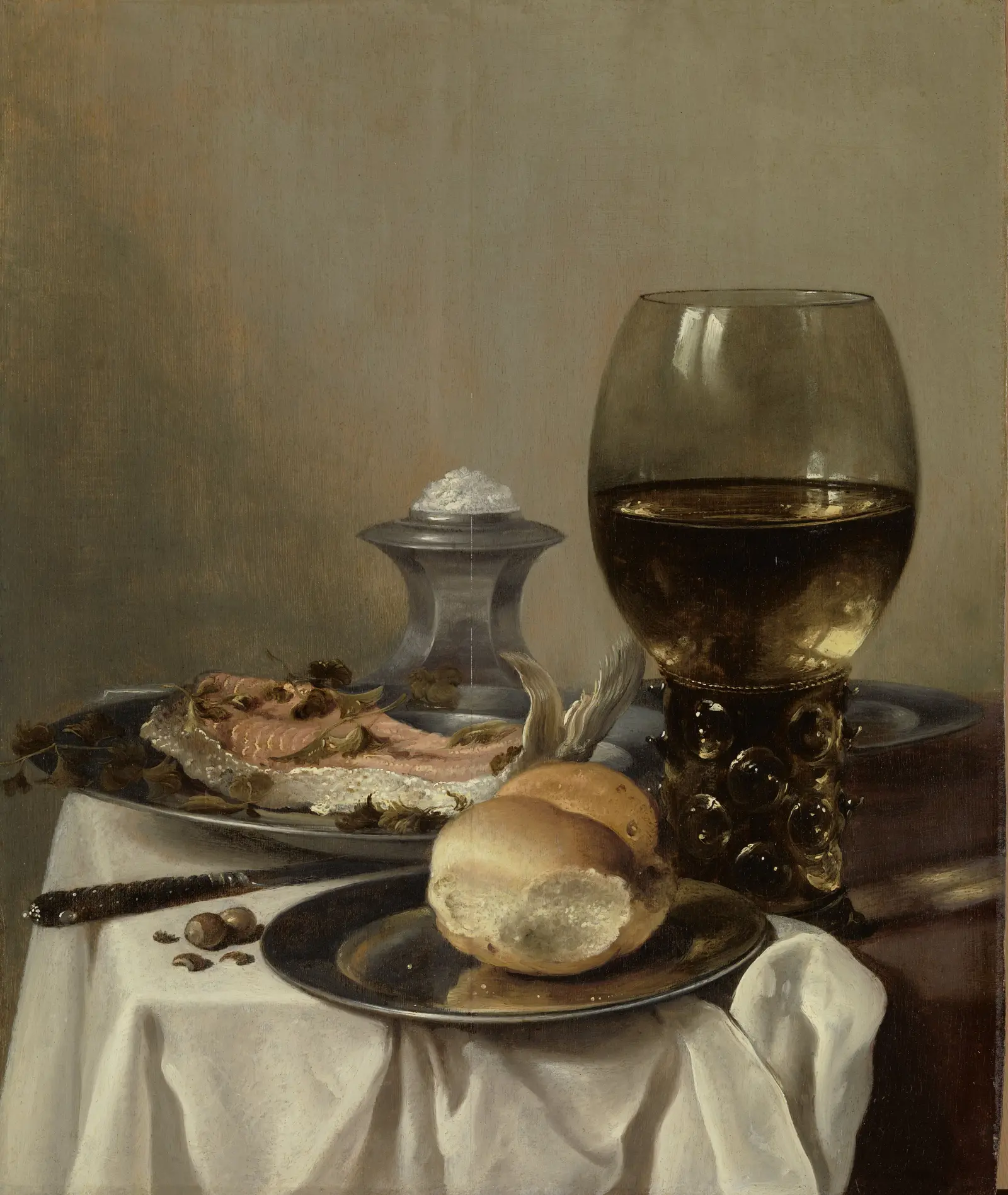
Pieter Claesz painted this breakfast table around 1640–1645. The roll’s crust is golden brown and its broken face is pale; the painting shows how bread looked, not what temperature baked it.
"Stilleven met een zoutvat (Still Life with a Salt Cellar)" by Pieter Claesz — https://commons.wikimedia.org/wiki/File:Stilleven_met_een_zoutvat,_SK-A-4839.jpg — CC0 1.0 (https://creativecommons.org/publicdomain/zero/1.0/)
Is the Maillard reaction the same as caramelization?
No: the review names caramelization and the Maillard reaction as the two non-enzymatic browning reactions behind the color and aroma of baked goods, and it defines the Maillard reaction by an amino group from an amino acid, peptide or protein. Sugar heated on its own has a starting-point puzzle of its own, covered on the caramelization page: a 2011 study's abstract proposes that sugar crystals break down by thermal decomposition rather than true melting; other food scientists published a comment on that work in 2012, and the authors replied.
FAQ
At what temperature does the Maillard reaction occur?
At a wide span of temperatures, at very different speeds. Studies cited in a 2025 review detected it at 4°C and in frozen storage down to −20°C. At the hot end, the review gives two conditions rather than a threshold: a high level of pyrazines and thiazoles above 140°C in an asparagine–glucose system, and bread crust browning at around 160°C. Using activation energies of 109–145 kJ/mol from that review, this page's calculation puts the rate at 160°C at roughly 130 to 650 times the rate at 100°C.
What is the difference between the Maillard reaction and caramelization?
The Maillard reaction joins a reducing sugar to an amino group from an amino acid, peptide or protein. A 2025 review names caramelization as the other non-enzymatic browning reaction in baked goods, so bread crust gets color from both. Table sugar on its own is not a direct Maillard reactant until it splits into glucose and fructose.
Why doesn't food brown in boiling water?
The reaction still runs, but slowly. Food surrounded by water at sea level stays near 100°C, where this page's calculation gives between one 130th and one 650th of the rate at 160°C. Very wet conditions slow the reaction further, since the fastest rates sit around a water activity of 0.6 to 0.7. Quick browning needs a surface that is both drier and hotter than boiling water allows.
Reaction card
| Type | Non-enzymatic browning (no enzymes involved) |
|---|---|
| Reactants | Carbonyl group of a reducing sugar + amino group of an amino acid, peptide or protein |
| First described | 1912, Louis-Camille Maillard, after heating a solution of a sugar and an amino acid |
| Stages | Early (colorless, odorless; Amadori product, or a Heyns product from a ketose), then intermediate (aroma compounds such as Strecker aldehydes and pyrazines), then final (melanoidins, brown polymers) |
| Speeds up with | Higher temperature (Ea 109–145 kJ/mol in three model systems); pH 7 and above; water activity 0.5–0.8, with the peak near 0.6–0.7 |
| Slows with | Cold, though still detected at −20°C in frozen meat; pH below 7 (pH 5 or below can stop it in heating at or below 100°C for under 24 hours); water activity below 0.4 or above 0.9 |
| Not the same as | Caramelization, the other non-enzymatic browning reaction in a baked crust |
| The invisible ingredient | Drying time at the surface |
This card as data (CSV) · Source and license notes
Data: El Hosry et al. 2025, Foods 14:1881, CC BY 4.0, https://doi.org/10.3390/foods14111881; Steam point: National Institute of Standards and Technology (NIST)
Sources
- El Hosry, L., Elias, V., Chamoun, V., Halawi, M., Cayot, P., Nehme, A., & Bou-Maroun, E. (2025). Maillard Reaction: Mechanism, Influencing Parameters, Advantages, Disadvantages, and Food Industrial Applications: A Review. Foods, 14(11), 1881. https://doi.org/10.3390/foods14111881 https://pmc.ncbi.nlm.nih.gov/articles/PMC12154226/Read: full text. License: CC BY 4.0.
- National Institute of Standards and Technology. Mercury Thermometer Alternatives: Verification Methods for Alternative Thermometers (section “Measurement at the steam point”). https://www.nist.gov/pml/sensor-science/thermodynamic-metrology/mercury-thermometer-alternatives/mercury-thermometer-7Read: full page.
- Hodge, J. E. (1953). Dehydrated Foods, Chemistry of Browning Reactions in Model Systems. Journal of Agricultural and Food Chemistry, 1(15), 928–943. https://doi.org/10.1021/jf60015a004Read: bibliography only.
- Lee, J. W., Thomas, L. C., & Schmidt, S. J. (2011). Investigation of the Heating Rate Dependency Associated with the Loss of Crystalline Structure in Sucrose, Glucose, and Fructose Using a Thermal Analysis Approach (Part I). Journal of Agricultural and Food Chemistry, 59(2), 684–701. https://doi.org/10.1021/jf1042344Read: abstract only.
- Roos, Y. H., Franks, F., Karel, M., Labuza, T. P., Levine, H., Mathlouthi, M., Reid, D., Shalaev, E., & Slade, L. (2012). Comment on the Melting and Decomposition of Sugars. Journal of Agricultural and Food Chemistry, 60(41), 10359–10362; reply by Schmidt, S. J., Thomas, L. C., & Lee, J. W., 10363–10371. https://doi.org/10.1021/jf3002526Read: bibliography only.
Cite this page
“Maillard Reaction: Browning Has No Starting Temperature.” Molecule & Menu. Published November 14, 2026. https://moleculeandmenu.com/cooking-science/maillard-reaction-temperature/. Accessed on the date you read it.
How pages here are checked · All corrections · Report an error on this page (contact@moleculeandmenu.com)
Second helping:
- Caramelization: sugar heated on its own browns by a different route, with its own argument over when the change begins.
- Pyrazines: the roasted-smelling compounds that form in the Maillard reaction's intermediate stage.
More from Cooking Science
Cooking Science
Caramelization: A 2011 Study Tied Sugar Melting to Heat Rate
Caramelization browns sugar without amino acids. In a 2011 study, sugar’s apparent melting point shifted with heating rate; a 2012 comment and reply followed.
Picture credit
"Boiling caramel in a pot" by Personal Creations — https://commons.wikimedia.org/wiki/File:Boiling_caramel_in_a_pot_(15092657599).jpg — CC BY 2.0 (https://creativecommons.org/licenses/by/2.0/)
Cooking Science
Why Does Bread Rise? Gas From Yeast, Then Heat Takes Over
Why does bread rise? Yeast fills dough with CO2; in the oven, heat swells the gas and adds steam until the pores open and the dough sets, per 2025–2026 studies.
Picture credit
"Sourdough bread with decorative scores" by SueRostvold — https://commons.wikimedia.org/wiki/File:Sourdough_bread_with_decorative_scores.jpg — CC BY 4.0 (https://creativecommons.org/licenses/by/4.0/)
Cooking Science
Sourdough Starter: Its Bacteria Usually Outnumber Its Yeasts
In counts a 2022 review cites, a mature sourdough starter’s lactic acid bacteria outnumber its yeasts 10 to 100 times. Who makes the acid? Does place matter?
Picture credit
"Sliced loaf of sourdough bread" by Nutrition, Food Safety & Health (Flickr) — https://commons.wikimedia.org/wiki/File:Sliced_loaf_of_sourdough_bread.jpg — CC0 1.0 (https://creativecommons.org/publicdomain/zero/1.0/); modified: cropped to remove appliances and a brand mark at upper left