Espresso Crema: The Foam Comes From Gas Made in Roasting
Short answer
Espresso crema is a tan foam whose bubbles hold mainly carbon dioxide from the roast. A 2020 study of espresso foam describes that gas as made during roasting and trapped in the cell structure of the bean. A 2021 review of espresso research explains the next step: the brewing pressure forces the carbon dioxide into the water, and when the pressure is released, the gas forms the crema on top of the cup.
Course list · 4 sections
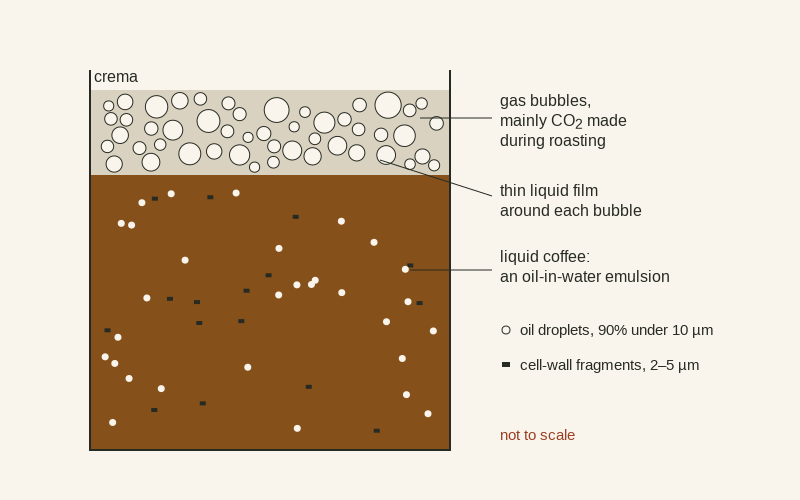
A schematic, not to scale. The labels follow a 2020 study's description of espresso foam: gas bubbles, mainly carbon dioxide made during roasting, each wrapped in a thin liquid film, above a liquid that carries tiny oil droplets and fragments of coffee cell walls. The droplet and fragment sizes are earlier measurements that the study cites.
"What espresso crema is made of (not to scale)" by Molecule & Menu, https://moleculeandmenu.com/roast-and-steep/espresso-crema/, licensed under CC BY 4.0 (https://creativecommons.org/licenses/by/4.0/)
Data: Description from Angeloni G. et al., Foods 9(12):1825 (2020), CC BY 4.0, retrieved 2026-11-13, with droplet and fragment sizes from earlier measurements that paper cites; drawing is a schematic, not to scale
This page follows that gas from the roaster to the cup. It then turns to a 2020 experiment that timed foams made with six different gases, where the carbon dioxide and nitrous oxide foams broke up fastest.
What is espresso crema made of?
The word crema sits inside a common definition of espresso itself. A 2021 review of espresso aroma, published in the journal Molecules, quotes a typical definition: “a concentrated polyphasic beverage with a characteristic foam layer (crema) on the surface, prepared by forcing hot water (90 ± 5 °C) under pressure (9 ± 2 bar) into a tamped R&G coffee (called coffee cake) for a short period of time (30 ± 5 s).” R&G means roasted and ground. Polyphasic means the drink is made of several distinct parts at once: a watery liquid, tiny oil droplets, gas bubbles and fine solids.
The same review reports a stricter set of numbers. For a Certified Italian Espresso, it lists water leaving the machine at 90 ± 2 °C, an entry water pressure of 9 ± 1 bar and a percolation time of 25 ± 2.5 s. Percolation is the water's passage through the bed of coffee. The review gives these as the specification of the Italian Espresso National Institute.
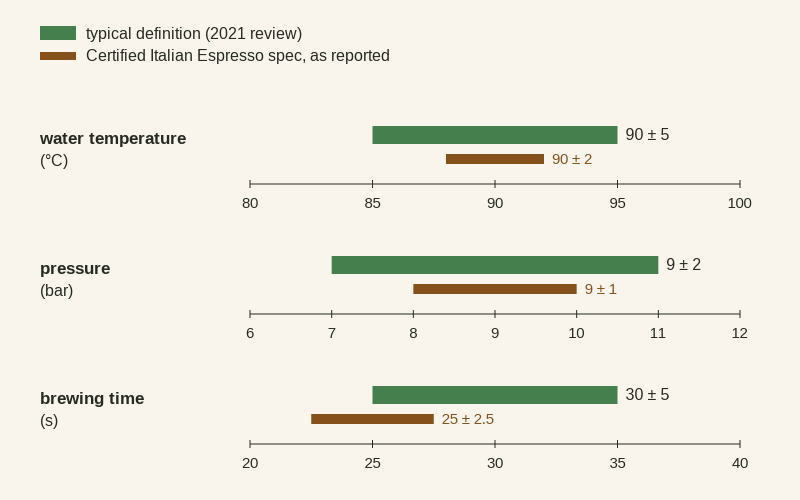
Ranges as printed in a 2021 review: its typical definition of espresso, and the Certified Italian Espresso specification it reports. Both are definitions, not measurements of any one cup.
"Espresso brewing ranges: a typical definition and a certification specification" by Molecule & Menu, https://moleculeandmenu.com/roast-and-steep/espresso-crema/, licensed under CC BY 4.0 (https://creativecommons.org/licenses/by/4.0/)
Data: Ranges from Angeloni S. et al., Molecules 26(13):3856 (2021), doi:10.3390/molecules26133856, CC BY 4.0, retrieved 2026-11-13
| Condition | Typical definition (2021 review) | Certified Italian Espresso (as the review reports it) |
|---|---|---|
| Water temperature | 90 ± 5 °C | 90 ± 2 °C, water leaving the machine |
| Pressure | 9 ± 2 bar | 9 ± 1 bar, water entering |
| Brewing time | 30 ± 5 s | 25 ± 2.5 s, percolation |
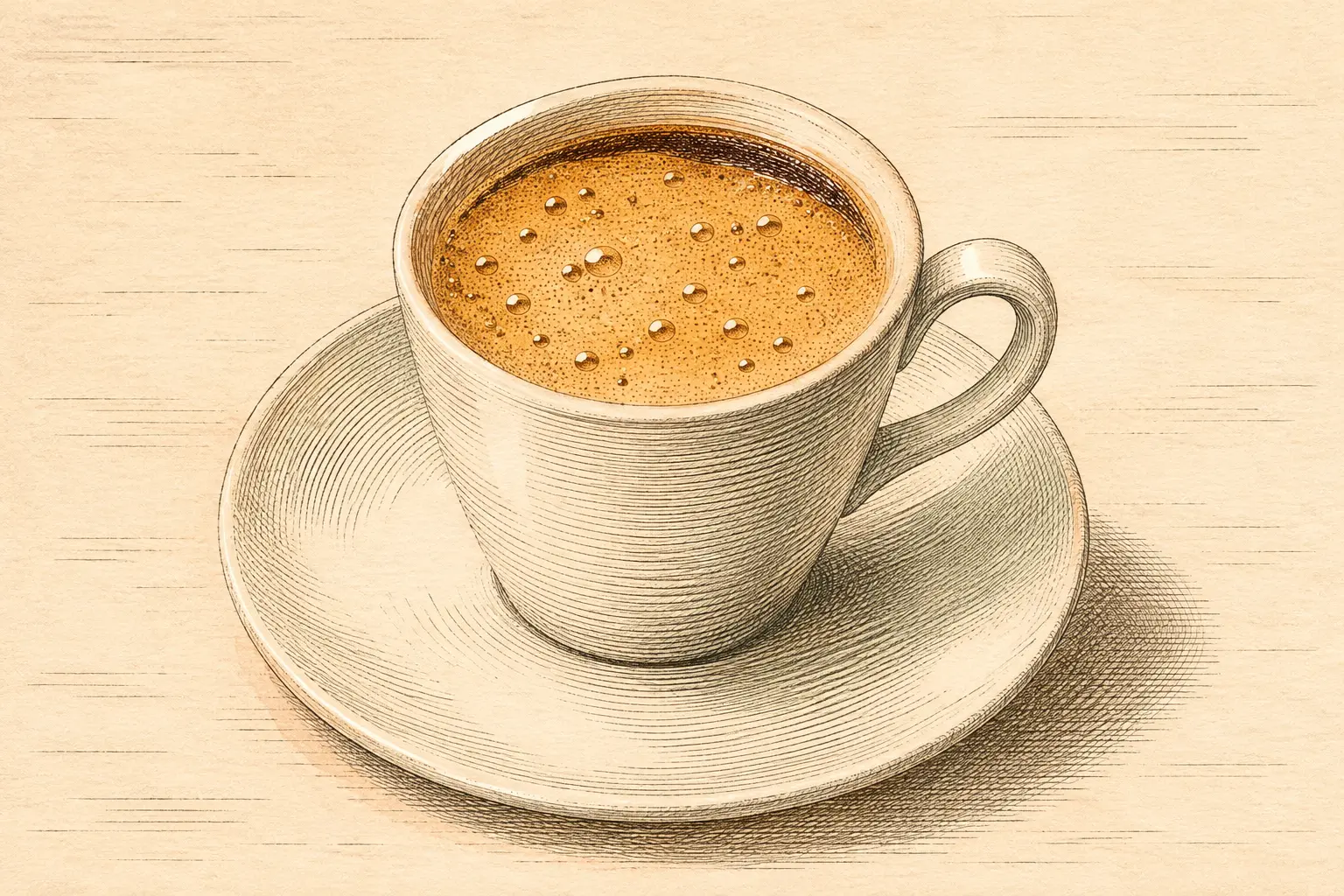
An illustration of espresso crema: the tan foam that covers the coffee is made of gas bubbles, mainly carbon dioxide from the roast.
Illustration: Molecule & Menu. Generated schematic illustration — not a photograph or historical record. Reuse: CC BY 4.0 (https://creativecommons.org/licenses/by/4.0/), to the extent Molecule & Menu holds rights in this image.
A 2020 study of espresso foam, published in the journal Foods, describes what the foam is built from. A foam is gas bubbles spread through a liquid. In crema, each bubble is wrapped in a lamella, a thin liquid film that holds large molecules and natural surfactants, compounds that gather at the surface of a film.
The liquid under and between the bubbles is an emulsion of oil in water. Citing earlier measurements, the 2020 study puts 90% of the oil droplets under 10 µm across, and the fragments of coffee cell walls at 2–5 µm. The study notes fine particles and microscopic oil droplets in the foam layer as well. Oil is part of crema, then, as tiny droplets, but the bubbles that make the foam hold gas.
Where does the gas in crema come from?
The gas starts in the roaster, not in the espresso machine. The 2020 study in Foods states that in espresso, “the gas phase mainly consists of carbon dioxide generated during roasting and trapped within the cell structure.” A roasted bean carries its own supply of gas into the grinder and the machine.
The same heat that makes this gas builds the bean's aroma. The page on pyrazines follows the roasty-smelling molecules that form in the roaster. Before any of that, the green bean has already left its fruit through one of the methods on the coffee processing page.
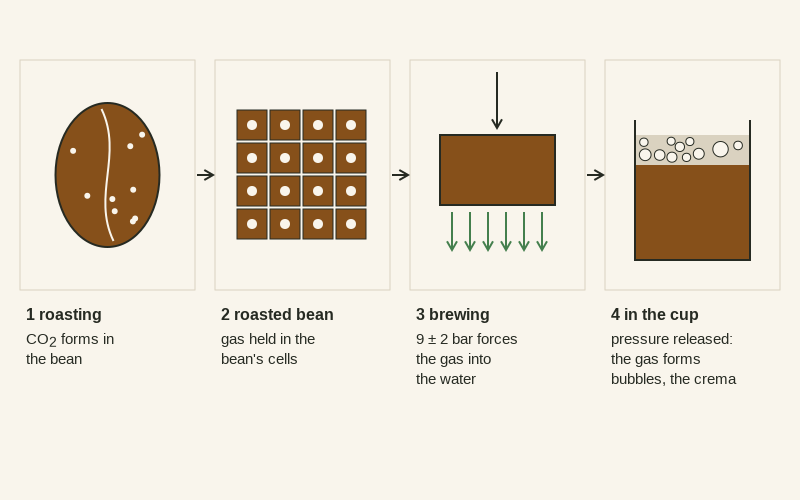
The path of the gas as the two papers describe it: carbon dioxide forms during roasting, stays in the bean's cells, is forced into the water under pressure and leaves it as bubbles. A schematic, not to scale.
"The gas in crema, from the roaster to the cup" by Molecule & Menu, https://moleculeandmenu.com/roast-and-steep/espresso-crema/, licensed under CC BY 4.0 (https://creativecommons.org/licenses/by/4.0/)
Data: Concept from Angeloni G. et al., Foods 9(12):1825 (2020), CC BY 4.0, and Angeloni S. et al., Molecules 26(13):3856 (2021), CC BY 4.0; retrieved 2026-11-13
The papers read for this page do not say how much gas a bean holds or how fast it escapes after roasting, so this page gives no figure for either. The 2020 study handled freshness in its own way. Each 250 g packet of beans was opened just before brewing, and the ground coffee was tested at once.
How does brewing pressure make the foam?
The 2021 review names three features that set espresso apart: it is made to order, it brews fast, and it uses pressure. Pressure, the review explains, is what pushes water through the packed coffee. It also makes the foam.
On that point the review is direct: “Pressure is also responsible for foam and crema formation. In fact, the carbon dioxide in coffee is forced into the water by the pressure and, when released, it forms the typical crema above the coffee.” Citing earlier studies, the review adds that espresso made at 9 bar has a high foam consistency, a measure of how firm the foam is.
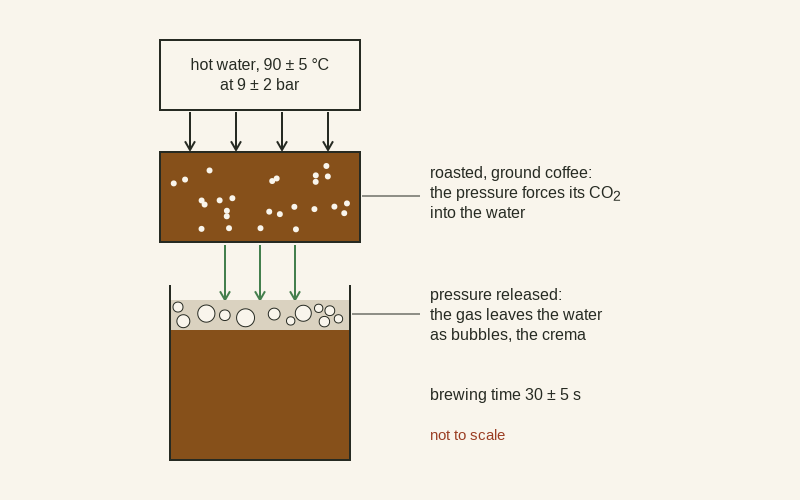
Pressure does two jobs here. It drives hot water through the bed of coffee and, as the 2021 review explains, forces the coffee's carbon dioxide into that water. Once the pressure is released, the gas comes out as bubbles. A schematic, not to scale.
"What brewing pressure does to the gas in coffee (not to scale)" by Molecule & Menu, https://moleculeandmenu.com/roast-and-steep/espresso-crema/, licensed under CC BY 4.0 (https://creativecommons.org/licenses/by/4.0/)
Data: Mechanism and values from Angeloni S. et al., Molecules 26(13):3856 (2021), CC BY 4.0, retrieved 2026-11-13; drawing is a schematic, not to scale
Call the brewing pressure the invisible ingredient of crema. No recipe lists it beside the coffee and the water. Yet the review's definition sets it at 9 ± 2 bar, and the review credits it with forming the foam. The beans supply the gas, and the pressure puts that gas into the water.
The review also sketches a short history of pressure brewing. It credits a design by Angelo Moriondo of Turin, in 1885, as the first machine to use pressure.
According to the same 2021 review, Achille Gaggia registered a patent in 1947 for a lever-operated piston that drove water from the boiler into the coffee. The review says the higher pressure this allowed produced a crema on the surface of the drink for the first time, and that the drink was called crema caffè, or cream coffee. This page did not read the patent itself.
Why does crema fade?
A crema breaks up with time. The 2020 study gives a general benchmark: coffee specialists expect the foam to fill at least 10% of the volume and to last at least two minutes before it breaks up to show the liquid below. The study credits the 10% figure to a 1995 book on espresso but names no source for the two minutes.
That study then timed foams made with different gases. It used Caffè Firenze, a brewing method in which the coffee is extracted in a sealed chamber pressurized with gas, here at 20 bar. The team brewed the same batch of Arabica coffee with six gases: air, argon, nitrogen, carbon dioxide, nitrous oxide and a 70:30 mix of carbon dioxide and nitrogen. Each gas was tested five times.
Persistence was the time before the foam broke up and left an uncovered black spot on the surface. The carbon dioxide and nitrous oxide foams lasted under 90 seconds. Air, argon and nitrogen foams lasted over 8 hours. The mix fell between them, at 15–18 minutes in the study's table.
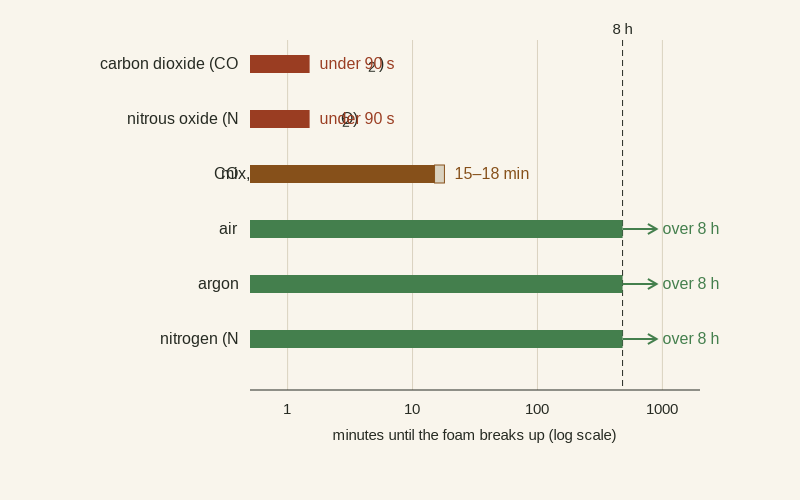
Foam persistence in a 2020 test of six gases in a sealed chamber at 20 bar, with one batch of Arabica coffee. The bars for carbon dioxide and nitrous oxide show an upper limit and those for air, argon and nitrogen a lower limit; the paper's table gives <2 min and >480 min.
"How long espresso foams lasted with six working gases, in a 2020 test" by Molecule & Menu, https://moleculeandmenu.com/roast-and-steep/espresso-crema/, licensed under CC BY 4.0 (https://creativecommons.org/licenses/by/4.0/)
Data: Values from Angeloni G. et al., Physical and Chemical Effects of Different Working Gases in Coffee Brewing: A Case Study of Caffè Firenze, Foods 9(12):1825 (2020), doi:10.3390/foods9121825, CC BY 4.0, retrieved 2026-11-13
| Gas in the chamber | Foam index at 30 s (mean) | Foam index at 2 min (mean) | Sugar test (mean) | Foam persistence |
|---|---|---|---|---|
| Carbon dioxide | 76.1% | not detected | 2.45 s | under 90 s (table: <2 min) |
| Nitrous oxide | 78.8% | not detected | 2.64 s | under 90 s (table: <2 min) |
| CO2/N2 mix, 70:30 | 88.8% | 13.3% | 2.72 s | 15–18 min (table only) |
| Air | 60.4% | 32.2% | 22.42 s | over 8 h (table: >480 min) |
| Argon | 50.2% | 34.0% | 23.28 s | over 8 h (table: >480 min) |
| Nitrogen | 40.2% | 28.2% | 6.71 s | over 8 h (table: >480 min) |
Download the espresso and foam values (CSV) (source and license notes) Data: Angeloni S. et al., Characterization of the Aroma Profile and Main Key Odorants of Espresso Coffee, Molecules 26(13):3856 (2021), CC BY 4.0; Angeloni G. et al., Physical and Chemical Effects of Different Working Gases in Coffee Brewing: A Case Study of Caffè Firenze, Foods 9(12):1825 (2020), CC BY 4.0; retrieved 2026-11-13
The foam index in that table is the ratio of foam to liquid, as a percentage. The gases that foamed most at 30 seconds tended to last least: the study reports a negative correlation (R = −0.8) between the 30-second foam index and persistence. Two minutes after brewing, the table records no foam at all for carbon dioxide or nitrous oxide.
The study links the difference to how well each gas dissolves in water. In a foam, gas moves through the liquid films between bubbles, so some bubbles grow while others shrink, a process called coarsening. Carbon dioxide and nitrous oxide dissolve readily in water, while nitrogen and argon dissolve much less. In the carbon dioxide and mixed-gas foams, the team measured some bubbles at ten times the diameter of the others.
How firm were the foams?
The same study also tested how firm each foam was, with a simple sugar test. One gram of granulated sugar was poured through a funnel from 10 cm onto the foam, and a stopwatch timed how long it stayed on top. On average, the sugar stayed about 22 to 23 seconds on the air and argon foams, 6.71 seconds on the nitrogen foam, and under 3 seconds on the carbon dioxide, nitrous oxide and mixed-gas foams. The paper gives these sugar-test averages as coming from six independent extractions, although its methods section lists five replicates per gas.
Those short times were taken one minute after brewing, when the foams were already disappearing. The study compares its results with an earlier report that put the foam consistency of espresso at 0.5–10 seconds. The air and argon foams held the sugar far longer than that, while the nitrogen foam fell within the range.
Does the foam hold in aroma?
Citing earlier work, the 2021 review says the aroma of espresso can come mainly from the surface foam, which can trap volatile aroma compounds and release them into the air a little at a time. The 2020 study measured volatile compounds in the air above each sample for 15 minutes. The readings rose least with the argon foam, which the authors took as a sign that argon was best at keeping those compounds in.
These test foams were not ordinary crema. The gas was fed into a sealed chamber at 20 bar rather than coming only from the beans, and the study itself calls the method substantially different from the usual commercial way of brewing. The result shows how carbon dioxide foams behaved in that device, but it does not measure how long the crema on an ordinary espresso lasts.
Questions about espresso crema
Is crema made of oil?
Not mainly. The bubbles of crema hold gas, mainly carbon dioxide made during roasting, according to a 2020 study in Foods. Oil is present as microscopic droplets in the liquid, 90% of them under 10 µm across in the earlier measurements that study cites, and the study notes oil droplets in the foam layer as well.
What pressure is used to make espresso crema?
A typical definition quoted in a 2021 review gives 9 ± 2 bar, with water at 90 ± 5 °C for 30 ± 5 s. The same review says the pressure forces the carbon dioxide in coffee into the water, and that the gas forms the crema once the pressure is released.
How long does espresso crema last?
A 2020 study says coffee specialists generally expect crema to last at least two minutes, without naming a source for that figure. In that study's own tests with a sealed, gas-pressurized brewer at 20 bar, carbon dioxide foams broke up in under 90 seconds, while air foams lasted over 8 hours. Those tests do not time the crema of an ordinary espresso.
Sources
- Angeloni, S., Mustafa, A. M., Abouelenein, D., Alessandroni, L., Acquaticci, L., Nzekoue, F. K., Petrelli, R., Sagratini, G., Vittori, S., Torregiani, E., & Caprioli, G. (2021). Characterization of the aroma profile and main key odorants of espresso coffee. Molecules, 26(13), 3856. https://doi.org/10.3390/molecules26133856 https://pmc.ncbi.nlm.nih.gov/articles/PMC8270317/Read: full text.
- Angeloni, G., Masella, P., Guerrini, L., Spadi, A., Bellumori, M., Innocenti, M., & Parenti, A. (2020). Physical and chemical effects of different working gases in coffee brewing: A case study of Caffè Firenze. Foods, 9(12), 1825. https://doi.org/10.3390/foods9121825 https://pmc.ncbi.nlm.nih.gov/articles/PMC7762973/Read: full text.
Cite this page
“Espresso Crema: The Foam Comes From Gas Made in Roasting.” Molecule & Menu. Published November 14, 2026. https://moleculeandmenu.com/roast-and-steep/espresso-crema/. Accessed on the date you read it.
How pages here are checked · All corrections · Report an error on this page (contact@moleculeandmenu.com)
Second helping:
- Why does bread rise: Another pocket of trapped CO2, set into crumb by the oven instead of held as foam on top of a cup.
- Swiss Water Process: Caffeine leaves the green bean before the roast, so decaf beans go through the same roaster that makes the gas for crema.
More from Roast & Steep
Roast & Steep
Coffee Processing: Washed Coffee Is Fermented, Too
Washed coffee sits in closed containers for 12 to 72 hours in one 2024 review's figures. How washed, natural and honey processing differ, layer by layer.
Picture credit
"Coffea arabica, plate 106 of Köhler's Medizinal-Pflanzen" by Franz Eugen Köhler, Köhler's Medizinal-Pflanzen — https://commons.wikimedia.org/wiki/File:Coffea_arabica_-_K%C3%B6hler%E2%80%93s_Medizinal-Pflanzen-189.jpg — Public domain (Public domain in the US (Köhler's Medizinal-Pflanzen, published in Germany in 1887-1898, before 1931) and in the EU (Commons tags the plate PD-old, life plus 70 years, and marks it with the Public Domain Mark; this basis rests on those two tags and the 1887-1898 publication, not on any artist's or editor's death year))
Roast & Steep
Swiss Water Process: Decaf Is Made Before the Roast
Decaf loses its caffeine as a green bean, before roasting. How the Swiss Water process and solvent and CO2 methods work, per two 2025 papers.
Picture credit (illustration)
Illustration: Molecule & Menu. Generated schematic illustration — not a photograph or historical record. Reuse: CC BY 4.0 (https://creativecommons.org/licenses/by/4.0/), to the extent Molecule & Menu holds rights in this image.
Roast & Steep
Pyrazines: Roasting Builds Part of Coffee’s Roasty Smell
Pyrazines form as coffee roasts. One, 2,3,5-trimethylpyrazine, is put at 1 to 6.7 mg/kg in coffee and about 50 ng per liter of air to smell, per earlier work.
Picture credit
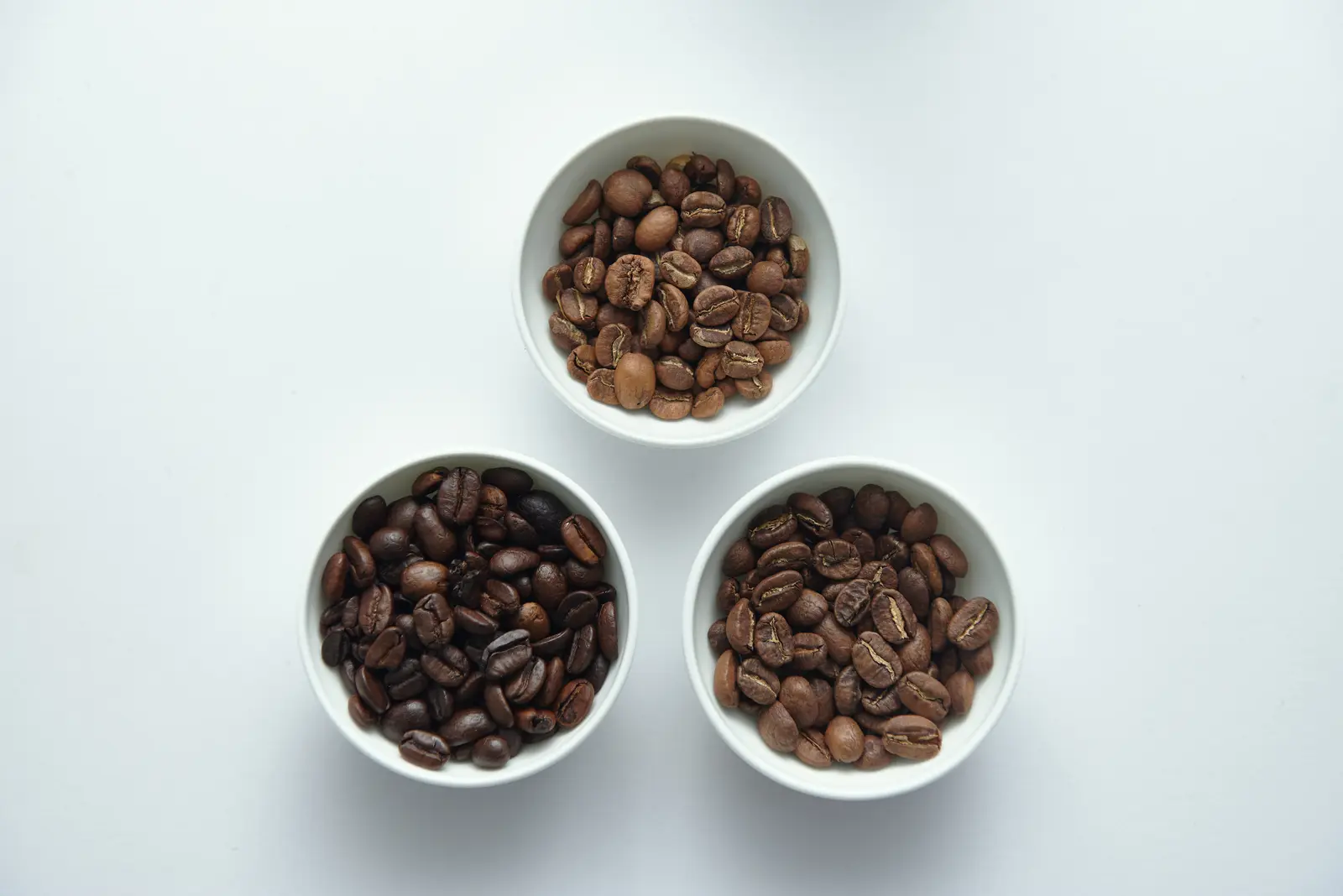
"15 grams of coffee roasted to different degrees" by Alorin — https://commons.wikimedia.org/wiki/File:15_grams_of_coffee_roasted_to_different_degrees.jpg — CC BY 4.0 (https://creativecommons.org/licenses/by/4.0/)