Swiss Water Process: Decaf Is Made Before the Roast
Short answer
Decaf coffee loses its caffeine while it is still a green, unroasted bean. A 2025 modeling paper by Bawornruttanaboonya and colleagues notes that taking caffeine out of green coffee beans “prior to roasting has long been conducted.” A 2025 review by Ran and colleagues describes the Swiss Water process as drawing caffeine out of green beans by “selective diffusion using pure water.” The two papers give different ceilings for that process, up to 99% in the review and up to 99.9% in the modeling paper, and both stop short of 100%.
Course list · 6 sections
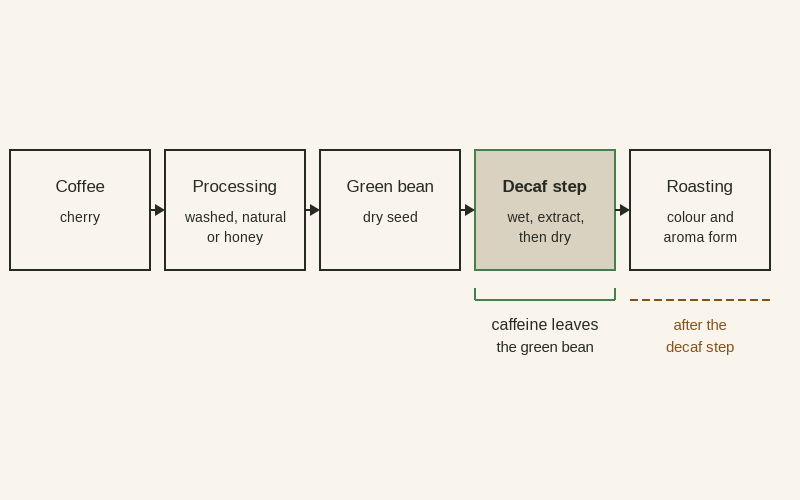
Where the decaf step sits between the farm and the roaster. The diagram shows the order of steps only, not how long each one takes.
"Where decaffeination sits: before the roast" by Molecule & Menu, https://moleculeandmenu.com/roast-and-steep/swiss-water-process-decaf/, licensed under CC BY 4.0 (https://creativecommons.org/licenses/by/4.0/)
Data: Bawornruttanaboonya et al., Foods 14(11):1956 (2025), CC BY 4.0; Ran et al., Foods 14(15):2606 (2025), CC BY 4.0; both retrieved 2026-11-13
A decaf bean has been wetted and stripped of most of its caffeine before any roaster sees it. Every extraction method in the two 2025 papers works on green coffee. The methods differ in what carries the caffeine out.
Decaf starts with green beans
A green bean is the dry seed left after coffee processing has taken the fruit away. Decaffeination is a second process applied to that seed. The 2025 paper lists the main routes in one sentence: organic solvents such as dichloromethane and ethyl acetate, supercritical carbon dioxide, and water.
Even the early solvent routes began with water, as steam. According to the 2025 review, early efforts to decaffeinate coffee were ineffective “until the use of steam on green coffee beans was discovered.” Steam raised the beans' moisture content and internal surface area. That made extraction with organic solvents work better.
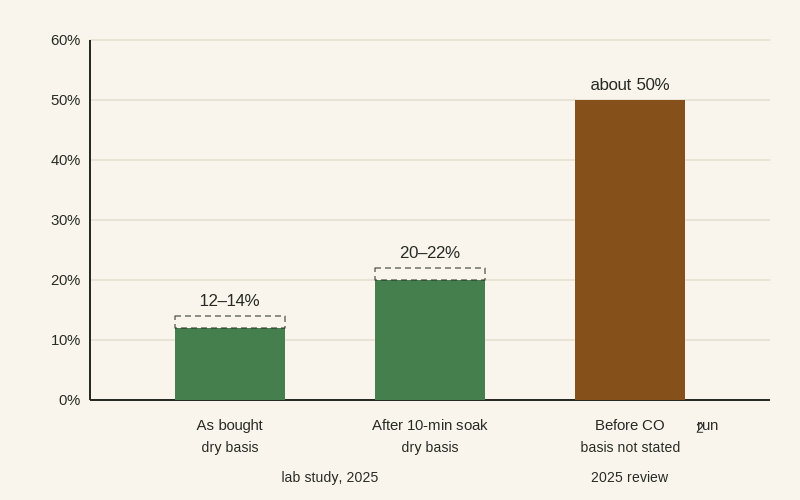
Moisture before extraction. The first two bars come from the laboratory work in a 2025 paper and are on a dry basis; the third is the pre-moistened level a 2025 review gives for supercritical carbon dioxide, with no basis stated.
"Green bean moisture before caffeine extraction" by Molecule & Menu, https://moleculeandmenu.com/roast-and-steep/swiss-water-process-decaf/, licensed under CC BY 4.0 (https://creativecommons.org/licenses/by/4.0/)
Data: Bawornruttanaboonya et al., Foods 14(11):1956 (2025), CC BY 4.0; Ran et al., Foods 14(15):2606 (2025), CC BY 4.0; both retrieved 2026-11-13
The laboratory numbers show how much a short soak changes a bean. The 2025 paper used robusta beans, which its authors note are known to contain more caffeine than arabica, and those green beans arrived at 12–14% moisture on a dry basis. After 10 minutes in water at a bean-to-water ratio of about 1:2, they held 20–22%, and the authors soaked them “to soften the bean structure” before extraction. For supercritical carbon dioxide, the 2025 review gives a much wetter starting point: beans pre-moistened to around 50%.
Roasting comes only after all of this. The browning and the roast aromas, such as the pyrazines, form later in the roaster, from a bean that has already lost most of its caffeine.
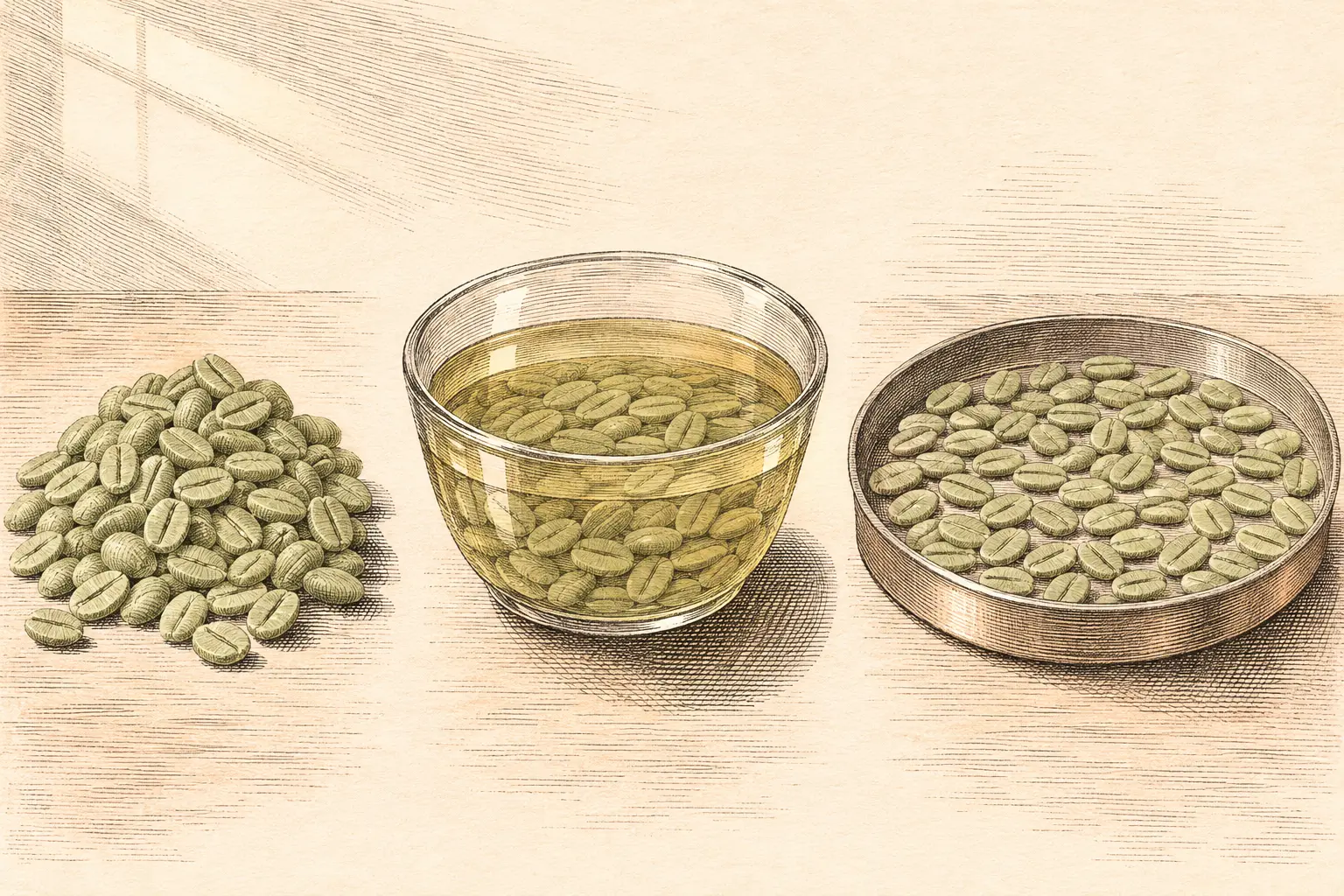
An illustration of decaffeination as a step on green beans: the beans are wetted and the caffeine is drawn out before any roasting.
Illustration: Molecule & Menu. Generated schematic illustration — not a photograph or historical record. Reuse: CC BY 4.0 (https://creativecommons.org/licenses/by/4.0/), to the extent Molecule & Menu holds rights in this image.
Four ways to pull caffeine out
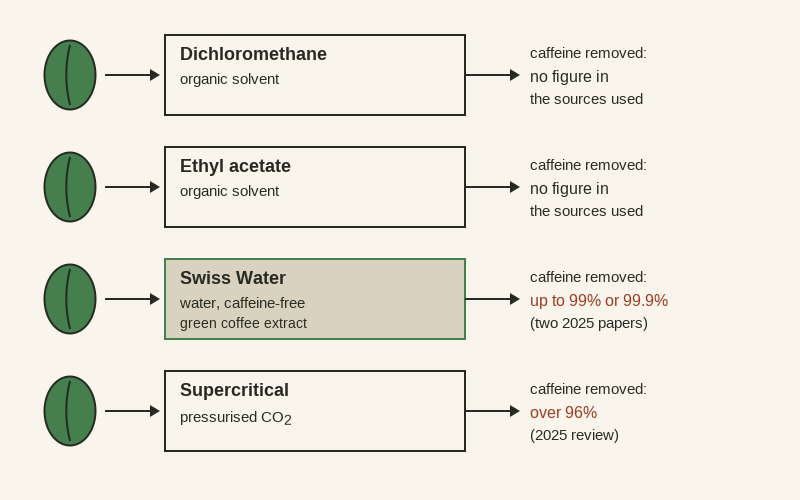
Four decaf methods side by side. The removal figures are the ones reported in two 2025 papers; neither paper gives a figure for the two organic solvents.
"Four decaf methods and their reported removal figures" by Molecule & Menu, https://moleculeandmenu.com/roast-and-steep/swiss-water-process-decaf/, licensed under CC BY 4.0 (https://creativecommons.org/licenses/by/4.0/)
Data: Ran et al., Foods 14(15):2606 (2025), CC BY 4.0; Bawornruttanaboonya et al., Foods 14(11):1956 (2025), CC BY 4.0; both retrieved 2026-11-13
The table below sets the four methods against what each source says about them. A blank removal figure means the sources read for this page give none, not that the method fails.
| Method | What carries the caffeine out | Removal figure reported | Source |
|---|---|---|---|
| Dichloromethane (methylene chloride) | An organic solvent | None given | Ran et al. 2025; Bawornruttanaboonya et al. 2025 |
| Ethyl acetate | An organic solvent | None given | Ran et al. 2025; Bawornruttanaboonya et al. 2025 |
| Swiss Water process | Water, as a caffeine-free green coffee extract | Up to 99% (2025 review); up to 99.9% (2025 paper) | Ran et al. 2025; Bawornruttanaboonya et al. 2025 |
| Supercritical carbon dioxide | Carbon dioxide under pressure, on pre-moistened beans | Over 96% (2025 review) | Ran et al. 2025 |
Download the decaf methods table (CSV) (source and license notes) Data: Ran et al. 2025, Foods 14:2606, CC BY 4.0, https://pmc.ncbi.nlm.nih.gov/articles/PMC12346622/; Bawornruttanaboonya et al. 2025, Foods 14:1956, CC BY 4.0, https://pmc.ncbi.nlm.nih.gov/articles/PMC12155289/; 21 CFR part 173 (2024 edition), US government work, https://www.govinfo.gov/content/pkg/CFR-2024-title21-vol3/pdf/CFR-2024-title21-vol3-part173.pdf; Directive 1999/4/EC, contains public sector information licensed under the Open Government Licence v3.0, https://www.legislation.gov.uk/eudr/1999/4/body/2020-12-31
Each method trades something away, according to the same sources. The 2025 paper says beans lose aroma and flavor compounds during organic solvent extraction. It calls supercritical extraction very costly, and the review adds that it needs specialized high-pressure equipment. Water, the paper says, has lower efficiency than the other methods, and the extraction time is very long.
In the supercritical route the 2025 review describes, carbon dioxide circulates through the moistened beans at supercritical conditions. The caffeine it picks up is either held on activated carbon or washed out with water. The beans are dried at the end.
What the Swiss Water process does
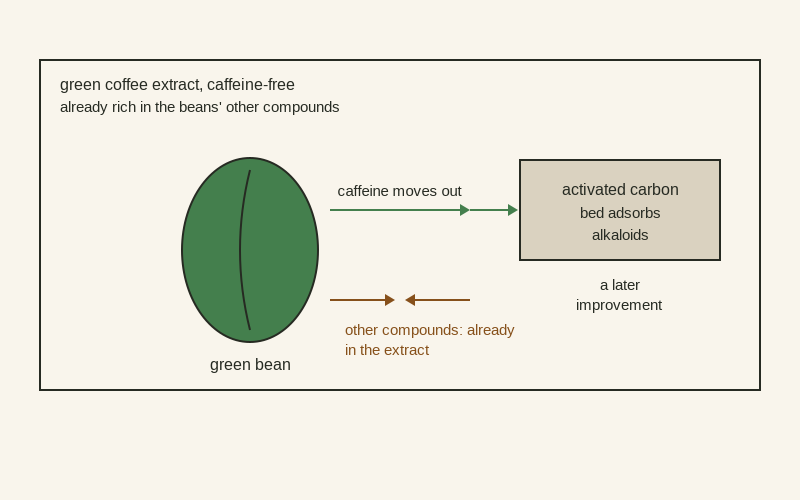
The Swiss Water process as a 2025 review describes it, schematic and not to scale. The review describes the extract as rich in the beans' other compounds and calls the movement selective diffusion; the carbon bed is the improvement it mentions.
"The Swiss Water process as selective diffusion (schematic)" by Molecule & Menu, https://moleculeandmenu.com/roast-and-steep/swiss-water-process-decaf/, licensed under CC BY 4.0 (https://creativecommons.org/licenses/by/4.0/)
Data: Ran et al., Foods 14(15):2606 (2025), CC BY 4.0, retrieved 2026-11-13
The 2025 review describes the process in three parts:
- Soak. Green beans go into a caffeine-free green coffee extract that is rich in the beans' other compounds.
- Diffuse. Caffeine moves out of the beans into the extract. The review calls this selective diffusion and says the beans soak in that extract “to facilitate the diffusion-driven decaffeination process.”
- Strip the caffeine. In an improved version, the review says, custom-designed activated carbon beds, preloaded with coffee extract or sucrose solutions, “selectively adsorb alkaloids,” the group of compounds that includes caffeine.
The same review is not consistent about how selective the method is. Its section on production methods says the process preserves “the original flavor profile of the beans.” A later section says the water-based method “lacks selectivity and often extracts other compounds along with caffeine.” This page reports both statements rather than choosing one.
In a paragraph on hot-water decaffeination of tea, the same review also calls water “a non-selective solvent that often co-extracts other compounds along with caffeine.” A pre-loaded extract may be a way around that problem. That link is this page's reading, not a claim in the review.
The brand name in the title is used here only as the name of the method. The 2025 paper calls it “the patented Swiss Water process” and says it “uses only water to remove up to 99.9% of caffeine in green coffee beans.”
The two removal figures come from different trails. For 99.9%, the 2025 paper cites a 1993 US patent, No. 5,208,056, titled Process for Decaffeinating Raw Coffee. For 99%, the review cites a 2023 study of aroma compounds in decaffeinated beans, published in a Korean food-preservation journal. Neither paper reports its own measurement of the Swiss Water process.
Why water is slow
Caffeine dissolves in water. That is why water works at all. The 2025 paper, citing earlier measurements, says its solubility in water increases with temperature and puts it at about 6.97 g per 100 mL at 50 °C.
Hotter water still has limits. The authors report that above 80 °C, water evaporated too fast in their trials and the beans turned paler and softer. They settled on 70 °C for their model of plain hot-water extraction from whole green robusta beans.
That model shows why water extraction takes so long:
- Fast start. Caffeine left the beans fastest in the first 4 hours, while the gap in concentration between bean and water was large.
- Slow middle. The rate then fell, because the gap narrowed and the remaining caffeine had farther to travel from the center of the bean.
- Early stop. Without fresh water, the bean and the water reached equilibrium too early and extraction stalled.
More water and more heat helped only up to a point. In the ultrasound version of the model, going from three to four times as much water as bean (a bean-to-water ratio of 1:3 versus 1:4) changed the caffeine left in the bean by around 5% at most. Going from 70 °C to 80 °C left the 12-hour result unchanged. The authors read that as equilibrium already reached.
Changing the water every hour kept the gap open. The paper's main subject was a faster variant: ultrasound in the water bath. In the model, ultrasound-assisted extraction removed caffeine at rates around 10% higher than plain hot water at every temperature tested, which the authors attribute to collapsing microbubbles that disrupt the bean surface.
Fresh water and a caffeine-free extract, as in the Swiss Water description, both keep the bean's caffeine facing a liquid that holds little of it; that link is this page's reading of the two papers, not a claim made in either.
The early solvents
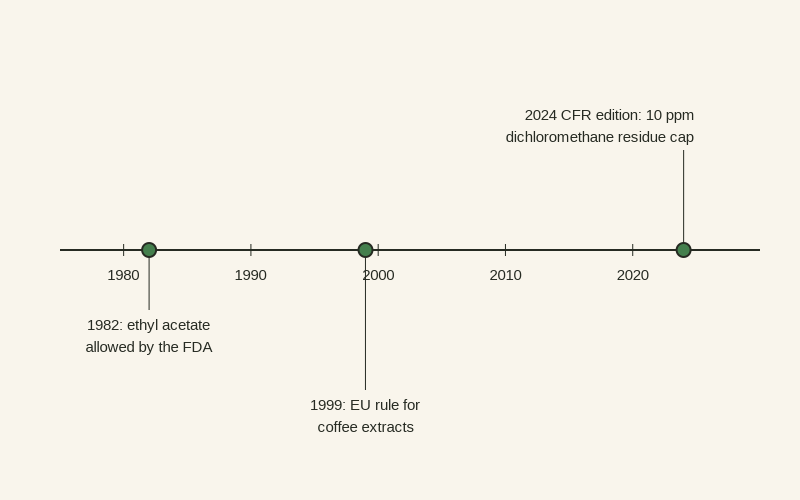
Dates for decaf that the sources on this page support. The steam step is undated in the 2025 review and is not placed on the line.
"Decaf dates supported by the sources on this page" by Molecule & Menu, https://moleculeandmenu.com/roast-and-steep/swiss-water-process-decaf/, licensed under CC BY 4.0 (https://creativecommons.org/licenses/by/4.0/)
The 2025 review lists the chemicals that decaffeination used at first, grouping all of them as organic solvents: dichloromethane, benzene, chloroform, ether, trichloroethylene, carbon tetrachloride, acetone, ammonium hydroxide and sulfuric acid. It gives no dates for when each one was used or dropped.
Two US rules in the 1 April 2024 edition of the Code of Federal Regulations cover these solvents:
- Dichloromethane. Under 21 CFR 173.255(c), in the 1 April 2024 edition, methylene chloride (another name for dichloromethane) may remain in decaffeinated roasted coffee and decaffeinated instant coffee “at a level not to exceed 10 parts per million (0.001 percent).”
- Ethyl acetate. Under 21 CFR 173.228(b), ethyl acetate may be used “as a solvent in the decaffeination of coffee and tea.” The section's source note cites a Federal Register notice of 5 January 1982.
The 1982 date matches the 2025 review, which says the FDA has approved ethyl acetate as a primary decaf solvent since that year. The review adds that ethyl acetate occurs naturally in many fruits. Neither rule says how much caffeine must come out. One says where a solvent may be used, and the other caps what is left.
Routes that skip the extraction tank
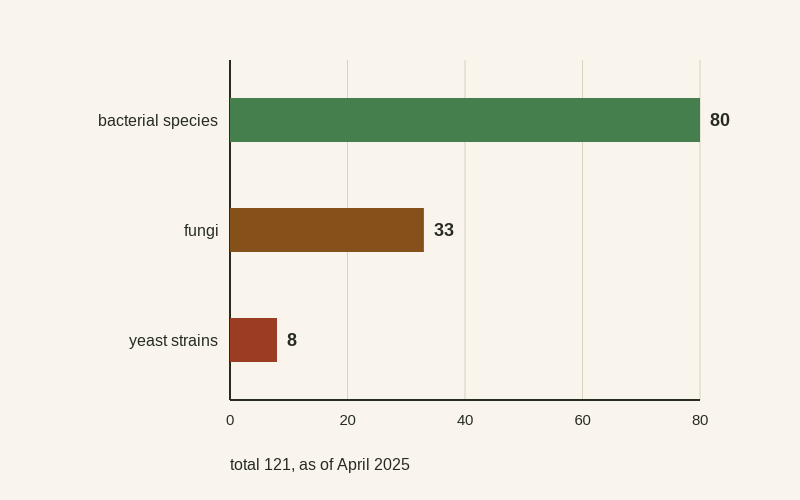
Microorganisms reported to break down caffeine, as counted in a 2025 review from the literature and earlier statistics. The review says these organisms are used mainly in tea fermentation so far, not in coffee bean fermentation.
"Microorganisms reported to degrade caffeine, as of April 2025" by Molecule & Menu, https://moleculeandmenu.com/roast-and-steep/swiss-water-process-decaf/, licensed under CC BY 4.0 (https://creativecommons.org/licenses/by/4.0/)
Data: Ran et al., Foods 14(15):2606 (2025), CC BY 4.0, retrieved 2026-11-13
Every method above starts with ordinary, caffeinated beans and takes caffeine out. The 2025 review also covers two ways around that step. By the review's account, neither is in large-scale use for coffee.
The first is a bean that makes less caffeine to begin with. Alkaloid profiling cited in the review found that, apart from the mutant cultivar Laurina, most coffee varieties hold between 1% and 1.3% caffeine. Laurina is naturally low in caffeine but has low yield potential. A survey of more than 700 Ethiopian coffees found three genotypes at about 0.07% caffeine, and the review says they were not productive enough to farm, while crossing the trait into high-yielding Coffea arabica and Coffea canephora ran into genetic incompatibility.
The second is to let microbes break caffeine down during fermentation, the review's own subject. It counts 121 microorganisms with caffeine-degrading ability identified as of April 2025: 80 bacterial species, 33 fungi and 8 yeast strains. Microbial fermentation is already part of washed and natural coffee processing, but the review describes adding caffeine-degrading strains to it as a research direction, not a working method.
Is decaf caffeine-free?
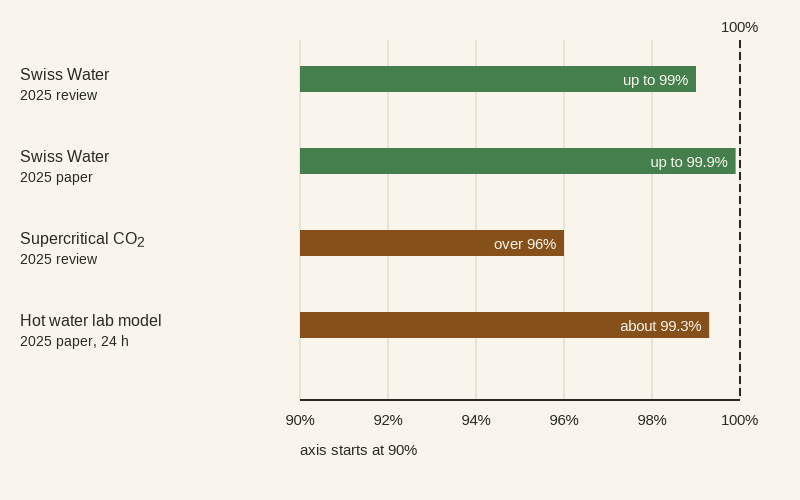
Removal figures as reported in two 2025 papers. The horizontal axis starts at 90%; the dashed line marks 100%, which none of the figures reaches. The supercritical carbon dioxide figure is a lower bound.
"Reported caffeine removal figures for decaf methods" by Molecule & Menu, https://moleculeandmenu.com/roast-and-steep/swiss-water-process-decaf/, licensed under CC BY 4.0 (https://creativecommons.org/licenses/by/4.0/)
Data: Ran et al., Foods 14(15):2606 (2025), CC BY 4.0; Bawornruttanaboonya et al., Foods 14(11):1956 (2025), CC BY 4.0; both retrieved 2026-11-13
No. Neither 2025 paper reports complete removal for any method:
- Swiss Water process: up to 99% in the 2025 review, and up to 99.9% in the 2025 paper. “Up to” marks a ceiling, not a typical result.
- Supercritical carbon dioxide: over 96%, per the 2025 review. “Over” marks a floor, not a ceiling.
- Plain hot water, in a model: about 99.3% after 24 hours at 70 °C with the water changed every hour, per the 2025 paper's simulation. Complete removal did not occur.
Even at the 99% ceiling, at least 1% of the bean's original caffeine stays in it, by this page's arithmetic.
The last fraction is the slowest to remove. In the 2025 paper's model of ultrasound-assisted extraction, raising removal from 99.0% to 99.9% took 33% of the total extraction time. That model describes ultrasound in plain water, not the Swiss Water process.
Labeling rules set their own thresholds. They do not all cover the same products. Directive 1999/4/EC allows a coffee extract to carry the word decaffeinated only if its anhydrous caffeine is no more than 0.3% by weight of the coffee-based dry matter. The directive defines coffee extract as the concentrated product made from roasted beans “using only water as the medium of extraction,” sold as soluble or instant coffee.
That 0.3% rule therefore applies to coffee extracts such as instant coffee, not to roasted decaf beans. This page found no limit for roasted decaf beans in that directive.
Sources
- Ran LX, Wei XY, Ren EF, Qin JF, Rasheed U, Chen GL. Application of Microbial Fermentation in Caffeine Degradation and Flavor Modulation of Coffee Beans. Foods. 2025;14(15):2606. doi:10.3390/foods14152606 https://pmc.ncbi.nlm.nih.gov/articles/PMC12346622/Read: full text; sections 1, 3.1, 3.2, 4 and 4.1 used. License: CC BY 4.0.
- Bawornruttanaboonya K, Chindapan N, Devahastin S. Numerical Investigation of Conventional and Ultrasound-Assisted Aqueous Extraction of Caffeine from Whole Green Robusta Coffee Beans: Extraction Enhancement via Changing of Extraction Water. Foods. 2025;14(11):1956. doi:10.3390/foods14111956 https://pmc.ncbi.nlm.nih.gov/articles/PMC12155289/Read: full text; introduction, sections 2.1, 2.2 and 4 used. License: CC BY 4.0.
- Code of Federal Regulations, Title 21, Part 173: Secondary Direct Food Additives Permitted in Food for Human Consumption, §173.228 (Ethyl acetate) and §173.255 (Methylene chloride). Revised as of April 1, 2024. Washington: U.S. Government Publishing Office. https://www.govinfo.gov/content/pkg/CFR-2024-title21-vol3/pdf/CFR-2024-title21-vol3-part173.pdfRead: full text of §173.228 and §173.255.
- Directive 1999/4/EC of the European Parliament and of the Council of 22 February 1999 relating to coffee extracts and chicory extracts (version as it stood on 31 December 2020, legislation.gov.uk). https://www.legislation.gov.uk/eudr/1999/4/body/2020-12-31Read: Articles 1 and 2 and the Annex, in the version published on legislation.gov.uk (as it stood on 31 December 2020). License: Open Government Licence v3.0.
Cite this page
“Swiss Water Process: Decaf Is Made Before the Roast.” Molecule & Menu. Published November 14, 2026. https://moleculeandmenu.com/roast-and-steep/swiss-water-process-decaf/. Accessed on the date you read it.
How pages here are checked · All corrections · Report an error on this page (contact@moleculeandmenu.com)
Second helping:
- Espresso crema: decaf beans still go to the roaster, and the gas a roast leaves in a bean ends up as foam on the cup.
- Scoville scale: another case of pulling one molecule out of a food in order to measure it.
More from Roast & Steep
Roast & Steep
Coffee Processing: Washed Coffee Is Fermented, Too
Washed coffee sits in closed containers for 12 to 72 hours in one 2024 review's figures. How washed, natural and honey processing differ, layer by layer.
Picture credit
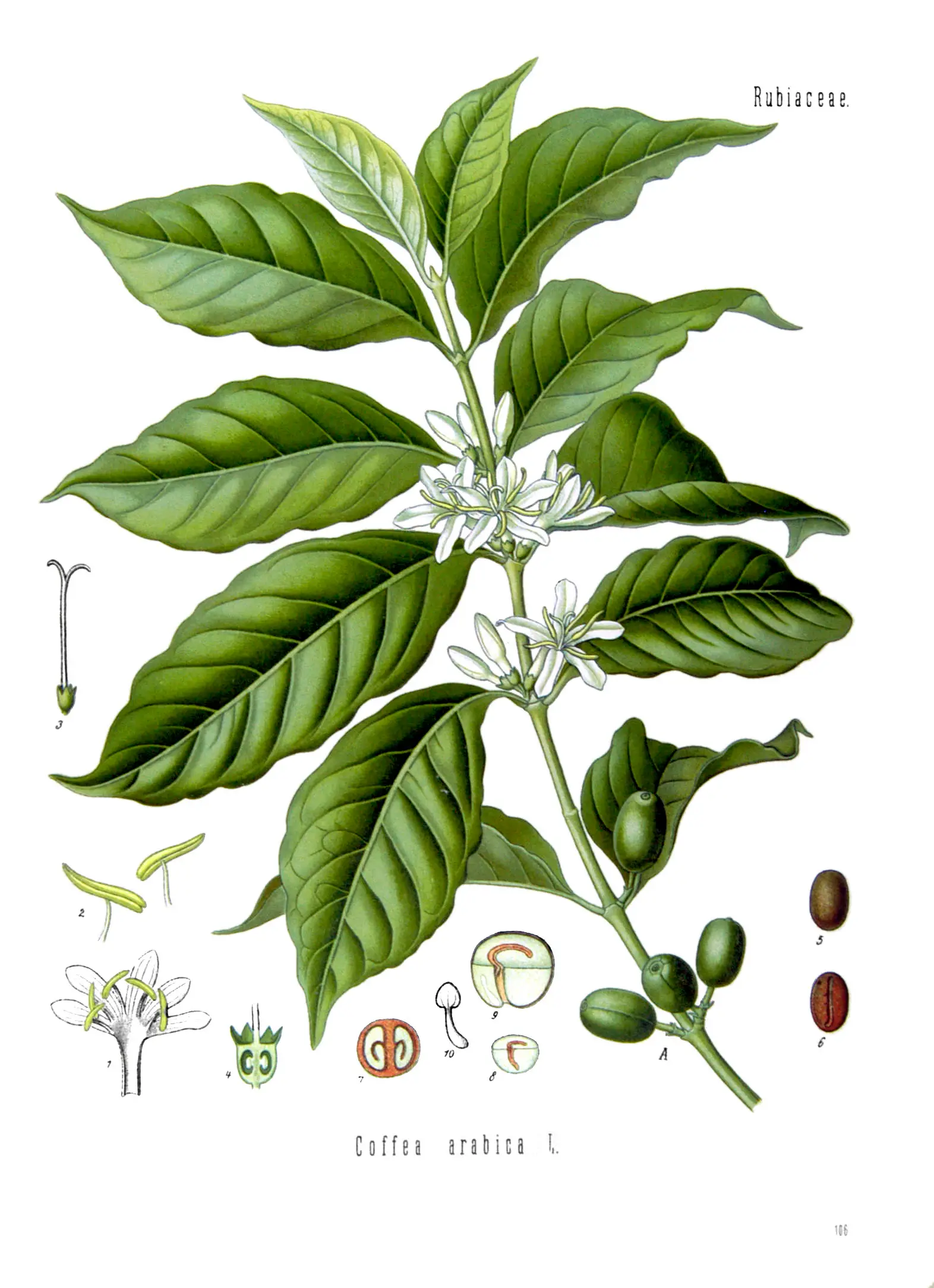
"Coffea arabica, plate 106 of Köhler's Medizinal-Pflanzen" by Franz Eugen Köhler, Köhler's Medizinal-Pflanzen — https://commons.wikimedia.org/wiki/File:Coffea_arabica_-_K%C3%B6hler%E2%80%93s_Medizinal-Pflanzen-189.jpg — Public domain (Public domain in the US (Köhler's Medizinal-Pflanzen, published in Germany in 1887-1898, before 1931) and in the EU (Commons tags the plate PD-old, life plus 70 years, and marks it with the Public Domain Mark; this basis rests on those two tags and the 1887-1898 publication, not on any artist's or editor's death year))
Roast & Steep
Espresso Crema: The Foam Comes From Gas Made in Roasting
Espresso crema is a foam whose bubbles hold mainly CO2 from the roast. How brewing pressure forces that gas into the water, per a 2021 review, and why it fades.
Picture credit (illustration)
Illustration: Molecule & Menu. Generated schematic illustration — not a photograph or historical record. Reuse: CC BY 4.0 (https://creativecommons.org/licenses/by/4.0/), to the extent Molecule & Menu holds rights in this image.
Roast & Steep
Pyrazines: Roasting Builds Part of Coffee’s Roasty Smell
Pyrazines form as coffee roasts. One, 2,3,5-trimethylpyrazine, is put at 1 to 6.7 mg/kg in coffee and about 50 ng per liter of air to smell, per earlier work.
Picture credit
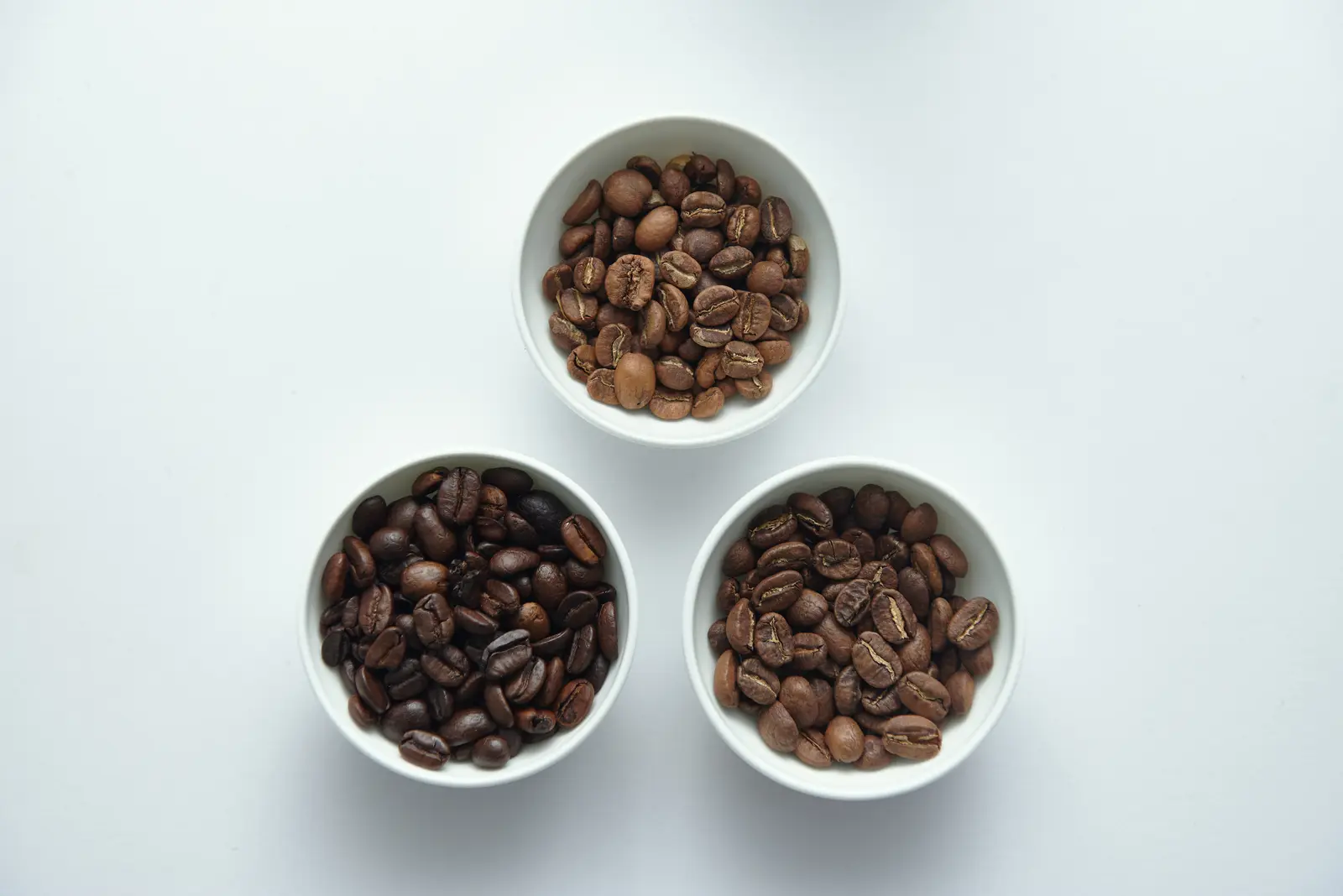
"15 grams of coffee roasted to different degrees" by Alorin — https://commons.wikimedia.org/wiki/File:15_grams_of_coffee_roasted_to_different_degrees.jpg — CC BY 4.0 (https://creativecommons.org/licenses/by/4.0/)