Scoville Scale: Diluted Until the Tongue Felt a Weak Bite
Short answer
The Scoville scale rates chili heat by how far an extract can be diluted and still bite. In his 1912 note, Wilbur Scoville described his own method: one grain of ground pepper soaked overnight in 100 cc of alcohol, then added to sweetened water until “a distinct but weak pungency” was perceptible on the tongue. The note presents this as a method Scoville himself used and names no tasting panel. Labs now measure capsaicin by chromatography and multiply parts per million by 15 to 16.1, per a 2026 review.
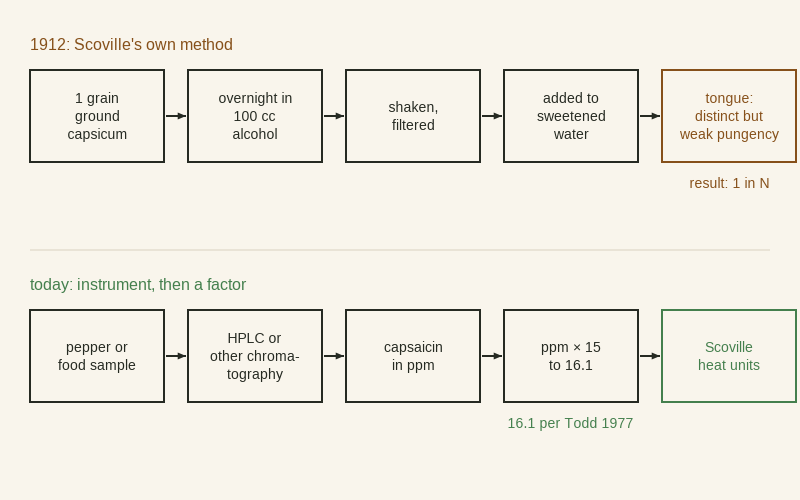
Two routes to a Scoville number. Top: the dilution test described in Scoville’s 1912 note. Bottom: chromatography and a conversion factor, as summarized in a 2026 systematic review.
"Two routes to a Scoville number, 1912 and today" by Molecule & Menu, https://moleculeandmenu.com/flavor-chemistry/scoville-scale/, licensed under CC BY 4.0 (https://creativecommons.org/licenses/by/4.0/)
The first Scoville number came from a tongue, not a machine. Scoville’s two-page note came from the laboratory of Parke, Davis & Co. in Detroit. He wrote it for pharmacists selecting capsicum. Ginger was known to vary, he wrote, but capsicums vary “to a much greater extent,” and naming a species did not guarantee its strength.
How did Scoville’s 1912 test work?
The whole procedure fits in a few lines on the note’s second page, and Scoville gives it as his own: “The method I have used is as follows.” An alcohol extract of the ground pepper then goes into sweetened water “in definite proportions until a distinct but weak pungency is perceptible on the tongue.”
In steps, as the note sets them out:
- One grain of ground capsicum soaks overnight in 100 cc of alcohol.
- The extract is shaken well and filtered.
- Measured amounts go into sweetened water.
- The endpoint is the dilution at which “a distinct but weak pungency” can still be perceived.
The endpoint is a faint bite that is still there, not a point where the bite is gone. The method is presented as Scoville’s own, and the note describes no panel or second taster. Hayward and colleagues, in a 2026 systematic review, note that the test has since been criticized for relying on human tasting panels. The 1912 text gives no count of tasters; its judge is simply “the tongue.”
Scoville defended the method on sensitivity. He relayed another researcher’s report that a solution of one part in a million could still be noticed, and argued that “when the tongue is sensitive to less than a millionth of a grain it certainly has an advantage over the analytical balance.”
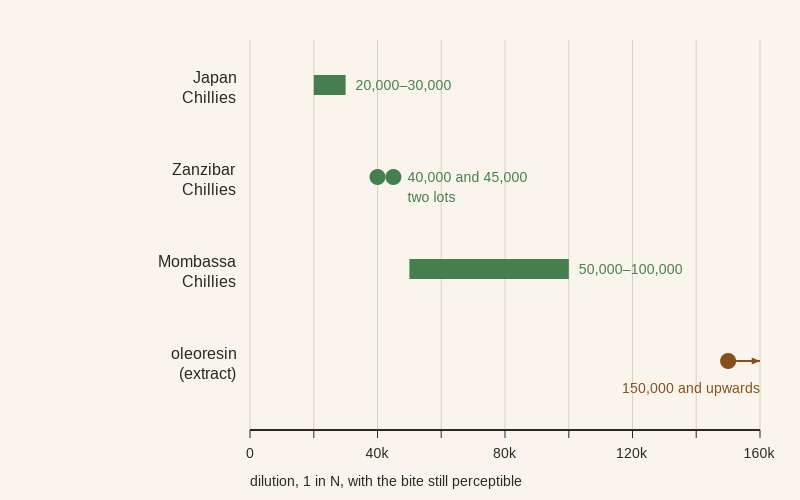
Dilutions reported in Scoville’s 1912 note, written as 1 in N: the larger N, the more the sample could be thinned with the bite still perceptible. Results from what the note calls a limited number of tests.
"Dilutions reported in Scoville’s 1912 note on capsicums" by Molecule & Menu, https://moleculeandmenu.com/flavor-chemistry/scoville-scale/, licensed under CC BY 4.0 (https://creativecommons.org/licenses/by/4.0/)
| Sample | Reported dilution (1 in N) | Note in the paper |
|---|---|---|
| Japan Chillies | 20,000 to 30,000 | not very pungent compared with the others |
| Zanzibar Chillies | 40,000 and 45,000 | two lots |
| Mombassa Chillies | 50,000 to 100,000 | the most pungent of the three |
| Oleoresin of capsicum | 150,000 and upwards | the paper says it “may test” this high and upwards |
Download the 1912 dilutions (CSV) (source and license notes) Data: Scoville 1912, Note on Capsicums, J Am Pharm Assoc 1:453-454, CC0 via Zenodo, https://zenodo.org/records/1427675
By this page’s arithmetic, the top of the Mombassa range is five times the bottom of the Japan range among the three whole chillies. From a limited number of tests, Scoville wrote, Mombassa “appears to be decidedly stronger in capsaicin,” but it had not been under observation long enough to set a limit of acceptability.
Color offered no shortcut. The note reports oleoresins holding from 5 to more than 50 percent fat, with fats that ran from green to deep red, and states that “no relation of color or fat to pungency could be observed.” Asked about fat in the printed discussion after the note, Scoville said the only satisfactory test he had found was the physiological one: the tongue.
Capsaicin, the molecule being measured
Scoville named the target in his second paragraph: “The pungent principle of Capsicum is capsaicin, a crystalline body.” The ChEBI database lists capsaicin as CHEBI:3374, with the formula C18H27NO3 and an average mass of 305.418 g/mol. ChEBI classes it as a capsaicinoid.
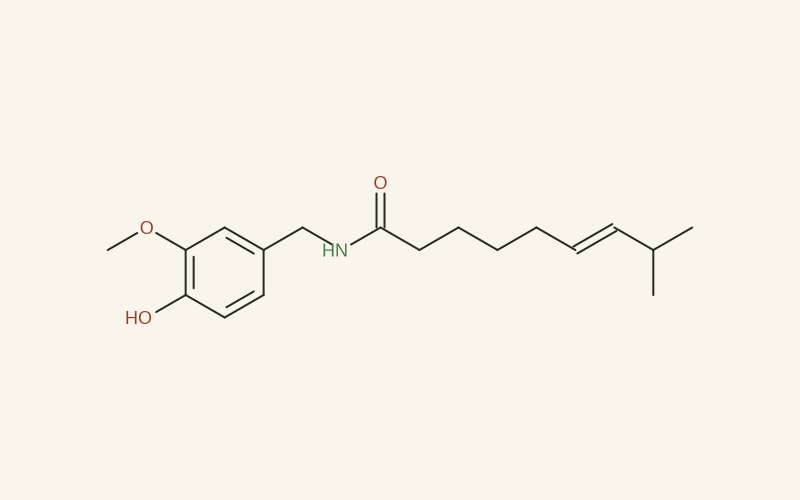
Capsaicin: a ring carrying a hydroxyl and a methoxy group, an amide link, and a carbon chain with one trans double bond. Structural diagram, not to scale. Structure data: ChEBI (CHEBI:3374), CC BY 4.0.
"Capsaicin, structural diagram" by Molecule & Menu, https://moleculeandmenu.com/flavor-chemistry/scoville-scale/, licensed under CC BY 4.0 (https://creativecommons.org/licenses/by/4.0/)
Data: Structure data: ChEBI (CHEBI:3374), CC BY 4.0
One of ChEBI’s synonyms for the molecule, (E)-8-methyl-N-vanillyl-6-nonenamide, names the ring end a vanillyl group, a name it shares with vanillin.
The bite has a receptor. A 2021 review by Shuba describes TRPV1, a calcium-permeable ion channel, as “best known for its ability to be gated by the pungent constituent of red chili pepper, capsaicin.” The review adds that related vanilloid chemicals and noxious heat open it too. Citing a 1997 cloning study, the same review reports that the cloned receptor appeared to be activated as well by temperatures in the noxious range, above 43 °C. ChEBI lists capsaicin’s role as a TRPV1 agonist.
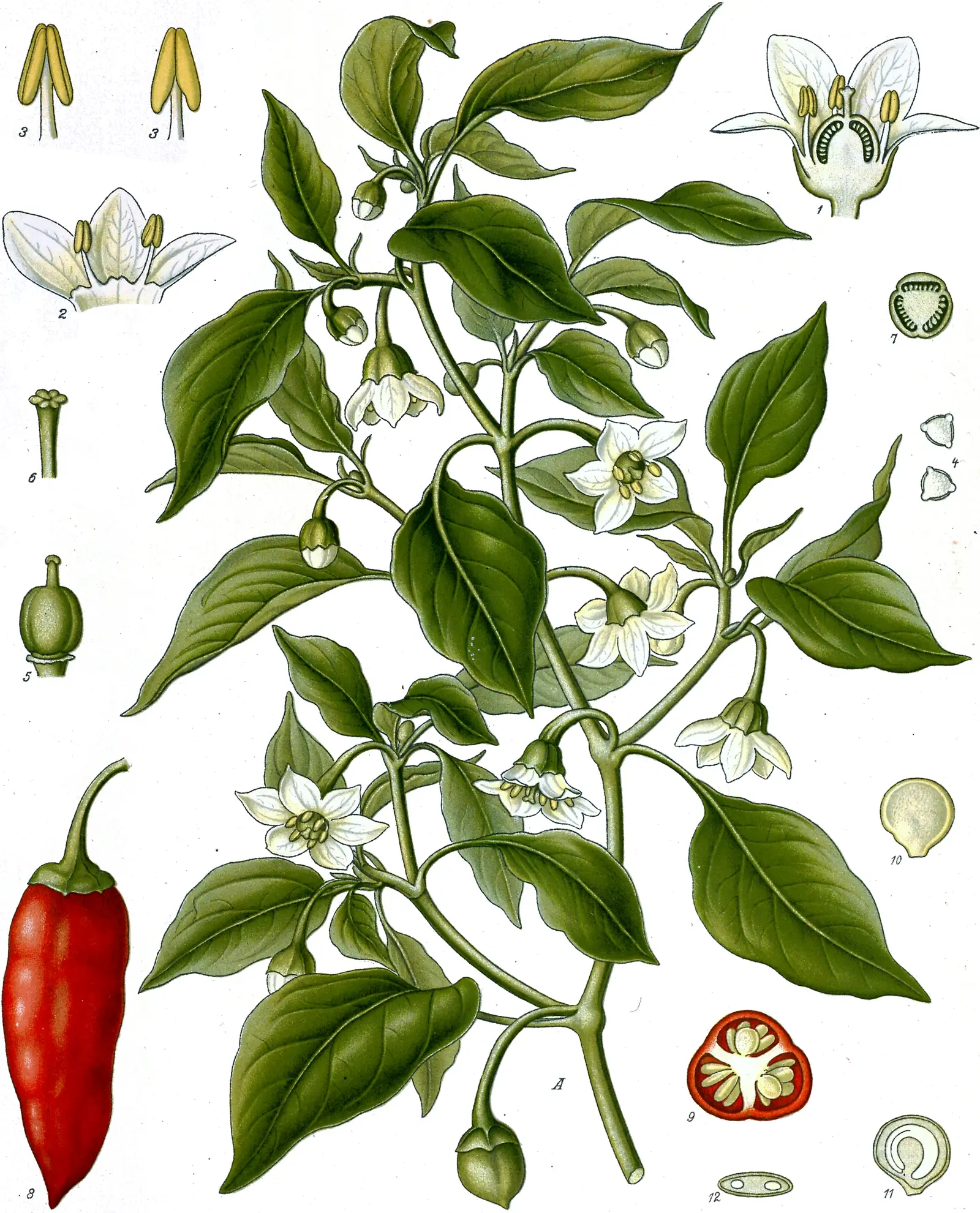
Capsicum annuum in Köhler’s Medizinal-Pflanzen, a German book of medicinal-plant plates: a flowering stem, a ripe pod at natural size (8) and the pod in cross-section (9). The plate shows the plant, not a measured heat level.
“Capsicum annuum (Spanischer Pfeffer), Köhler’s Medizinal-Pflanzen” by Franz Eugen Köhler — PD
Full credit
"Capsicum annuum (Spanischer Pfeffer), Köhler’s Medizinal-Pflanzen" by Franz Eugen Köhler, Köhler's Medizinal-Pflanzen — https://commons.wikimedia.org/wiki/File:Capsicum_annuum_-_K%C3%B6hler%E2%80%93s_Medizinal-Pflanzen-027.jpg — Public domain (Public domain in the US (Köhler's Medizinal-Pflanzen, published in Germany in 1887-1898, this plate in 1897, before 1931) and in the EU (Commons tags the plate PD-old, life plus 70 years, and marks it with the Public Domain Mark; this basis rests on those two tags and the 1887-1898 publication, not on any artist's or editor's death year))
How do labs turn capsaicin into Scoville units?
Instruments replaced the tongue for measuring content. The 2026 review says “HPLC was adopted for capsaicin determination” because human tasting brings subjective biases. HPLC, high-performance liquid chromatography, separates a sample’s compounds so each can be measured.
The result is a concentration in parts per million (ppm), where 1 ppm means one milligram of capsaicin per kilogram of sample, and that figure still has to be translated back into the familiar unit. According to the review, Todd and colleagues in 1977 set out the conversion as ppm × 16.1. One study it covers, on Brazilian pepper sauces, used a factor of 16, and that study noted other authors using factors from 15 to 16.1.
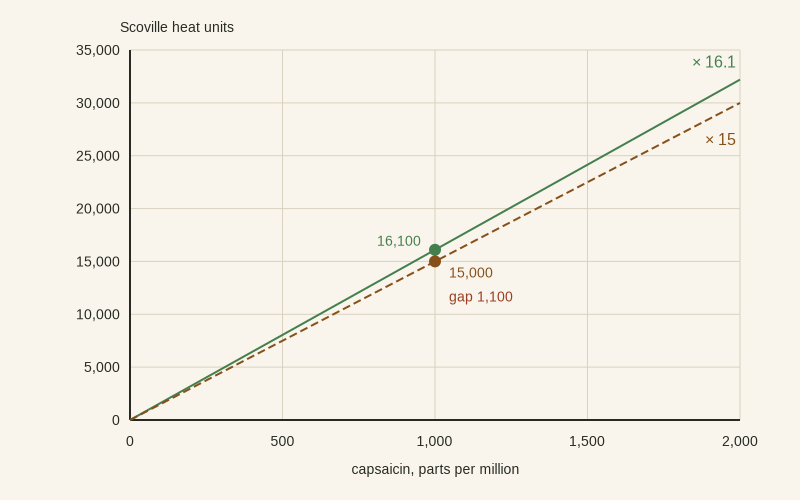
Scoville heat units from the same capsaicin content under the highest and lowest factors the 2026 review reports. This page’s arithmetic, not a measured pepper.
"Capsaicin parts per million to Scoville heat units, factors 15 and 16.1" by Molecule & Menu, https://moleculeandmenu.com/flavor-chemistry/scoville-scale/, licensed under CC BY 4.0 (https://creativecommons.org/licenses/by/4.0/)
| Capsaicin (ppm) | × 15 | × 16 | × 16.1 |
|---|---|---|---|
| 100 | 1,500 | 1,600 | 1,610 |
| 1,000 | 15,000 | 16,000 | 16,100 |
| 10,000 | 150,000 | 160,000 | 161,000 |
Download the conversion factors and worked examples (CSV) (source and license notes) Data: Hayward, Leaver & Crampton 2026, Food Sci Nutr 14:e71407, CC BY 4.0, https://pmc.ncbi.nlm.nih.gov/articles/PMC12835616/; Scoville 1912, CC0 via Zenodo, https://zenodo.org/records/1427675
By this page’s calculation, the factors differ by about 7% of the lower figure, at any concentration. The review calls this an ongoing inconsistency, and it notes that Todd’s 1977 work reported a gender difference among its trained tasters. It warns that conversion to Scoville units “may dilute the accuracy of information from precise instrumentation.” Pulling one molecule out of a food and putting a number on it is also the business of the Swiss Water Process, where the molecule is caffeine.
Molecule card
| Name | capsaicin |
|---|---|
| Molecular formula | C18H27NO3 |
| Molar mass | 305.418 g/mol |
| Shape | Structural diagram, not to scale |
| Where you meet it | Chili peppers, as their pungent constituent |
| ChEBI ID | CHEBI:3374 |
This card as data (CSV) · Source and license notes
Data: Structure data: ChEBI (CHEBI:3374), CC BY 4.0; Shuba 2021, Front Cell Neurosci 14:612480, CC BY, https://pmc.ncbi.nlm.nih.gov/articles/PMC7892457/
Sources
- Scoville, W. L. (1912). Note on Capsicums. Journal of the American Pharmaceutical Association, 1(5), 453–454. https://doi.org/10.1002/jps.3080010520 https://zenodo.org/records/1427675Read: full text, pages 453–454 including the printed discussion. License: CC0 1.0.
- Hayward, S., Leaver, D. J., & Crampton, A. (2026). Is the Quantity of Capsaicin in Food Related to Its Organoleptic and Sensory Effects? A Systematic Review. Food Science & Nutrition, 14(1), e71407. https://doi.org/10.1002/fsn3.71407 https://pmc.ncbi.nlm.nih.gov/articles/PMC12835616/Read: full text; introduction and discussion used. License: CC BY 4.0.
- Shuba, Y. M. (2021). Beyond Neuronal Heat Sensing: Diversity of TRPV1 Heat-Capsaicin Receptor-Channel Functions. Frontiers in Cellular Neuroscience, 14, 612480. https://doi.org/10.3389/fncel.2020.612480 https://pmc.ncbi.nlm.nih.gov/articles/PMC7892457/Read: full text; abstract and introduction used. License: CC BY.
- ChEBI entry CHEBI:3374, capsaicin (Chemical Entities of Biological Interest, EMBL-EBI). https://www.ebi.ac.uk/chebi/CHEBI:3374Read: entry record (structure, formula, identifiers, synonyms, classification and roles). License: CC BY 4.0.
- Todd, P. H., Bensinger, M. G., & Biftu, T. (1977). Determination of Pungency due to Capsicum by Gas-Liquid Chromatography. Journal of Food Science, 42(3), 660–665. https://doi.org/10.1111/j.1365-2621.1977.tb12573.xRead: bibliography only.
Cite this page
“Scoville Scale: Diluted Until the Tongue Felt a Weak Bite.” Molecule & Menu. Published November 14, 2026. https://moleculeandmenu.com/flavor-chemistry/scoville-scale/. Accessed on the date you read it.
How pages here are checked · All corrections · Report an error on this page (contact@moleculeandmenu.com)
Second helping:
More from Flavor Chemistry
Flavor Chemistry
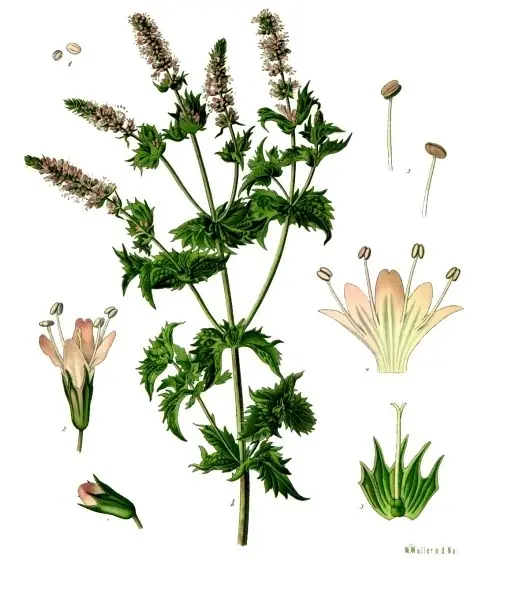
Carvone: Mirror-Image Molecules Some Noses Can’t Tell Apart
Carvone has two mirror-image forms, linked mainly to spearmint and caraway. In a 2019 study, 12 of 46 volunteers screened could not tell them apart at first.
Picture credit
"Mentha viridis (spearmint), Köhler’s Medizinal-Pflanzen" by Franz Eugen Köhler, Köhler's Medizinal-Pflanzen — https://commons.wikimedia.org/wiki/File:Mentha_viridis_-_K%C3%B6hler%E2%80%93s_Medizinal-Pflanzen-096.jpg — Public domain (Public domain in the US (Köhler's Medizinal-Pflanzen, published in Germany in 1887-1898, this plate in 1897, before 1931; the plate is signed W. Müller) and in the EU (Commons tags the plate PD-old, life plus 70 years, and marks it with the Public Domain Mark; this basis rests on those two tags and the 1887-1898 publication, not on any artist's or editor's death year))
Flavor Chemistry
Umami: Glutamate’s Savory Taste, From Kombu Broth to MSG
Umami is the savory taste of glutamate, which Kikunae Ikeda drew from a seaweed broth. The FDA never confirmed MSG caused reported symptoms; see the evidence.
Picture credit (illustration)
Illustration: Molecule & Menu. Generated schematic illustration — not a photograph or historical record. Reuse: CC BY 4.0 (https://creativecommons.org/licenses/by/4.0/), to the extent Molecule & Menu holds rights in this image.
Flavor Chemistry
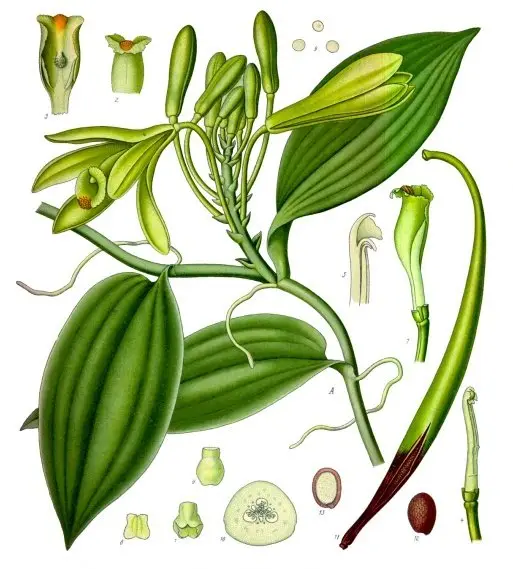
Vanillin: One Review Puts the Synthetic Share at 88%
Most vanillin is synthetic: a 2024 review puts it at 88% of the market, plant-based at 11.5% and vanilla pods at 1.5%. Carbon isotopes can hint at the source.
Picture credit
"Vanilla planifolia (Echte Vanille), Köhler's Medizinal-Pflanzen" by Franz Eugen Köhler, Köhler's Medizinal-Pflanzen — https://commons.wikimedia.org/wiki/File:Vanilla_planifolia_-_K%C3%B6hler%E2%80%93s_Medizinal-Pflanzen-278.jpg — Public domain (Public domain in the US (Köhler's Medizinal-Pflanzen, published in Germany in 1887-1898, this plate in 1897, before 1931) and in the EU (Commons tags the plate PD-old, life plus 70 years, and marks it with the Public Domain Mark; this basis rests on those two tags and the 1887-1898 publication, not on any artist's or editor's death year))