Carvone: Mirror-Image Molecules Some Noses Can’t Tell Apart
Short answer
Carvone is the main compound in spearmint and caraway oils, and it comes in two mirror-image forms. A 2026 review links (R)-(−)-carvone mainly with spearmint and (S)-(+)-carvone mainly with caraway. In a 2019 eLife study by Feng and Zhou, 12 of 46 volunteers screened could separate neither the two carvones nor the two limonenes. After about nine days of practice with feedback, their accuracy on the pair they practiced, sniffed through the trained nostril, rose from 0.37 to 0.72.
Course list · 4 sections
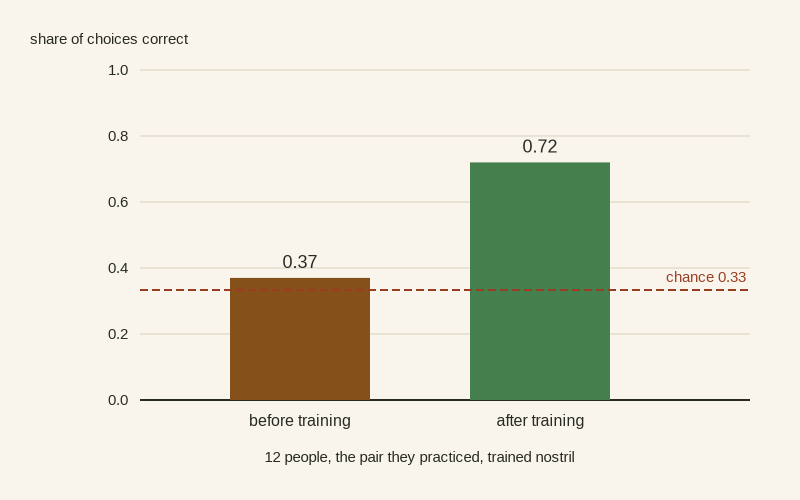
Accuracy of the 12 volunteers on the mirror-image pair they practiced, sniffed through the trained nostril, in Feng and Zhou’s 2019 study. Each trial offered three bottles with one odd one out, so guessing scores about one in three.
"Accuracy before and after smell training, Feng and Zhou 2019" by Molecule & Menu, https://moleculeandmenu.com/flavor-chemistry/carvone/, licensed under CC BY 4.0 (https://creativecommons.org/licenses/by/4.0/)
Data: Feng & Zhou 2019, eLife 8:e41296, CC BY 4.0, https://pmc.ncbi.nlm.nih.gov/articles/PMC6336403/
Two carvones, one formula
In their ChEBI entries, the two forms of carvone share one formula, C10H14O, and one average mass, 150.221. They differ at a single ring carbon: the one that carries the side group. Feng and Zhou’s paper gives the general rule: a carbon with four chemically distinct groups allows two mirror-image forms that are not identical, called enantiomers.
Such pairs, the same paper notes, have almost identical physical and chemical properties. In living things they usually act differently, though. They can also smell different to the human nose.
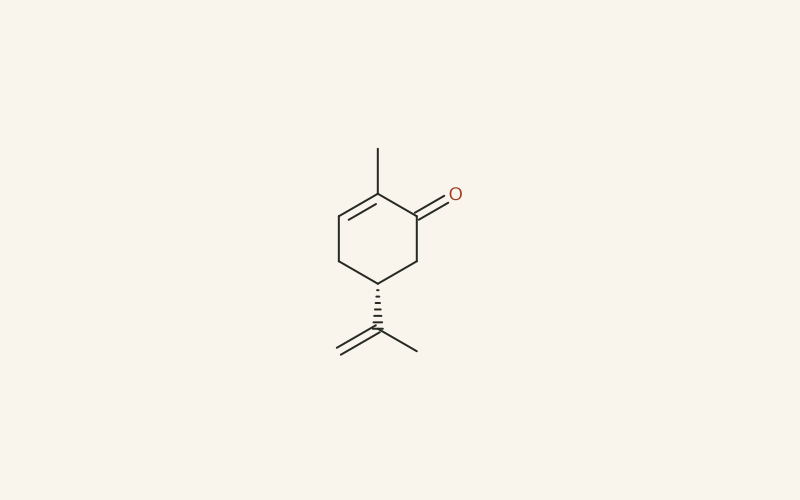
(R)-(−)-carvone, ChEBI CHEBI:15400. Structural diagram, not to scale. The hashed wedge at the lower ring carbon marks the side group pointing away from the viewer.
"(R)-(−)-carvone, structural diagram" by Molecule & Menu, https://moleculeandmenu.com/flavor-chemistry/carvone/, licensed under CC BY 4.0 (https://creativecommons.org/licenses/by/4.0/)
Data: Structure data: ChEBI (CHEBI:15400), CC BY 4.0
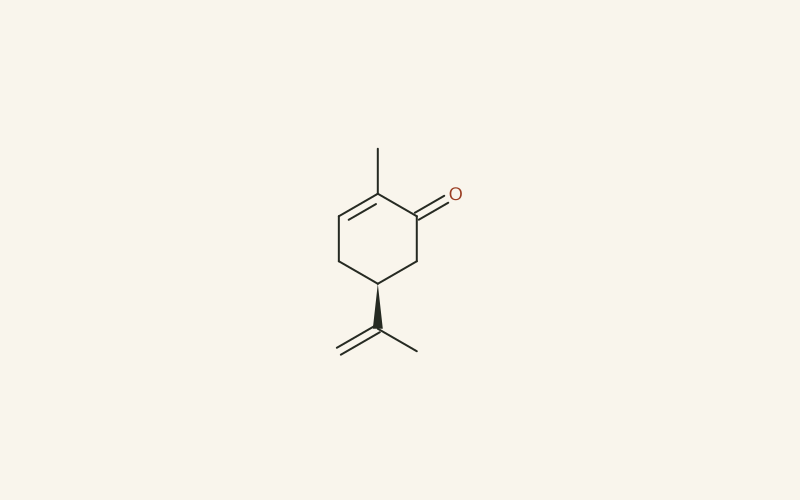
(S)-(+)-carvone, ChEBI CHEBI:15399. Structural diagram, not to scale. The same bond is a solid wedge here, so the side group points toward the viewer.
"(S)-(+)-carvone, structural diagram" by Molecule & Menu, https://moleculeandmenu.com/flavor-chemistry/carvone/, licensed under CC BY 4.0 (https://creativecommons.org/licenses/by/4.0/)
Data: Structure data: ChEBI (CHEBI:15399), CC BY 4.0
Each name carries two labels from two separate systems. The letter, R or S, describes how the groups sit in space around that ring carbon; ChEBI defines each entry by it. The sign, (−) or (+), does not follow from the letter. As the authors of the 2019 study point out, (−)-carvone and (+)-limonene both have the R arrangement.
Older names add a third label. ChEBI lists l-carvone as a synonym for the (R) entry and d-(+)-carvone for the (S) entry. US food regulations name the pair that way, as “d- or l-Carvone,” on their list of synthetic flavoring substances generally recognized as safe for their intended use (21 CFR 182.60, 2025 edition).
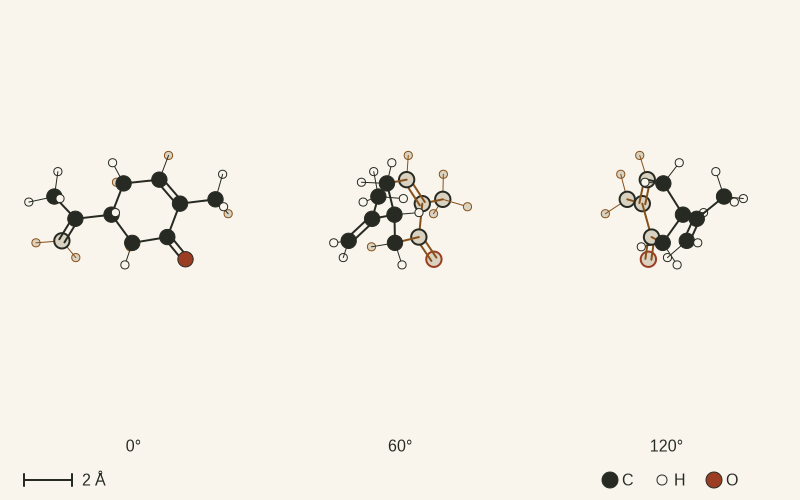
Computed 3D conformer generated by Molecule & Menu from the ChEBI SMILES (RDKit 2026.09.2), not an experimentally measured shape. (R)-(−)-carvone, seen from three angles.
"(R)-(−)-carvone, computed 3D conformer" by Molecule & Menu, https://moleculeandmenu.com/flavor-chemistry/carvone/, licensed under CC BY 4.0 (https://creativecommons.org/licenses/by/4.0/)
Data: Structure data: ChEBI (CHEBI:15400), CC BY 4.0
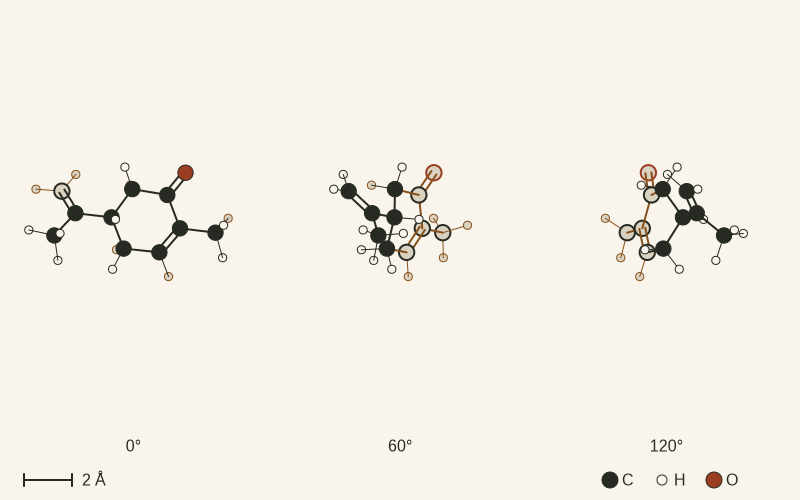
Computed 3D conformer generated by Molecule & Menu from the ChEBI SMILES (RDKit 2026.09.2), not an experimentally measured shape. Turned the same way, the (S) form is the mirror image of the (R) form.
"(S)-(+)-carvone, computed 3D conformer" by Molecule & Menu, https://moleculeandmenu.com/flavor-chemistry/carvone/, licensed under CC BY 4.0 (https://creativecommons.org/licenses/by/4.0/)
Data: Structure data: ChEBI (CHEBI:15399), CC BY 4.0
| (R)-(−)-carvone | (S)-(+)-carvone | |
|---|---|---|
| ChEBI entry | CHEBI:15400 | CHEBI:15399 |
| Formula and average mass | C10H14O, 150.221 | C10H14O, 150.221 |
| Plant it is mainly linked to, per a 2026 review | Spearmint | Caraway |
| Carvone in that plant’s oil, any form, per the same review | 60–70% | 50–60% |
| Smell, per a 2004 paper citing 1971 work | Like spearmint | Like caraway |
| Human receptor OR1A1, per a 2017 study cited in the 2026 review | Activated, less potently | Activated, more potently |
Spearmint: mostly one mirror image
Spearmint’s essential oil is mostly carvone. A 2025 review of mint oils by Yu and colleagues says carvone is typically the major component of spearmint oil, often exceeding 60% of the oil, with limonene alongside it. The single analyses it cites run from 62.9% in an oil from Sardinia to 72.8% in another sample. Peppermint oil is built differently: the same review describes a high concentration of menthol and menthone, often at around 50% of the oil.
That review does not say which mirror image the oil holds. A 2026 review of carvone by Dvořák and Hrubý does: spearmint oil contains (R)-(−)-carvone, and carvone makes up 60–70% of it. The same review sets a limit on that link. It calls each form’s tie to its plant predominant but not absolute, because the mix can vary with cultivar, growing conditions and extraction method.
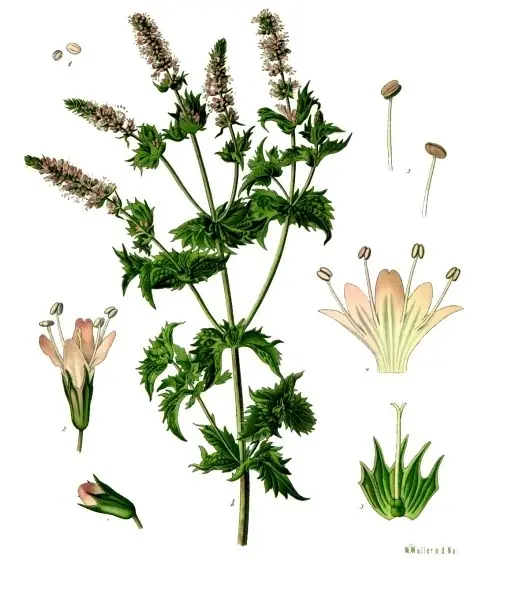
Spearmint in Köhler’s Medizinal-Pflanzen, a German book of medicinal-plant plates. The German description on its file page names it Mentha viridis var. crispata, a curled-leaf mint, and the Latin entry gives Mentha spicata.
“Mentha viridis (spearmint), Köhler’s Medizinal-Pflanzen” by Franz Eugen Köhler — PD
Full credit
"Mentha viridis (spearmint), Köhler’s Medizinal-Pflanzen" by Franz Eugen Köhler, Köhler's Medizinal-Pflanzen — https://commons.wikimedia.org/wiki/File:Mentha_viridis_-_K%C3%B6hler%E2%80%93s_Medizinal-Pflanzen-096.jpg — Public domain (Public domain in the US (Köhler's Medizinal-Pflanzen, published in Germany in 1887-1898, this plate in 1897, before 1931; the plate is signed W. Müller) and in the EU (Commons tags the plate PD-old, life plus 70 years, and marks it with the Public Domain Mark; this basis rests on those two tags and the 1887-1898 publication, not on any artist's or editor's death year))
Carvone is made in the growing plant: the 2025 review describes spearmint enzymes that turn limonene into carvone. Pyrazines, the roasty-smelling molecules in coffee, have a different origin. They form as the beans roast.
Caraway: the other mirror image
Caraway oil is steam-distilled from the plant’s dry fruits, according to a 2021 study by Możdżeń and colleagues. Two compounds dominate it: carvone and limonene. Together they make up 93.3–98.1% of the oil in the earlier analyses that study cites. For Polish cultivars, the cited figures are 55.4–71.6% carvone and 25.0–40.3% limonene.
The study’s own sample, oil packed into spray-dried microcapsules, measured 79.9% carvone. The authors note that this is about 23% more carvone than the European Pharmacopoeia figure, and that spray drying might explain the gap. The 2026 review gives a lower range for caraway seed oil, 50–60% carvone. Both sources appear side by side below.
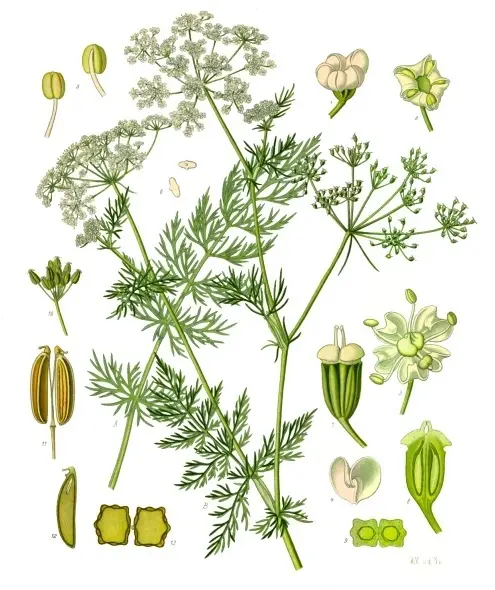
Caraway (Carum carvi) in Köhler’s Medizinal-Pflanzen. Figure 11 shows a ripe fruit, enlarged; figures 12 and 13 show sections through a half-fruit and a whole fruit.
“Carum carvi (caraway), Köhler’s Medizinal-Pflanzen” by Franz Eugen Köhler — PD
Full credit
"Carum carvi (caraway), Köhler’s Medizinal-Pflanzen" by Franz Eugen Köhler, Köhler's Medizinal-Pflanzen — https://commons.wikimedia.org/wiki/File:Carum_carvi_-_K%C3%B6hler%E2%80%93s_Medizinal-Pflanzen-172.jpg — Public domain (Public domain in the US (Köhler's Medizinal-Pflanzen, published in Germany in 1887-1898, this plate in 1897, before 1931) and in the EU (Commons tags the plate PD-old, life plus 70 years, and marks it with the Public Domain Mark; this basis rests on those two tags and the 1887-1898 publication, not on any artist's or editor's death year))
Both sources name the same mirror image for caraway. The 2021 study calls caraway’s main compound the (+)-carvone enantiomer, and the 2026 review says caraway seed oil contains (S)-(+)-carvone.
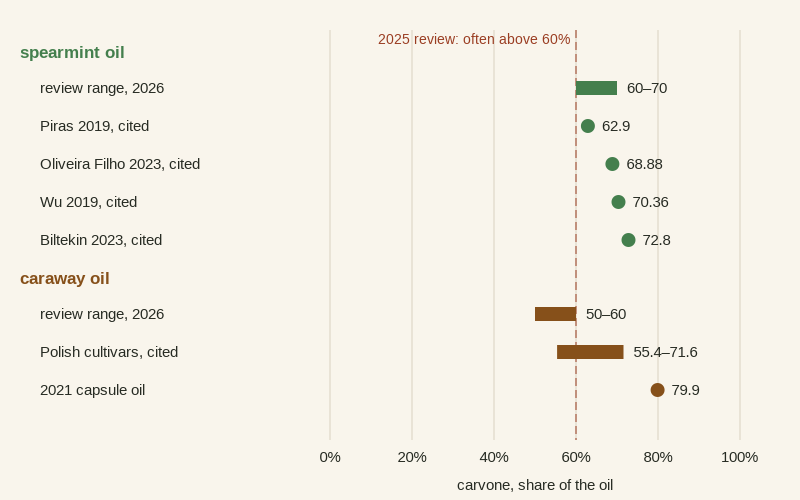
Carvone as a share of the oil in each figure this page could trace; labels marked cited are earlier analyses reported in the 2025 review or 2021 study. Bars are ranges and dots are single oils; the dashed line marks the 60% level that a 2025 review says spearmint oil often exceeds. The figures count carvone in any mirror-image form.
"Carvone share of spearmint and caraway oils in five sources" by Molecule & Menu, https://moleculeandmenu.com/flavor-chemistry/carvone/, licensed under CC BY 4.0 (https://creativecommons.org/licenses/by/4.0/)
Data: Yu et al. 2025, Nutrients 17:3258, CC BY 4.0, https://pmc.ncbi.nlm.nih.gov/articles/PMC12567415/; Dvořák & Hrubý 2026, Molecules 31:3106, CC BY 4.0, https://pmc.ncbi.nlm.nih.gov/articles/PMC13567479/; Możdżeń et al. 2021, Molecules 26:5059, CC BY 4.0, https://pmc.ncbi.nlm.nih.gov/articles/PMC8402095/
| Oil | Carvone share | Kind of figure | Reported by |
|---|---|---|---|
| Spearmint | often above 60% | level often exceeded, per a review | Yu et al. 2025 |
| Spearmint | 60–70% | review range | Dvořák & Hrubý 2026 |
| Spearmint (Sardinia) | 62.9% | one oil, cited | Piras et al. 2019, cited by Yu et al. 2025 |
| Spearmint | 68.88% | one oil, cited | Oliveira Filho et al. 2023, cited by Yu et al. 2025 |
| Spearmint | 70.36% | one oil, cited | Wu et al. 2019, cited by Yu et al. 2025 |
| Spearmint | 72.8% | one oil, cited | Biltekin et al. 2023, cited by Yu et al. 2025 |
| Caraway seed | 50–60% | review range | Dvořák & Hrubý 2026 |
| Caraway (Polish cultivars) | 55.4–71.6% | cultivar range, cited | Seidler-Łożykowska et al. 2010, cited by Możdżeń et al. 2021 |
| Caraway (in microcapsules) | 79.9% | one oil | Możdżeń et al. 2021 |
Download the carvone oil-share table (CSV) (source and license notes) Data: Yu et al. 2025, Nutrients 17:3258, CC BY 4.0, https://pmc.ncbi.nlm.nih.gov/articles/PMC12567415/; Dvořák & Hrubý 2026, Molecules 31:3106, CC BY 4.0, https://pmc.ncbi.nlm.nih.gov/articles/PMC13567479/; Możdżeń et al. 2021, Molecules 26:5059, CC BY 4.0, https://pmc.ncbi.nlm.nih.gov/articles/PMC8402095/; Identifiers: ChEBI, CC BY 4.0
Who can smell the difference?
A 2004 neuroscience paper by Reisenman and colleagues, citing a 1971 study by Friedman and Miller, describes (+)-carvone as smelling like caraway and (−)-carvone like spearmint. Feng and Zhou cite an earlier German study in which 20 people told the carvone forms apart about 80% of the time, against 33% by chance. That study also found marked differences between individuals.
Feng and Zhou went looking for the opposite: people who could not. They screened 46 volunteers and found 12 who could separate neither the two carvones nor the two limonenes, a pair with a similar structure. Each test trial gave three bottles, two alike and one holding the mirror image, and the task was to pick the odd one out.
Half of the 12 then trained on carvone and half on limonene, always through the same nostril. They did 12 trials a day with feedback until they scored 9 of 12 on two days in a row. That took 9.1 days on average. Accuracy on the practiced pair, through the trained nostril, rose from 0.37 to 0.72.
The gain stayed largely on one side. Through the other nostril, the change in accuracy was not statistically significant. In the trained nostril, the similar pair that had not been practiced improved by 25.9 percentage points, against 35.2 for the practiced pair, while α-pinene, a structurally different control pair, did not change.
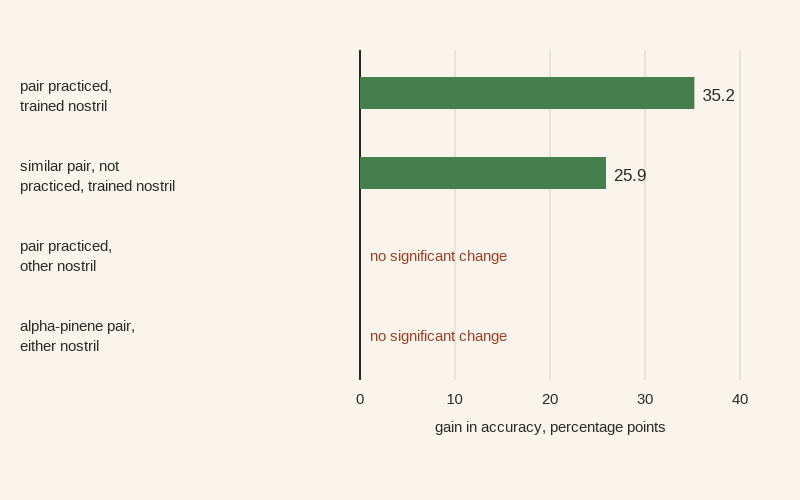
What training changed, in Feng and Zhou’s 2019 study. The gain stayed largely with the trained nostril and spread only to the pair with a similar structure. The paper reports the two gains as percentages; this page reads them as percentage points, since 0.37 to 0.72 is a rise of about 0.35.
"Where smell training transferred, Feng and Zhou 2019" by Molecule & Menu, https://moleculeandmenu.com/flavor-chemistry/carvone/, licensed under CC BY 4.0 (https://creativecommons.org/licenses/by/4.0/)
Data: Feng & Zhou 2019, eLife 8:e41296, CC BY 4.0, https://pmc.ncbi.nlm.nih.gov/articles/PMC6336403/
| Test after training | Change in accuracy |
|---|---|
| Pair practiced, trained nostril | +35.2 points (0.37 to 0.72) |
| Similar pair not practiced, trained nostril | +25.9 points |
| Pair practiced, other nostril | Not statistically significant |
| α-pinene pair, either nostril | Not statistically significant |
Download the smell-training figures (CSV) (source and license notes) Data: Feng & Zhou 2019, eLife 8:e41296, CC BY 4.0, https://pmc.ncbi.nlm.nih.gov/articles/PMC6336403/
The authors read this as learning that can take place early in smell processing, where a molecule’s structural features are first sorted. They also add a caveat: the results did not fully rule out that people learned some sub-quality of the smells instead. Their summary: human smell perception “can partially be a learned trait.” The same paper notes that the ability to tell mirror-image smells apart has a genetic basis, yet adults can still acquire it through learning.
At the receptor level, the 2026 review cites a 2017 study in which the human odorant receptor OR1A1 responded to both carvones, with (S)-carvone the more potent of the two. Smell runs on receptors in the nose; umami is a taste traced to receptors on the tongue.
Molecule card
| Name | (R)-(−)-carvone |
|---|---|
| Molecular formula | C10H14O |
| Molar mass | 150.221 g/mol |
| Shape | Computed 3D conformer generated by Molecule & Menu from the ChEBI SMILES (RDKit ETKDG), not an experimentally measured shape |
| Where you meet it | Spearmint oil, where a 2026 review calls it the predominant form, not the only one |
| ChEBI ID | CHEBI:15400 |
| PubChem CID | 439570 |
This card as data (CSV) · Source and license notes
Data: Structure data: ChEBI (CHEBI:15400), CC BY 4.0; Dvořák & Hrubý 2026, Molecules 31:3106, CC BY 4.0, https://pmc.ncbi.nlm.nih.gov/articles/PMC13567479/
Molecule card
| Name | (S)-(+)-carvone |
|---|---|
| Molecular formula | C10H14O |
| Molar mass | 150.221 g/mol |
| Shape | Computed 3D conformer generated by Molecule & Menu from the ChEBI SMILES (RDKit ETKDG), not an experimentally measured shape |
| Where you meet it | Caraway seed oil, where a 2026 review calls it the predominant form, not the only one |
| ChEBI ID | CHEBI:15399 |
| PubChem CID | 16724 |
This card as data (CSV) · Source and license notes
Data: Structure data: ChEBI (CHEBI:15399), CC BY 4.0; Dvořák & Hrubý 2026, Molecules 31:3106, CC BY 4.0, https://pmc.ncbi.nlm.nih.gov/articles/PMC13567479/; Możdżeń et al. 2021, Molecules 26:5059, CC BY 4.0, https://pmc.ncbi.nlm.nih.gov/articles/PMC8402095/
Sources
- Feng G, Zhou W. Nostril-specific and structure-based olfactory learning of chiral discrimination in human adults. eLife. 2019;8:e41296. doi:10.7554/eLife.41296 https://pmc.ncbi.nlm.nih.gov/articles/PMC6336403/Read: full text. License: CC BY 4.0.
- Dvořák Z, Hrubý J. Molecular Targets and Biological Activities of Carvone: An Evidence-Graded Review. Molecules. 2026;31(17):3106. doi:10.3390/molecules31173106 https://pmc.ncbi.nlm.nih.gov/articles/PMC13567479/Read: full text; the introduction and the section on chemosensory receptors used. License: CC BY 4.0.
- Yu Y, Ma Y, Ouyang Z, Huang L. Mentha Essential Oils: Unraveling Chemotype-Dependent Biosynthesis and Assessing Evidence for Health-Promoting Activities. Nutrients. 2025;17(20):3258. doi:10.3390/nu17203258 https://pmc.ncbi.nlm.nih.gov/articles/PMC12567415/Read: full text; the sections on chemotypes and chemical profiling used. License: CC BY 4.0.
- Możdżeń K, Krajewska A, Bocianowski J, Jop B, Synowiec A. Microencapsulated Caraway Essential Oil Affects Initial Growth of Maize Cultivars. Molecules. 2021;26(16):5059. doi:10.3390/molecules26165059 https://pmc.ncbi.nlm.nih.gov/articles/PMC8402095/Read: full text; the introduction, the oil composition results and the discussion used. License: CC BY 4.0.
- Reisenman CE, Christensen TA, Francke W, Hildebrand JG. Enantioselectivity of Projection Neurons Innervating Identified Olfactory Glomeruli. J Neurosci. 2004;24(11):2602–2611. doi:10.1523/JNEUROSCI.5192-03.2004 https://doi.org/10.1523/JNEUROSCI.5192-03.2004Read: abstract and introduction; one sentence paraphrased, not quoted.
- ChEBI entry CHEBI:15400, (−)-carvone (Chemical Entities of Biological Interest, EMBL-EBI). https://www.ebi.ac.uk/chebi/CHEBI:15400Read: entry record (structure, formula, identifiers). License: CC BY 4.0.
- ChEBI entry CHEBI:15399, (+)-carvone (Chemical Entities of Biological Interest, EMBL-EBI). https://www.ebi.ac.uk/chebi/CHEBI:15399Read: entry record (structure, formula, identifiers). License: CC BY 4.0.
- Code of Federal Regulations, Title 21, Part 182: Substances Generally Recognized as Safe, §182.50 (Certain other spices, seasonings, essential oils, oleoresins, and natural extracts) and §182.60 (Synthetic flavoring substances and adjuvants). Revised as of April 1, 2025. Washington: U.S. Government Publishing Office. https://www.govinfo.gov/content/pkg/CFR-2025-title21-vol3/pdf/CFR-2025-title21-vol3-part182.pdfRead: full text of §182.50 and §182.60 (pages 484 and 485).
- Friedman L, Miller JG. Odor incongruity and chirality. Science. 1971;172(3987):1044–1046. doi:10.1126/science.172.3987.1044 https://doi.org/10.1126/science.172.3987.1044Read: bibliography only.
Cite this page
“Carvone: Mirror-Image Molecules Some Noses Can’t Tell Apart.” Molecule & Menu. Published November 14, 2026. https://moleculeandmenu.com/flavor-chemistry/carvone/. Accessed on the date you read it.
How pages here are checked · All corrections · Report an error on this page (contact@moleculeandmenu.com)
Second helping:
- Why does cilantro taste like soap: another smell that differs from person to person, where genes explain only a small part of the story.
- Vanillin: another flavor molecule entry, with its own structure drawings and molecule card.
More from Flavor Chemistry
Flavor Chemistry
Umami: Glutamate’s Savory Taste, From Kombu Broth to MSG
Umami is the savory taste of glutamate, which Kikunae Ikeda drew from a seaweed broth. The FDA never confirmed MSG caused reported symptoms; see the evidence.
Picture credit (illustration)
Illustration: Molecule & Menu. Generated schematic illustration — not a photograph or historical record. Reuse: CC BY 4.0 (https://creativecommons.org/licenses/by/4.0/), to the extent Molecule & Menu holds rights in this image.
Flavor Chemistry
Scoville Scale: Diluted Until the Tongue Felt a Weak Bite
Scoville’s 1912 test diluted chili extract in sweetened water to a distinct but weak bite. A 2026 review reports labs multiplying capsaicin ppm by 15 to 16.1.
Picture credit
"Capsicum annuum (Spanischer Pfeffer), Köhler’s Medizinal-Pflanzen" by Franz Eugen Köhler, Köhler's Medizinal-Pflanzen — https://commons.wikimedia.org/wiki/File:Capsicum_annuum_-_K%C3%B6hler%E2%80%93s_Medizinal-Pflanzen-027.jpg — Public domain (Public domain in the US (Köhler's Medizinal-Pflanzen, published in Germany in 1887-1898, this plate in 1897, before 1931) and in the EU (Commons tags the plate PD-old, life plus 70 years, and marks it with the Public Domain Mark; this basis rests on those two tags and the 1887-1898 publication, not on any artist's or editor's death year))
Flavor Chemistry
Vanillin: One Review Puts the Synthetic Share at 88%
Most vanillin is synthetic: a 2024 review puts it at 88% of the market, plant-based at 11.5% and vanilla pods at 1.5%. Carbon isotopes can hint at the source.
Picture credit
"Vanilla planifolia (Echte Vanille), Köhler's Medizinal-Pflanzen" by Franz Eugen Köhler, Köhler's Medizinal-Pflanzen — https://commons.wikimedia.org/wiki/File:Vanilla_planifolia_-_K%C3%B6hler%E2%80%93s_Medizinal-Pflanzen-278.jpg — Public domain (Public domain in the US (Köhler's Medizinal-Pflanzen, published in Germany in 1887-1898, this plate in 1897, before 1931) and in the EU (Commons tags the plate PD-old, life plus 70 years, and marks it with the Public Domain Mark; this basis rests on those two tags and the 1887-1898 publication, not on any artist's or editor's death year))