Why Does Cilantro Taste Like Soap? Aldehydes and Some Genes
Short answer
Cilantro tastes like soap to some people because its leaves carry aldehydes that flavor studies describe as soapy. A 2012 preprint by Eriksson and colleagues cites those studies and, based on 14,604 people of mainly European ancestry, links reporting soap to a variant near a cluster of smell-receptor genes that includes OR6A2. The genetic variants it measured explain only a small part of the trait, though. In the same study, common SNPs combined gave a heritability estimate of only about 0.087, which the authors treat as a lower bound.
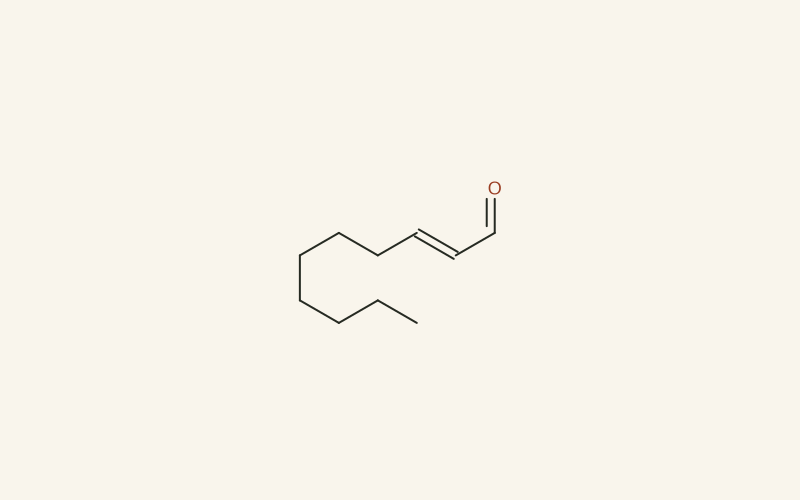
(E)-2-decenal, ChEBI CHEBI:133455, listed there as (2E)-dec-2-enal. Earlier flavor studies cited in the 2012 preprint describe it as one of the soapy-smelling aldehydes in cilantro. Structural diagram, not to scale.
"(E)-2-decenal, structural diagram" by Molecule & Menu, https://moleculeandmenu.com/flavor-chemistry/cilantro-soap-taste/, licensed under CC BY 4.0 (https://creativecommons.org/licenses/by/4.0/)
Data: Structure data: ChEBI (CHEBI:133455), CC BY 4.0
Two people taste the same salsa, and one of them tastes soap. The preprint calls cilantro polarizing: some love it, while others find its taste or smell foul and often compare it to soap or dirt. Its authors add that the dislike may come mostly from smell rather than taste, a point they call suspected but not proven.
Which molecules make cilantro smell like soap?
The preprint, citing two earlier flavor studies, says cilantro’s key aroma compounds are aldehydes. An aldehyde is a molecule that ends in a CHO group, a carbon double-bonded to an oxygen and also bonded to a hydrogen. Two kinds stand out in cilantro. They smell different.
- (E)-2-alkenals, mostly (E)-2-decenal and (E)-2-dodecenal, have one trans double bond right next to the CHO group. They are described as soapy, fatty, pungent, or simply as smelling like cilantro.
- Straight-chain aldehydes with no double bond in the chain, mostly decanal and dodecanal, are described as fruity, green and pungent.
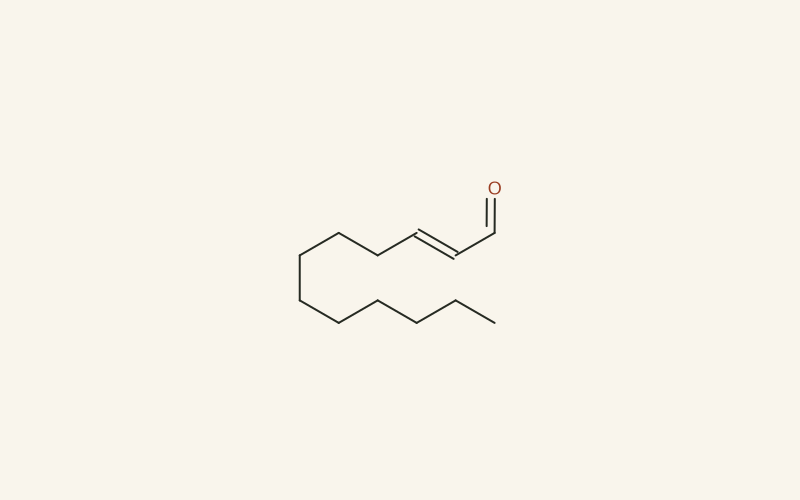
(E)-2-dodecenal, ChEBI CHEBI:133741: the same pattern as (E)-2-decenal with two more carbons in the chain. Structural diagram, not to scale.
"(E)-2-dodecenal, structural diagram" by Molecule & Menu, https://moleculeandmenu.com/flavor-chemistry/cilantro-soap-taste/, licensed under CC BY 4.0 (https://creativecommons.org/licenses/by/4.0/)
Data: Structure data: ChEBI (CHEBI:133741), CC BY 4.0
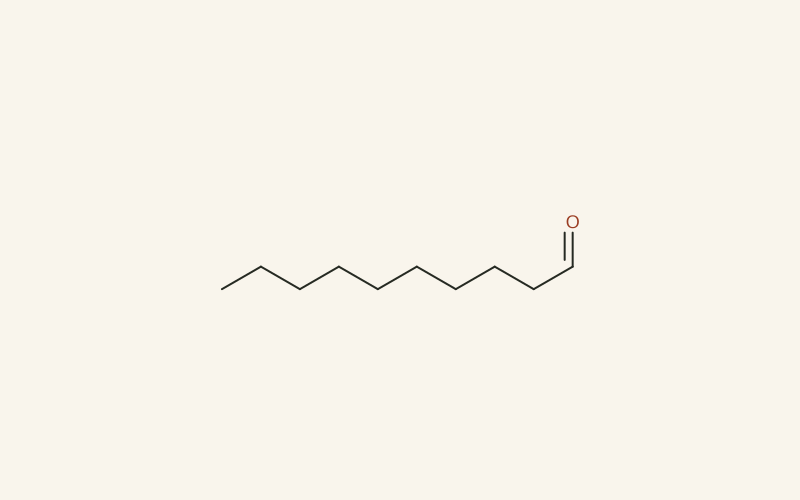
Decanal, ChEBI CHEBI:31457: ten carbons like (E)-2-decenal, but with no double bond in the chain. Structural diagram, not to scale.
"Decanal, structural diagram" by Molecule & Menu, https://moleculeandmenu.com/flavor-chemistry/cilantro-soap-taste/, licensed under CC BY 4.0 (https://creativecommons.org/licenses/by/4.0/)
Data: Structure data: ChEBI (CHEBI:31457), CC BY 4.0
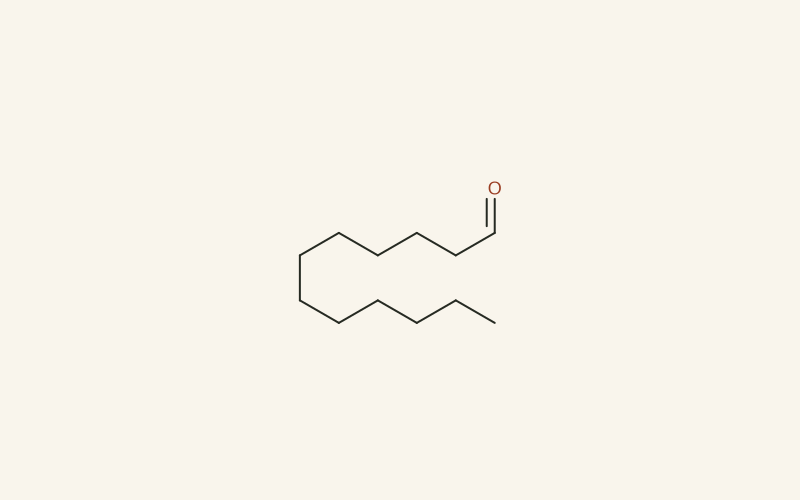
Dodecanal, ChEBI CHEBI:27836: twelve carbons and no double bond in the chain. Structural diagram, not to scale.
"Dodecanal, structural diagram" by Molecule & Menu, https://moleculeandmenu.com/flavor-chemistry/cilantro-soap-taste/, licensed under CC BY 4.0 (https://creativecommons.org/licenses/by/4.0/)
Data: Structure data: ChEBI (CHEBI:27836), CC BY 4.0
| Aldehyde | ChEBI entry | Formula and average mass (g/mol) | Double bond in the chain | Smell, per studies cited in the preprint |
|---|---|---|---|---|
| (E)-2-decenal | CHEBI:133455 | C10H18O, 154.253 | One, trans | Soapy, fatty, pungent |
| (E)-2-dodecenal | CHEBI:133741 | C12H22O, 182.307 | One, trans | Soapy, fatty, pungent |
| Decanal | CHEBI:31457 | C10H20O, 156.269 | None | Fruity, green, pungent |
| Dodecanal | CHEBI:27836 | C12H24O, 184.323 | None | Fruity, green, pungent |
The preprint then ties two of these molecules, decanal and (E)-2-decenal, to one smell receptor, OR6A2. That receptor is often studied in its rat counterpart, so much of the evidence it cites comes from rat rather than human receptors. In that work, every odorant found to switch the receptor on was an aldehyde: straight chains from heptanal to undecanal bind to it, and (E)-2-decenal binds with high affinity.
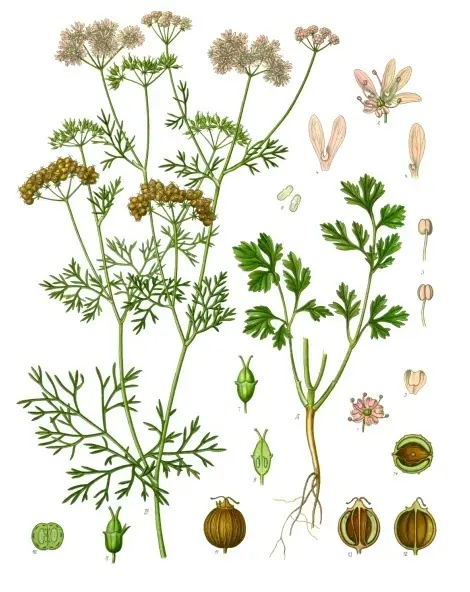
Coriander (Coriandrum sativum) in Köhler’s Medizinal-Pflanzen, a German series of medicinal-plant plates; this plate is dated 1897. The young plant (A) shows the broad lower leaves sold as cilantro; the tall stem (B) carries feathery upper leaves, flower clusters and the round fruits sold as coriander seed.
“Coriandrum sativum (Echter Koriander), Köhler’s Medizinal-Pflanzen” by Franz Eugen Köhler — PD
Full credit
"Coriandrum sativum (Echter Koriander), Köhler’s Medizinal-Pflanzen" by Franz Eugen Köhler, Köhler's Medizinal-Pflanzen — https://commons.wikimedia.org/wiki/File:Coriandrum_sativum_-_K%C3%B6hler%E2%80%93s_Medizinal-Pflanzen-193.jpg — Public domain (Public domain in the US (Köhler's Medizinal-Pflanzen, published in Germany in 1887-1898, this plate in 1897, before 1931) and in the EU (Commons tags the plate PD-old, life plus 70 years, and marks it with the Public Domain Mark; this basis rests on those two tags and the 1887-1898 publication, not on any artist's or editor's death year))
Pyrazines, the roasty-smelling molecules in coffee, are another family of smell molecules, studied against how little of them the nose can detect.
What did the genetic study find?
The participants were customers of a consumer genetics company who answered short online questions. In the discovery group, 14,604 unrelated people of mainly European ancestry were asked whether fresh cilantro tasted like soap to them. Of these, 1,994 said yes, about 14%. Next the authors scanned the genome for variants that differed between the two answers, a method called a genome-wide association study.
Two variants passed the genome-wide threshold. One of them, rs72921001 on chromosome 11, held up in a separate group of 11,851 people who were asked only whether they liked cilantro. Each copy of its A allele came with lower odds of reporting soap, an odds ratio of 0.81, while the C allele went with both tasting soap and disliking the herb. In the liking group the link was weaker: each A allele came with an odds ratio of 0.92 for disliking the herb.
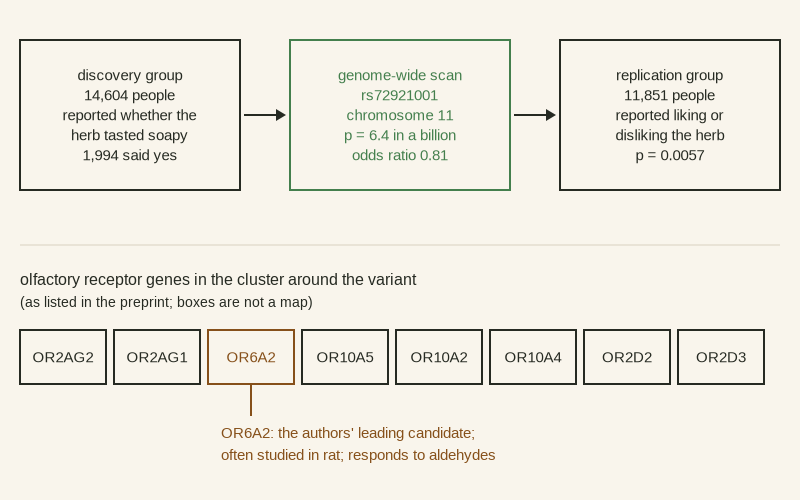
How the 2012 preprint found its variant, and the eight olfactory receptor genes in the cluster around it. The boxes list the genes in the order the preprint gives; they are not a map of the chromosome.
"The 2012 cilantro soap-taste study, step by step" by Molecule & Menu, https://moleculeandmenu.com/flavor-chemistry/cilantro-soap-taste/, licensed under CC BY 4.0 (https://creativecommons.org/licenses/by/4.0/)
| Step | People | What they reported | Result reported |
|---|---|---|---|
| Discovery | 14,604 | Whether the fresh herb tasted soapy to them | rs72921001 on chromosome 11; odds ratio 0.81 per A allele, for reporting soap |
| Replication | 11,851 | Whether they liked or disliked the herb | Same variant confirmed, p = 0.0057; odds ratio 0.92 per A allele, for disliking |
The variant sits among eight olfactory receptor genes. The authors name OR6A2 the most promising candidate because its receptor, often studied in its rat form, responds to aldehydes such as decanal and (E)-2-decenal; OR10A2, they say, may also be a reasonable candidate. Neither is offered as a proven cause. The other variant that passed, in a gene called SNX9, did not hold up in the replication group.
The study also found group differences. Women were more likely than men to report soap, with an odds ratio of 1.36. African-American, Latino, East Asian and South Asian participants were significantly less likely to report it than participants of European ancestry. The preprint notes that dislike of cilantro varies widely by ancestry, citing a 2012 study by Mauer and El-Sohemy, and says it is unclear how much of that comes from things like how often people eat the herb.
How much do the genes explain?
Heritability is the share of the variation in a trait, across a group, that traces to genetic differences, and this study could count only the part tagged by common SNPs. Using the SNPs genotyped in 13,628 unrelated Europeans, the authors estimated the heritability of tasting soap at 0.087, the part that common SNPs combined could account for. That estimate was not statistically different from zero, with a 95% range from −0.037 to 0.211.
The authors treat the 0.087 from common SNPs as a lower bound, because it counts only the variants the study measured. The single variant near OR6A2 explained about 0.5% of the variation. The estimate for common SNPs together is about 17 times larger, which leaves room for other variants. For scale, the preprint cites height, whose total heritability is about 0.8 while common SNPs tag about 0.45.
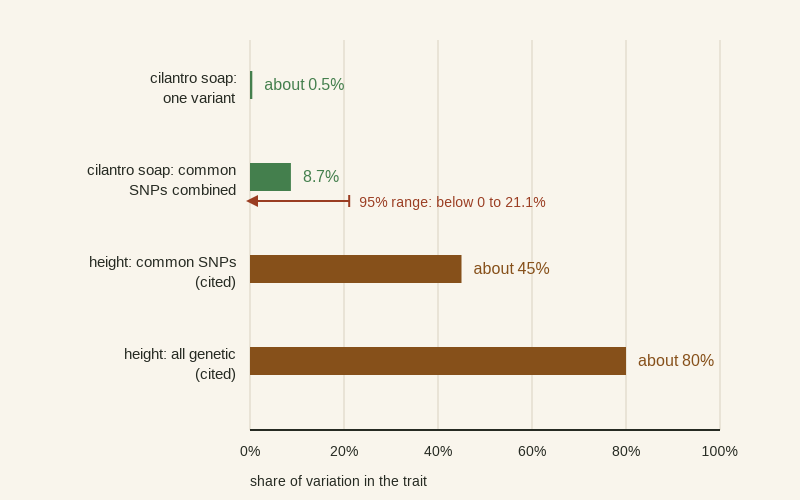
Share of variation explained, as reported in the 2012 preprint. The height bars are figures the preprint cites for comparison. The red line marks the 95% range for the cilantro estimate, which runs from below zero to 21.1%; the arrowhead at 0% shows that it continues past the left end of the scale.
"How much of cilantro soap-tasting the genes explain" by Molecule & Menu, https://moleculeandmenu.com/flavor-chemistry/cilantro-soap-taste/, licensed under CC BY 4.0 (https://creativecommons.org/licenses/by/4.0/)
| Trait and measure | Share of variation | Note |
|---|---|---|
| Cilantro soap, one variant (rs72921001) | about 0.5% | Variance explained |
| Cilantro soap, common SNPs combined | 8.7% | 95% range −3.7% to 21.1%; the authors call it a lower bound |
| Height, common SNPs | about 45% | Cited by the preprint |
| Height, all genetic factors | about 80% | Cited by the preprint |
The authors give three ways to read the gap. Rare variants the chips did not measure could raise the true figure. Many genes, each with a small effect, could share it, as with many complex traits. Or the trait could simply have a low genetic share, with other factors doing more of the work.
Smell runs on about 400 working olfactory receptor genes, the preprint notes, while the TAS1R and TAS2R gene families build the receptors for sweet, umami and bitter tastes on the tongue.
Molecule card
| Name | (2E)-dec-2-enal |
|---|---|
| Molecular formula | C10H18O |
| Molar mass | 154.253 g/mol |
| Shape | Structural diagram, not to scale |
| Where you meet it | Steam-distilled oil of fresh coriander (cilantro) leaves: 15.7-25.1% of the oil across four cultivars in one 2022 study, the most abundant compound in three of them |
| ChEBI ID | CHEBI:133455 |
This card as data (CSV) · Source and license notes
Data: Structure data: ChEBI (CHEBI:133455), CC BY 4.0; Where you meet it: Kumar et al. 2022, Frontiers in Plant Science, CC BY
Sources
- Eriksson N, Wu S, Do CB, Kiefer AK, Tung JY, Mountain JL, Hinds DA, Francke U. A genetic variant near olfactory receptor genes influences cilantro preference. arXiv:1209.2096 [q-bio.GN]; 2012. https://arxiv.org/abs/1209.2096Read: full text of the preprint (version 1); paraphrased, not quoted.
- ChEBI entry CHEBI:133455, (2E)-dec-2-enal (Chemical Entities of Biological Interest, EMBL-EBI). https://www.ebi.ac.uk/chebi/CHEBI:133455Read: entry record (structure, formula, identifiers). License: CC BY 4.0.
- ChEBI entry CHEBI:133741, (E)-dodec-2-enal (Chemical Entities of Biological Interest, EMBL-EBI). https://www.ebi.ac.uk/chebi/CHEBI:133741Read: entry record (structure, formula, identifiers). License: CC BY 4.0.
- ChEBI entry CHEBI:31457, decanal (Chemical Entities of Biological Interest, EMBL-EBI). https://www.ebi.ac.uk/chebi/CHEBI:31457Read: entry record (structure, formula, identifiers). License: CC BY 4.0.
- ChEBI entry CHEBI:27836, dodecanal (Chemical Entities of Biological Interest, EMBL-EBI). https://www.ebi.ac.uk/chebi/CHEBI:27836Read: entry record (structure, formula, identifiers). License: CC BY 4.0.
- Kumar S, Ahmad R, Saeed S, Azeem M, Mozūraitis R, Borg-Karlson AK, Zhu G. Chemical Composition of Fresh Leaves Headspace Aroma and Essential Oils of Four Coriander Cultivars. Frontiers in Plant Science. 2022;13:820644. doi:10.3389/fpls.2022.820644 https://pmc.ncbi.nlm.nih.gov/articles/PMC8891447/Read: full text (PMC8891447): abstract, Materials and Methods (steam distillation of fresh leaves), Results and Table 3. License: CC BY.
- Mauer, L., El-Sohemy, A., Spence, C., Harrar, V., Piqueras-Fiszman, B., Havermans, R., Roefs, A., Nederkoorn, C., Jansen, A., Mouritsen, O., et al. (2012). Prevalence of cilantro (Coriandrum sativum) disliking among different ethnocultural groups. Flavour, 1(1), 8. https://arxiv.org/abs/1209.2096Read: bibliography only, as listed in the reference list of the 2012 preprint (reference 6); the link goes to that preprint, not to this article.
Cite this page
“Why Does Cilantro Taste Like Soap? Aldehydes and Some Genes.” Molecule & Menu. Published November 14, 2026. https://moleculeandmenu.com/flavor-chemistry/cilantro-soap-taste/. Accessed on the date you read it.
How pages here are checked · All corrections · Report an error on this page (contact@moleculeandmenu.com)
Second helping:
More from Flavor Chemistry
Flavor Chemistry
Carvone: Mirror-Image Molecules Some Noses Can’t Tell Apart
Carvone has two mirror-image forms, linked mainly to spearmint and caraway. In a 2019 study, 12 of 46 volunteers screened could not tell them apart at first.
Picture credit
"Mentha viridis (spearmint), Köhler’s Medizinal-Pflanzen" by Franz Eugen Köhler, Köhler's Medizinal-Pflanzen — https://commons.wikimedia.org/wiki/File:Mentha_viridis_-_K%C3%B6hler%E2%80%93s_Medizinal-Pflanzen-096.jpg — Public domain (Public domain in the US (Köhler's Medizinal-Pflanzen, published in Germany in 1887-1898, this plate in 1897, before 1931; the plate is signed W. Müller) and in the EU (Commons tags the plate PD-old, life plus 70 years, and marks it with the Public Domain Mark; this basis rests on those two tags and the 1887-1898 publication, not on any artist's or editor's death year))
Flavor Chemistry
Umami: Glutamate’s Savory Taste, From Kombu Broth to MSG
Umami is the savory taste of glutamate, which Kikunae Ikeda drew from a seaweed broth. The FDA never confirmed MSG caused reported symptoms; see the evidence.
Picture credit (illustration)
Illustration: Molecule & Menu. Generated schematic illustration — not a photograph or historical record. Reuse: CC BY 4.0 (https://creativecommons.org/licenses/by/4.0/), to the extent Molecule & Menu holds rights in this image.
Flavor Chemistry
Scoville Scale: Diluted Until the Tongue Felt a Weak Bite
Scoville’s 1912 test diluted chili extract in sweetened water to a distinct but weak bite. A 2026 review reports labs multiplying capsaicin ppm by 15 to 16.1.
Picture credit
"Capsicum annuum (Spanischer Pfeffer), Köhler’s Medizinal-Pflanzen" by Franz Eugen Köhler, Köhler's Medizinal-Pflanzen — https://commons.wikimedia.org/wiki/File:Capsicum_annuum_-_K%C3%B6hler%E2%80%93s_Medizinal-Pflanzen-027.jpg — Public domain (Public domain in the US (Köhler's Medizinal-Pflanzen, published in Germany in 1887-1898, this plate in 1897, before 1931) and in the EU (Commons tags the plate PD-old, life plus 70 years, and marks it with the Public Domain Mark; this basis rests on those two tags and the 1887-1898 publication, not on any artist's or editor's death year))