Umami: Glutamate’s Savory Taste, From Kombu Broth to MSG
Short answer
Umami is a savory taste, the one in kombu broth that salty or sweet does not describe. Glutamate, an amino acid, produces it. According to the FDA, the Japanese professor Kikunae Ikeda extracted glutamate from a seaweed broth in 1908 and found that it gave the soup its savory taste; MSG is the sodium salt of the same amino acid. The FDA says it was never able to confirm that MSG caused the symptoms people reported, and a 2016 systematic review found no significant headache difference in studies where MSG was taken with food, except in one group of women.
Course list · 5 sections
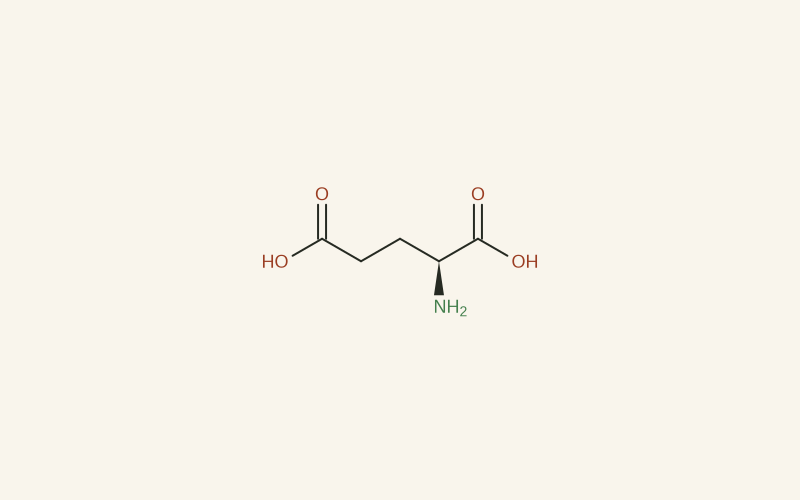
L-glutamic acid, the amino acid behind umami, drawn from its ChEBI record. MSG is its sodium salt. Structural diagram, not to scale.
"L-glutamic acid, structural diagram" by Molecule & Menu, https://moleculeandmenu.com/flavor-chemistry/umami/, licensed under CC BY 4.0 (https://creativecommons.org/licenses/by/4.0/)
Data: Structure data: ChEBI (CHEBI:16015), CC BY 4.0
What is umami?
In chemical terms, umami is the taste of L-glutamate. A 2009 review by S. C. Kinnamon covers how taste cells signal umami. It describes umami as a taste now counted as a fifth basic quality, beside sweet, sour, salty and bitter. The same review notes that two nucleotides, IMP (inosine 5′-monophosphate) and GMP (guanosine 5′-monophosphate), strengthen the taste of glutamate and also taste of umami on their own.
The seasoning and the molecule are close relatives, not the same thing. MSG, monosodium glutamate, is in the FDA’s words “the sodium salt of the common amino acid glutamic acid.” A 2019 review of MSG by Anca Zanfirescu and colleagues notes that glutamic acid on its own has only a mild umami taste compared with MSG. The structure on this page is the acid form from ChEBI; the sodium salt is not drawn.
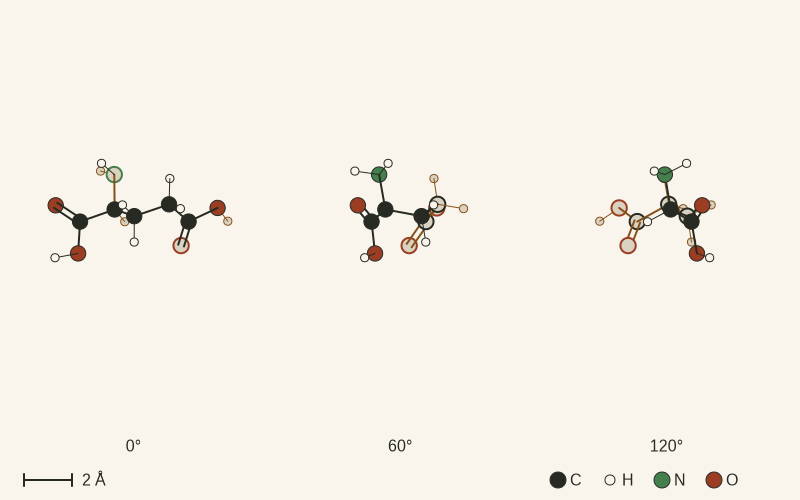
Computed 3D conformer generated by Molecule & Menu from the ChEBI SMILES (RDKit 2026.09.2), not an experimentally measured shape. Three views of one computed shape of L-glutamic acid, each turned 60 degrees from the last.
"L-glutamic acid, computed 3D conformer" by Molecule & Menu, https://moleculeandmenu.com/flavor-chemistry/umami/, licensed under CC BY 4.0 (https://creativecommons.org/licenses/by/4.0/)
Data: Structure data: ChEBI (CHEBI:16015), CC BY 4.0
The L in L-glutamic acid marks one of the two mirror-image forms of the molecule. The ChEBI record (CHEBI:16015) gives the formula C5H9NO4 and an average mass of 147.130 g/mol. The mirror-image form, D-glutamate, comes back in the receptor section below, because the receptor study tested both.
Small changes to the molecule change the taste. The 2019 review reports that turning glutamic acid into an ester or an amide weakens its umami, and that only acidic relatives of glutamic acid, such as L-aspartic acid and succinic acid, were reported to have some umami effect. Theanine, a natural constituent of green tea built on glutamic acid, also has umami properties, which the review takes as support for the idea that a free carboxylic acid group matters.
A professor and a bowl of seaweed broth
The FDA’s account of umami begins with a dish: a glutamate-rich seaweed broth, which the agency calls a historical dish in the Asian community. In 1908, the agency says, Kikunae Ikeda, a Japanese professor, extracted glutamate from this broth and determined that glutamate gave the soup its savory taste. Kinnamon’s 2009 review names the seaweed. Ikeda isolated L-glutamate from dried kombu, a kelp, and identified it as a taste unlike bitter, sweet, salty or sour.
He named the taste umami, from the Japanese word umai, according to the same review. Ikeda then filed a patent to produce MSG, and the FDA page says commercial production started the following year; it gives no year for the patent. The method has changed since. MSG is no longer extracted and crystallized from seaweed broth but made by fermenting starch, sugar beets, sugar cane or molasses, a process the FDA compares to the making of yogurt, vinegar and wine.
The 1908 result did not settle the question of a fifth taste at once. Kinnamon writes that umami was not completely accepted as a separate taste quality until receptors for glutamate taste were identified, receptors that responded more strongly when nucleotides were added, just as the taste does. Ikeda’s own report appears in this page’s sources through its 2002 English translation. This page did not read the translation.
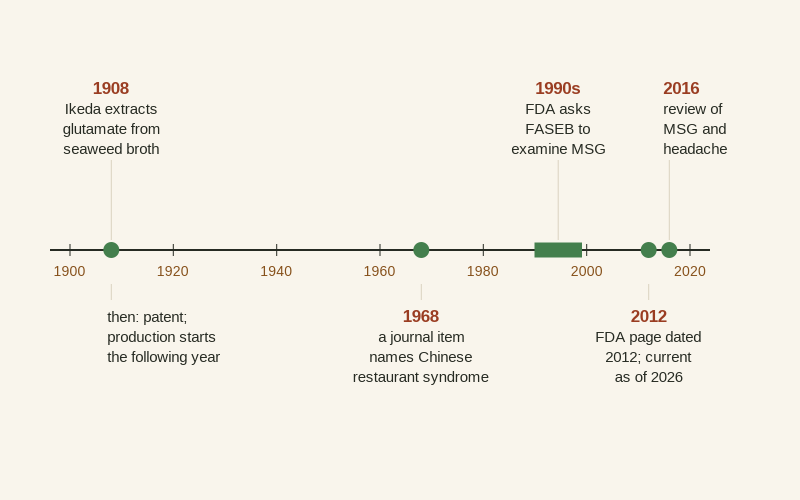
Dated events on this page, from the FDA question-and-answer page and the 2016 systematic review. The FDA gives no year for Ikeda’s patent, so it sits beside 1908 as a note. The 2002 receptor report is covered in the next section.
"Umami and MSG: dated events, 1908 to 2016" by Molecule & Menu, https://moleculeandmenu.com/flavor-chemistry/umami/, licensed under CC BY 4.0 (https://creativecommons.org/licenses/by/4.0/)
Data: FDA, Questions and Answers on Monosodium glutamate (MSG) (public domain); Obayashi & Nagamura, J Headache Pain 17:54 (2016), CC BY 4.0; retrieved 2026-11-13
| Year | Event | Source |
|---|---|---|
| 1908 | Ikeda extracts glutamate from a seaweed broth and links it to the savory taste | FDA |
| After the 1908 extraction, no year given | Patent filed; commercial production starts the following year | FDA |
| 1968 | A one-page journal item names Chinese restaurant syndrome | 2016 review, citing the item |
| 1990s | FDA asks FASEB to examine MSG | FDA |
| 2012 | FDA question-and-answer page on MSG, current as of July 2026 | FDA |
| 2016 | Systematic review of MSG and headache | Obayashi and Nagamura |
Download the timeline (CSV) (source and license notes) Data: FDA (public domain); Obayashi & Nagamura 2016, CC BY 4.0; retrieved 2026-11-13
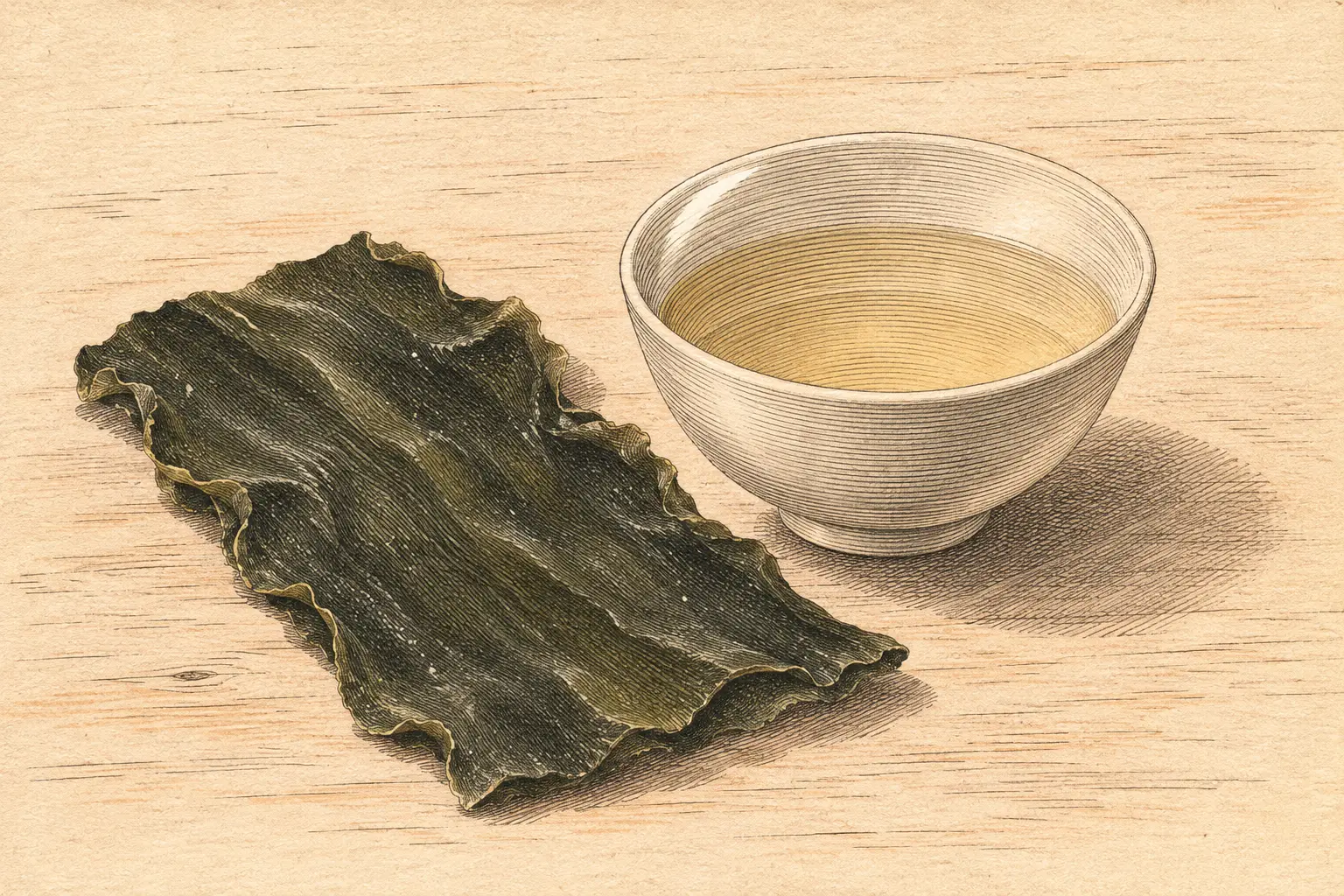
An illustration of kombu, a dried kelp, beside a bowl of clear seaweed broth, where the umami story starts.
Illustration: Molecule & Menu. Generated schematic illustration — not a photograph or historical record. Reuse: CC BY 4.0 (https://creativecommons.org/licenses/by/4.0/), to the extent Molecule & Menu holds rights in this image.
How does the tongue detect umami?
Taste starts at receptor proteins on taste cells, and one receptor pair studied for umami is T1R1 with T1R3. In 2002, Li and colleagues reported that human cells grown in the laboratory and given human T1R1 and T1R3 responded to L-glutamate. The nucleotides IMP and GMP did nothing on their own, but they boosted the response to glutamate. A third nucleotide, CMP, which does not strengthen umami taste, had no effect.
That pattern tracks the taste closely. With 0.2 millimolar IMP present, the cells needed about 30 times less glutamate to reach half of their top response, and the authors note that the effect resembles the way IMP boosts umami taste. The cells did not respond to sugars or sweeteners, and they did not respond to D-glutamate, the mirror image of L-glutamate. Mirror images matter in smell as well; carvone is the kitchen example, with two forms that some noses cannot tell apart.
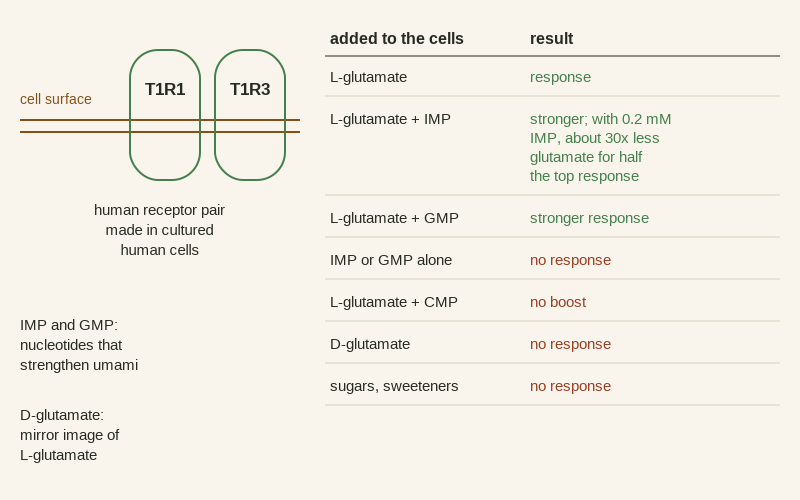
What the 2002 study added to cultured human cells carrying T1R1 and T1R3, and what it reported. The schematic is drawn from the paper’s text, not from its figures, and does not show where the receptor sits on the tongue.
"T1R1 and T1R3 in cultured cells: what they responded to" by Molecule & Menu, https://moleculeandmenu.com/flavor-chemistry/umami/, licensed under CC BY 4.0 (https://creativecommons.org/licenses/by/4.0/)
Data: Outcomes paraphrased from Li et al., Proc. Natl. Acad. Sci. USA 99(7):4692–4696 (2002), retrieved 2026-11-13; schematic drawn independently, not copied from the paper’s figures
| Added to the cells | Result reported in 2002 |
|---|---|
| L-glutamate | Response |
| L-glutamate with IMP | Stronger; with 0.2 mM IMP, about 30 times less glutamate for half the top response |
| L-glutamate with GMP | Stronger |
| IMP or GMP alone | No response |
| L-glutamate with CMP | No boost |
| D-glutamate | No response |
| Sugars and sweeteners | No response |
The test also reached beyond glutamate. The authors describe L-aspartate and a compound called L-AP4 as weak umami stimuli. Neither activated T1R1/T1R3 on its own. Both did once IMP or GMP was present.
The 2002 result came from cells in a dish, not from people tasting, and it was not the last word. Kinnamon’s 2009 review lists other glutamate receptors found in taste cells, including taste forms of the metabotropic glutamate receptors mGluR4 and mGluR1. It also reports that knockout studies, in which a receptor gene is switched off, disagree. In one, losing T1R1 or T1R3 removed the response to glutamate; in another, losing T1R3 removed mainly the boost from nucleotides, and the review reads this as a sign that umami has more than one receptor.
This page does not name the invisible ingredient, the unlisted condition this site looks for in a cooking process. In the sources read here, umami depends on which molecules reach which receptors. None of them measures a kitchen condition, such as heat or time, that changes the taste.
Does MSG cause headaches?
The FDA notes that many people identify themselves as sensitive to MSG. According to the 2016 systematic review discussed below, the complaint was first reported in 1968, in a one-page item in the New England Journal of Medicine that described short-lived symptoms such as numbness, weakness and palpitations after meals of Chinese dishes. The review calls the symptoms by the name they came to carry, Chinese restaurant syndrome.
The FDA’s question-and-answer page on MSG addresses such reports directly. “Over the years, FDA has received reports of symptoms such as headache and nausea after eating foods containing MSG,” it says. “However, we were never able to confirm that the MSG caused the reported effects.” The same page says that when people who consider themselves sensitive were given MSG or a placebo in studies, scientists could not trigger reactions consistently.
As of 2026, the agency places MSG added to food in its “generally recognized as safe” (GRAS) category, a regulatory status. In the 1990s it asked an independent group, the Federation of American Societies for Experimental Biology (FASEB), to examine MSG. The FDA’s summary of that report lists short-term, generally mild symptoms, such as headache and flushing, that may occur in some sensitive people who take 3 grams or more of MSG without food.
What the 2016 review counted
That condition, with or without food, is also how the 2016 review sorts the evidence. Yoko Obayashi and Yoichi Nagamura, writing in The Journal of Headache and Pain, gathered human studies that recorded headaches after people took MSG by mouth. Of six studies with food, “none showed a significant difference in the incidence of headache except for the female group in one study.” Of seven studies without food, four found a significant difference.
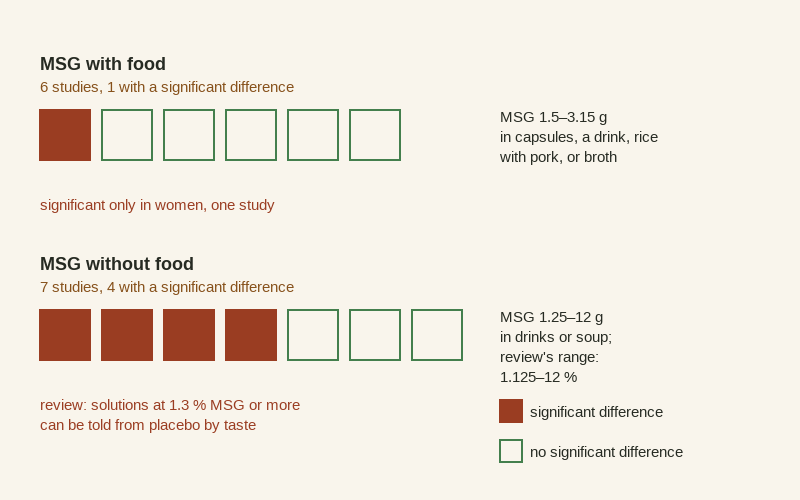
Studies in the 2016 systematic review, one square each, sorted by whether the MSG was taken with food. The one significant difference with food was among women in a single study. In the studies without food, the MSG was dissolved at strengths the review says can be recognized by taste.
"MSG and headache: studies with and without food in a 2016 systematic review" by Molecule & Menu, https://moleculeandmenu.com/flavor-chemistry/umami/, licensed under CC BY 4.0 (https://creativecommons.org/licenses/by/4.0/)
Data: Obayashi & Nagamura, J Headache Pain 17:54 (2016), CC BY 4.0, retrieved 2026-11-13
In the studies without food, MSG was dissolved in drinks or soup, at strengths the review gives as 1.125 to 12 percent. The authors judge that MSG is easy to recognize by taste at such strengths, so the volunteers may have known which drink they had. They estimate that a drink with 1.3 percent MSG or more can be told from a placebo. Some of the trials were also small: two of the four that found a difference had 14 volunteers each.
The authors conclude that “it would seem premature to conclude that the MSG present in food causes headache,” and that further studies are needed to settle whether MSG causes headache at all. They also disclose that the first author is an employee of an MSG manufacturer belonging to the International Glutamate Technical Committee, which paid the article’s publication fee.
A 2019 review of MSG’s alleged health hazards by Zanfirescu and colleagues reads the symptom reports in a similar way. It finds little supporting evidence for MSG hypersensitivity and notes that the first studies were small and flawed. Larger double-blind trials, it says, found no difference between MSG and placebo groups. It also cites studies in which large amounts of MSG taken without solid food were linked to more symptoms.
The sources measure different things. The FDA statement concerns reports sent to the agency, which it could not confirm, while the 2016 review counts controlled trials, and its clearest positive results come from the studies whose blinding it doubts. The 2019 review adds that MSG sensitivity is usually self-assessed and that placebo responses are thought to play a part. This page gives no dietary or medical advice and draws no conclusion about safety.
| Source | What it reports | Condition | Studies | With a significant headache difference |
|---|---|---|---|---|
| FDA, as of 2026 | Never able to confirm that MSG caused reported effects | Reports sent to the agency | Not given | Not given |
| FDA, as of 2026 | Reactions not triggered consistently | People who see themselves as sensitive, given MSG or a placebo | Not given | Not given |
| 2016 review | A significant difference only among women in one study | MSG with food, 1.5–3.15 g | 6 | 1 |
| 2016 review | A significant difference in four studies; blinding questioned | MSG without food, 1.25–12 g dissolved | 7 | 4 |
Download the MSG evidence table (CSV) (source and license notes) Data: FDA (public domain); Obayashi & Nagamura 2016, CC BY 4.0; retrieved 2026-11-13
Where else does glutamate turn up?
MSG is only one source of glutamate in a kitchen. The FDA names tomatoes and cheeses as foods in which it occurs naturally. Free glutamate also comes with ingredients such as hydrolyzed vegetable protein, autolyzed yeast, yeast extract, soy extracts and protein isolate. Zanfirescu’s review adds meat, fish, mushrooms and cheeses such as Roquefort and Parmesan.
Protein is the hidden supply. Proteins are built from amino acids, glutamic acid among them. The FDA says that digesting protein releases free glutamate that is chemically the same as the glutamate in MSG. The FDA also does not allow foods made with ingredients such as yeast extract or hydrolyzed vegetable protein to claim “No MSG” or “No added MSG” on the package.
Labels show the line the agency draws. Added MSG must be listed as “monosodium glutamate,” while ingredients that contain free glutamate naturally are listed under their own names. The label need not say that those ingredients contain glutamate. Other salts of glutamic acid, such as monopotassium glutamate, must also be named.
The two nucleotides that strengthen umami have their own trail through the kitchen. The 2019 review lists them in processed meat, canned vegetables, soups, sauces, dried bouillon cubes and salty snacks. It notes that IMP is added to bring out the umami of MSG. The review also says that how much umami adds to a dish depends above all on the concentration of the umami substance and on the food around it.
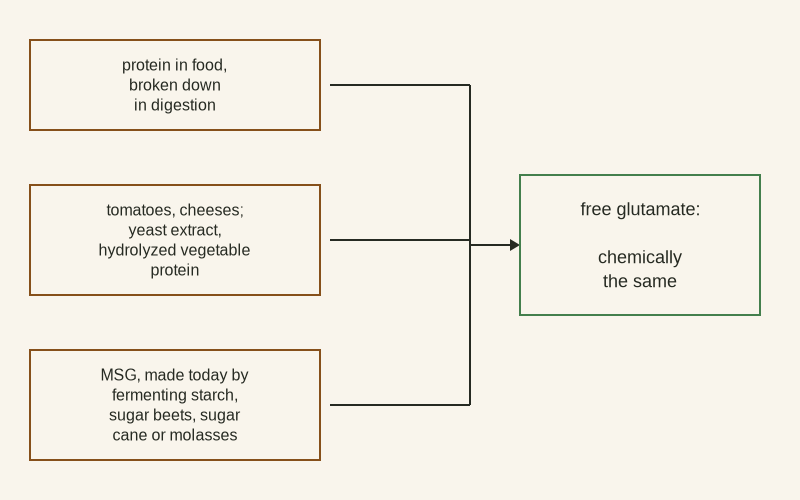
Three routes to free glutamate described on the FDA’s question-and-answer page. Whatever the route, the FDA says the glutamate is chemically the same.
"Where free glutamate comes from" by Molecule & Menu, https://moleculeandmenu.com/flavor-chemistry/umami/, licensed under CC BY 4.0 (https://creativecommons.org/licenses/by/4.0/)
Data: FDA, Questions and Answers on Monosodium glutamate (MSG) (public domain), retrieved 2026-11-13
Amino acids, the family glutamate belongs to, also take part in a different kitchen process. The Maillard reaction, defined in a 2025 review by El Hosry and colleagues as a reaction between amino acid residues and reducing sugars, is one of two non-enzymatic browning reactions that the review ties to the color and aroma changes of baking. None of the sources read for this page measures how that browning changes a food’s umami, so the two are linked here by chemistry only.
Molecule card
| Name | L-glutamic acid |
|---|---|
| Molecular formula | C5H9NO4 |
| Molar mass | 147.130 g/mol |
| Shape | Computed 3D conformer generated by Molecule & Menu from the ChEBI SMILES (RDKit ETKDG), not an experimentally measured shape |
| Where you meet it | A glutamate-rich seaweed broth |
| ChEBI ID | CHEBI:16015 |
This card as data (CSV) · Source and license notes
Data: Structure data: ChEBI (CHEBI:16015), CC BY 4.0; FDA (public domain), for the where-you-meet-it row; retrieved 2026-11-13
Sources
- U.S. Food and Drug Administration. Questions and Answers on Monosodium glutamate (MSG). Page dated November 19, 2012; content current as of July 17, 2026. https://www.fda.gov/food/food-additives-petitions/questions-and-answers-monosodium-glutamate-msgRead: full page.
- Kinnamon, S. C. (2009). Umami taste transduction mechanisms. The American Journal of Clinical Nutrition, 90(3), 753S–755S. https://doi.org/10.3945/ajcn.2009.27462K https://pmc.ncbi.nlm.nih.gov/articles/PMC3136003/Read: full text, paraphrased.
- Li, X., Staszewski, L., Xu, H., Durick, K., Zoller, M., & Adler, E. (2002). Human receptors for sweet and umami taste. Proceedings of the National Academy of Sciences of the USA, 99(7), 4692–4696. https://doi.org/10.1073/pnas.072090199 https://doi.org/10.1073/pnas.072090199Read: full text, paraphrased.
- Obayashi, Y., & Nagamura, Y. (2016). Does monosodium glutamate really cause headache? A systematic review of human studies. The Journal of Headache and Pain, 17, 54. https://doi.org/10.1186/s10194-016-0639-4 https://pmc.ncbi.nlm.nih.gov/articles/PMC4870486/Read: full text.
- Zanfirescu, A., Ungurianu, A., Tsatsakis, A. M., Nițulescu, G. M., Kouretas, D., Veskoukis, A., Tsoukalas, D., Engin, A. B., Aschner, M., & Margină, D. (2019). A review of the alleged health hazards of monosodium glutamate. Comprehensive Reviews in Food Science and Food Safety, 18(4), 1111–1134. https://doi.org/10.1111/1541-4337.12448 https://pmc.ncbi.nlm.nih.gov/articles/PMC6952072/Read: full text, paraphrased.
- ChEBI entry CHEBI:16015, L-glutamic acid (Chemical Entities of Biological Interest, EMBL-EBI). https://www.ebi.ac.uk/chebi/CHEBI:16015Read: entry record (structure, formula, identifiers).
- El Hosry, L., Elias, V., Chamoun, V., Halawi, M., Cayot, P., Nehme, A., & Bou-Maroun, E. (2025). Maillard Reaction: Mechanism, Influencing Parameters, Advantages, Disadvantages, and Food Industrial Applications: A Review. Foods, 14(11), 1881. https://doi.org/10.3390/foods14111881 https://pmc.ncbi.nlm.nih.gov/articles/PMC12154226/Read: full text. License: CC BY 4.0.
- Ikeda, K. (2002). New seasonings. Chemical Senses, 27(9), 847–849. https://doi.org/10.1093/chemse/27.9.847 (English translation of Ikeda’s report on glutamate and umami) https://doi.org/10.1093/chemse/27.9.847Read: bibliography only.
- Kwok, R. H. (1968). Chinese-restaurant syndrome. New England Journal of Medicine, 278(14), 796. https://doi.org/10.1056/NEJM196804042781419 https://doi.org/10.1056/NEJM196804042781419Read: bibliography only.
Cite this page
“Umami: Glutamate’s Savory Taste, From Kombu Broth to MSG.” Molecule & Menu. Published November 14, 2026. https://moleculeandmenu.com/flavor-chemistry/umami/. Accessed on the date you read it.
How pages here are checked · All corrections · Report an error on this page (contact@moleculeandmenu.com)
Second helping:
- Scoville scale: Chili heat is another sensation on the tongue, and a 1912 test measured it by diluting a pepper extract until one taster found a weak but distinct bite.
- Why does cilantro taste like soap: Why some people find cilantro soapy, and how little of that the measured genes explain.
More from Flavor Chemistry
Flavor Chemistry
Carvone: Mirror-Image Molecules Some Noses Can’t Tell Apart
Carvone has two mirror-image forms, linked mainly to spearmint and caraway. In a 2019 study, 12 of 46 volunteers screened could not tell them apart at first.
Picture credit
"Mentha viridis (spearmint), Köhler’s Medizinal-Pflanzen" by Franz Eugen Köhler, Köhler's Medizinal-Pflanzen — https://commons.wikimedia.org/wiki/File:Mentha_viridis_-_K%C3%B6hler%E2%80%93s_Medizinal-Pflanzen-096.jpg — Public domain (Public domain in the US (Köhler's Medizinal-Pflanzen, published in Germany in 1887-1898, this plate in 1897, before 1931; the plate is signed W. Müller) and in the EU (Commons tags the plate PD-old, life plus 70 years, and marks it with the Public Domain Mark; this basis rests on those two tags and the 1887-1898 publication, not on any artist's or editor's death year))
Flavor Chemistry
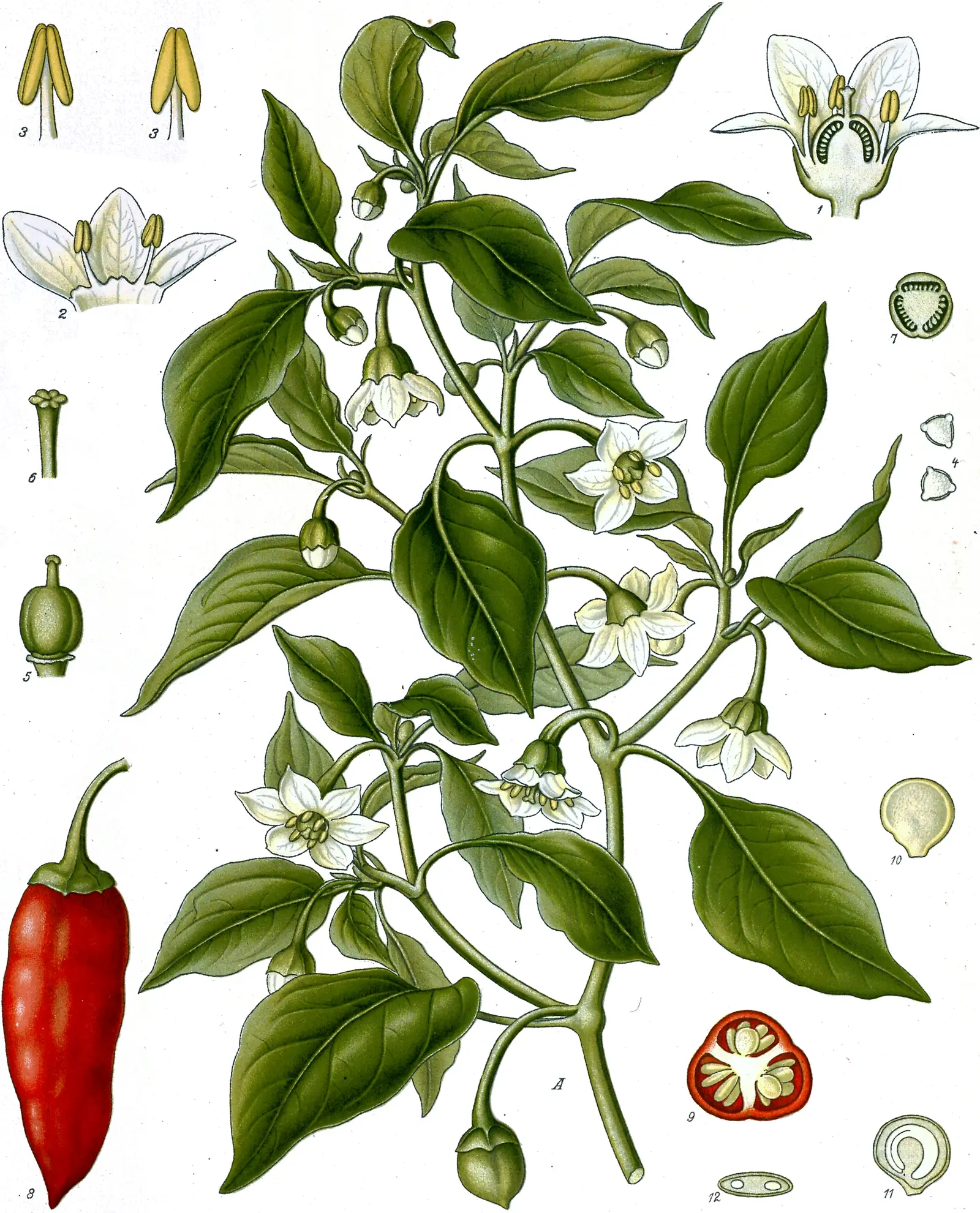
Scoville Scale: Diluted Until the Tongue Felt a Weak Bite
Scoville’s 1912 test diluted chili extract in sweetened water to a distinct but weak bite. A 2026 review reports labs multiplying capsaicin ppm by 15 to 16.1.
Picture credit
"Capsicum annuum (Spanischer Pfeffer), Köhler’s Medizinal-Pflanzen" by Franz Eugen Köhler, Köhler's Medizinal-Pflanzen — https://commons.wikimedia.org/wiki/File:Capsicum_annuum_-_K%C3%B6hler%E2%80%93s_Medizinal-Pflanzen-027.jpg — Public domain (Public domain in the US (Köhler's Medizinal-Pflanzen, published in Germany in 1887-1898, this plate in 1897, before 1931) and in the EU (Commons tags the plate PD-old, life plus 70 years, and marks it with the Public Domain Mark; this basis rests on those two tags and the 1887-1898 publication, not on any artist's or editor's death year))
Flavor Chemistry
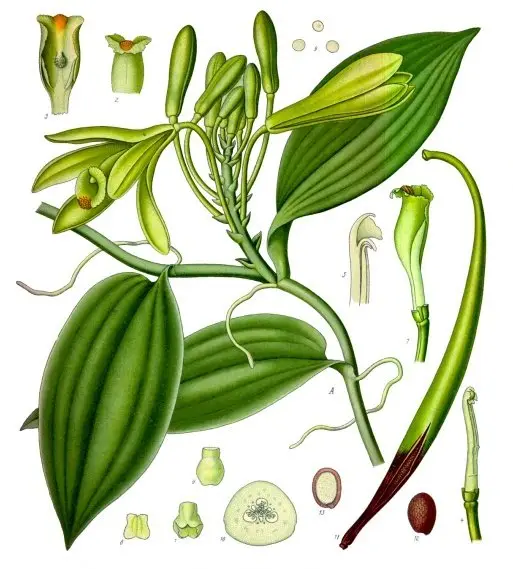
Vanillin: One Review Puts the Synthetic Share at 88%
Most vanillin is synthetic: a 2024 review puts it at 88% of the market, plant-based at 11.5% and vanilla pods at 1.5%. Carbon isotopes can hint at the source.
Picture credit
"Vanilla planifolia (Echte Vanille), Köhler's Medizinal-Pflanzen" by Franz Eugen Köhler, Köhler's Medizinal-Pflanzen — https://commons.wikimedia.org/wiki/File:Vanilla_planifolia_-_K%C3%B6hler%E2%80%93s_Medizinal-Pflanzen-278.jpg — Public domain (Public domain in the US (Köhler's Medizinal-Pflanzen, published in Germany in 1887-1898, this plate in 1897, before 1931) and in the EU (Commons tags the plate PD-old, life plus 70 years, and marks it with the Public Domain Mark; this basis rests on those two tags and the 1887-1898 publication, not on any artist's or editor's death year))