Vanillin: One Review Puts the Synthetic Share at 88%
Short answer
Most of the world's vanillin is made by chemical synthesis, not taken from vanilla pods. A 2024 review by D'Arrigo and colleagues puts synthetic vanillin at 88% of the global market, plant-based vanillin made with microbes or enzymes at 11.5%, and vanillin from pods at 1.5%. As printed, the three shares add up to 101%. The review adds that the molecule is chemically the same whatever its origin, though its carbon isotopes can hint at where a sample came from.
Course list · 4 sections
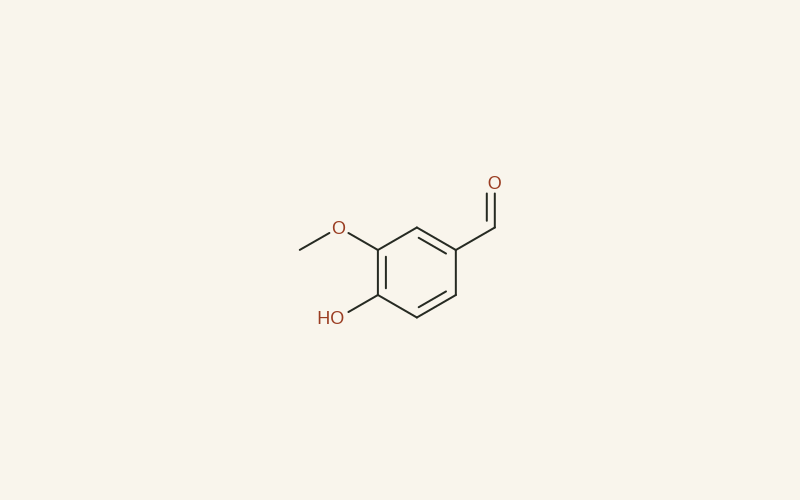
Vanillin, which a 2024 review calls the most important aroma component of natural vanilla. The ring carries an aldehyde group at the upper right and, side by side, a methoxy group and a hydroxy group. Structural diagram, not to scale. Structure data: ChEBI (CHEBI:18346), CC BY 4.0.
"Vanillin, structural diagram" by Molecule & Menu, https://moleculeandmenu.com/flavor-chemistry/vanillin/, licensed under CC BY 4.0 (https://creativecommons.org/licenses/by/4.0/)
Data: Structure data: ChEBI (CHEBI:18346), CC BY 4.0
A vanilla pod and a factory batch can hold the same molecule. The route to it differs. So do the price and the label. This page follows the numbers in two 2024 reviews and the US federal list of flavoring substances, and it notes where those numbers disagree.
What is vanillin?
Vanillin is a small aromatic aldehyde. Its chemical name is 4-hydroxy-3-methoxybenzaldehyde, which spells out the three groups on its six-carbon ring: a hydroxy group (OH), a methoxy group (OCH3) and an aldehyde group (CHO). Its ChEBI entry, CHEBI:18346, gives the formula C8H8O3 and an average mass of 152.149 g/mol. The D'Arrigo review describes it as a white solid that dissolves in water and gives natural vanilla its “sweet and creamy odor.”
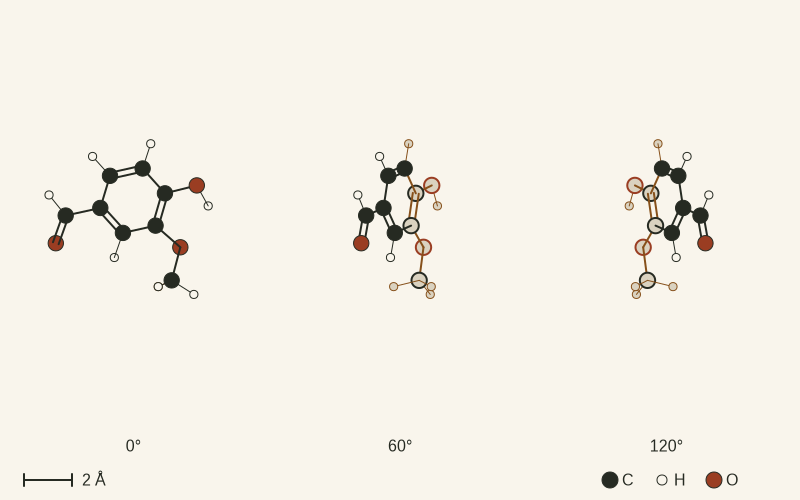
The same molecule in three views, turned 60 degrees each time. Computed 3D conformer generated by Molecule & Menu from the ChEBI SMILES (RDKit 2026.09.2), not an experimentally measured shape. Structure data: ChEBI (CHEBI:18346), CC BY 4.0.
"Vanillin, computed 3D conformer" by Molecule & Menu, https://moleculeandmenu.com/flavor-chemistry/vanillin/, licensed under CC BY 4.0 (https://creativecommons.org/licenses/by/4.0/)
Data: Structure data: ChEBI (CHEBI:18346), CC BY 4.0
In the pod, vanillin starts out tied to a sugar. According to the review, the green bean holds it as vanillin glucoside. During curing, enzymes split it into vanillin and glucose, and the review puts the result at about 20 g of vanillin per kg of beans. Vanillin is only one part of the pod's smell: the review counts more than 200 components in natural vanilla flavoring.
The same ring pattern, with the hydroxy and methoxy groups side by side, turns up in other food molecules. ChEBI lists capsaicin, the compound behind chili heat, under the synonym (E)-8-methyl-N-vanillyl-6-nonenamide, a vanillyl group joined to a fatty chain. Its structure is drawn on the Scoville scale page.
Where does the world's vanillin come from?
The review sorts commercial vanillin by origin. Natural vanillin comes from vanilla pods, or it is plant-based: made by microbes or enzymes from starting materials such as ferulic acid, eugenol, isoeugenol or guaiacol taken from wood, rice, cloves or straw. Synthetic vanillin is made by chemical methods from oil-derived products or from plant-based precursors.
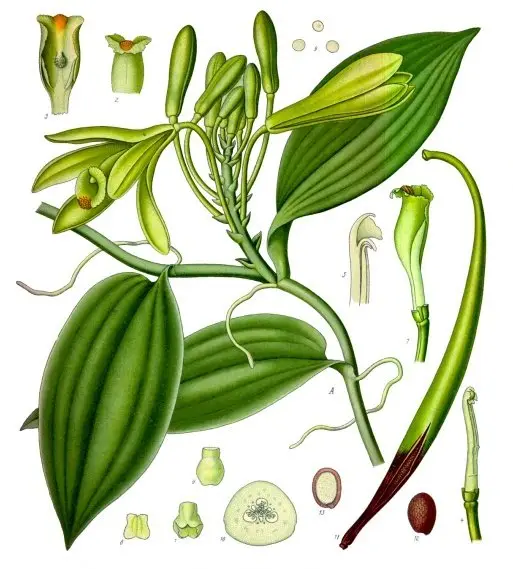
Vanilla planifolia, the species the 2024 review calls the most cultivated for its pod quality and yield, in Köhler's Medizinal-Pflanzen, a German book of medicinal-plant plates: a flowering stem and, at right, a long pod (11). The plate shows the plant, not how much vanillin it yields.
“Vanilla planifolia (Echte Vanille), Köhler's Medizinal-Pflanzen” by Franz Eugen Köhler — PD
Full credit
"Vanilla planifolia (Echte Vanille), Köhler's Medizinal-Pflanzen" by Franz Eugen Köhler, Köhler's Medizinal-Pflanzen — https://commons.wikimedia.org/wiki/File:Vanilla_planifolia_-_K%C3%B6hler%E2%80%93s_Medizinal-Pflanzen-278.jpg — Public domain (Public domain in the US (Köhler's Medizinal-Pflanzen, published in Germany in 1887-1898, this plate in 1897, before 1931) and in the EU (Commons tags the plate PD-old, life plus 70 years, and marks it with the Public Domain Mark; this basis rests on those two tags and the 1887-1898 publication, not on any artist's or editor's death year))
For the market split, the review gives three figures in one sentence: “Synthetic vanillin accounts for 88% of the global market, whereas natural vanillin from pods accounts for only 1.5% and plant-based vanillin 11.5%.” By this page's arithmetic, the three add up to 101%, not 100%. The chart below shows them as printed rather than forcing them to fit.
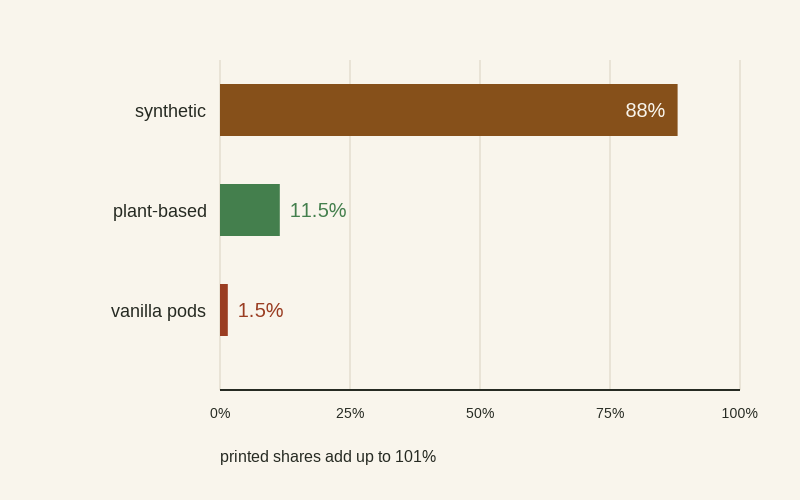
Shares of the global vanillin market by origin, as printed in one 2024 review. The three figures add up to 101%, so they are drawn as separate bars, not as one whole.
"Vanillin market shares by origin in one 2024 review" by Molecule & Menu, https://moleculeandmenu.com/flavor-chemistry/vanillin/, licensed under CC BY 4.0 (https://creativecommons.org/licenses/by/4.0/)
The same review gives a second figure for the natural side. Its introduction says natural vanilla extract makes up “less than 1% of the total vanillin production” and amounts to around 50 tons a year worldwide. Either way, pod vanillin is a small slice. The exact size depends on which passage, and which definition, a reader takes.
Most synthetic vanillin starts from guaiacol. The review credits one guaiacol route, the Riedel process, with 85% of total production, and notes that synthetic vanillin “has to be labelled ‘synthetic or artificial vanilla flavor’.”
US regulation names vanillin directly. Title 21 of the Code of Federal Regulations, section 182.60, lists vanillin and ethyl vanillin among synthetic flavoring substances generally recognized as safe (GRAS) for their intended use. The same list includes d- or l-carvone, the mirror-image molecule on the Carvone page.
Castoreum is on the neighboring list, 21 CFR 182.50, among natural extracts on the GRAS list. That section is headed “Certain other spices, seasonings, essential oils, oleoresins, and natural extracts.” This page has no readable source for how much castoreum, if any, is used, so it gives no figure.
How much vanillin is made each year?
In two 2024 reviews, the yearly figures run from about 12,000 to 20,000 tons, and they do not all measure the same thing. This page reports the range and does not average it.
- The D'Arrigo review gives annual production of around 20,000 t, in a sentence noting that 15% of it is obtained from lignin, a woody polymer left over from papermaking.
- A second 2024 review, by Venkataraman and colleagues in Food Science and Biotechnology, gives three numbers in different passages, two of them citing earlier work: market demand of about 20,000 tons, roughly 16,000 metric tons manufactured each year, and about 12,000 tons a year of industrial-level production, which it says relies on chemical synthesis.
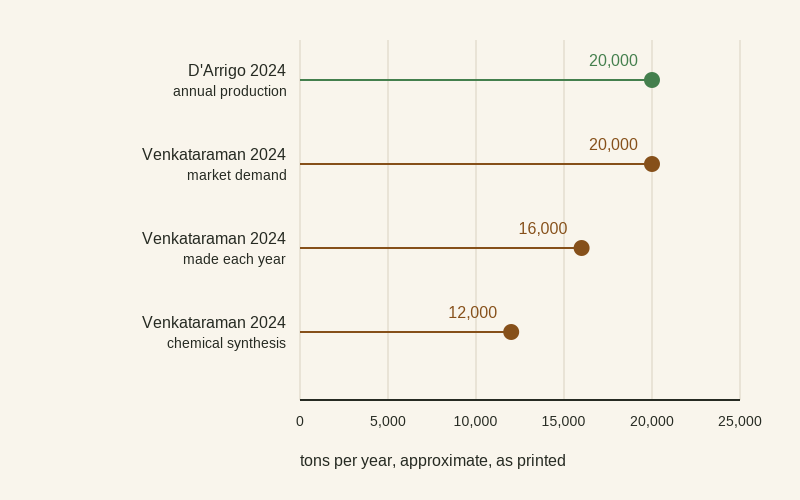
Yearly vanillin figures from two 2024 reviews, each given as approximate and in tons as printed. The labels show what each number measures: production, demand, total manufacture or industrial-level chemical synthesis. They are not averaged. Green: the D'Arrigo review, whose figure is also in the market-shares CSV. Brown: the Venkataraman review, paraphrased here and not in any CSV.
"Annual vanillin figures in two 2024 reviews" by Molecule & Menu, https://moleculeandmenu.com/flavor-chemistry/vanillin/, licensed under CC BY 4.0 (https://creativecommons.org/licenses/by/4.0/)
Estimates for the natural side differ even more. The D'Arrigo introduction puts natural vanilla extract at around 50 tons a year. The Venkataraman review, citing earlier work, puts the natural supply at less than 2,000 tons. This page found no explanation for the gap in either paper.
Can a lab tell synthetic vanillin from vanilla?
Not by the molecule itself. The D'Arrigo review states it plainly: “From a chemical standpoint, there is no difference between vanillin deriving from vanilla plants and vanillin prepared through synthetic methods.” The review ties the search for a test to fraud, the swapping of costly natural vanillin for cheaper synthetic vanillin.
What can differ is the mix of carbon atoms. Carbon comes in a light form, carbon-12, and a rarer heavy form, carbon-13. Chemists convert the ratio of the two into a δ13C value, expressed in parts per thousand (per mil), where a more negative value means less carbon-13.
The vanilla plant fixes carbon dioxide by a pathway called CAM photosynthesis, and the review cites earlier measurements that place pod vanillin at −22.2 to −14.6 per mil. Petrochemical vanillin sits at −36.2 to −24.9.
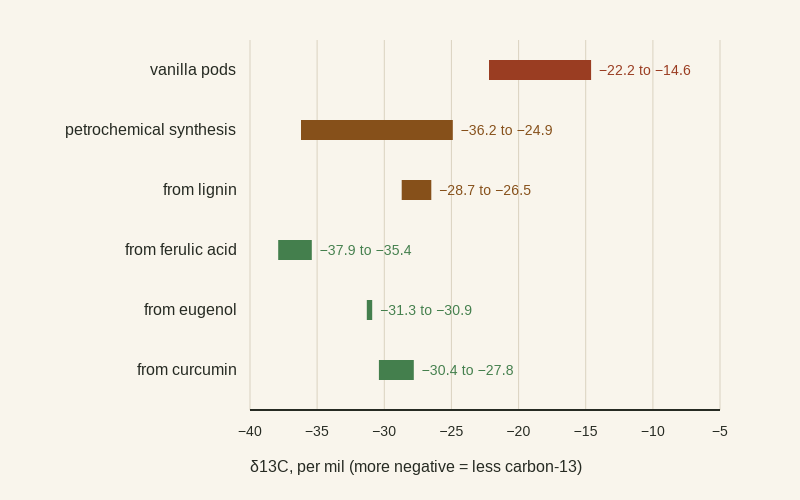
Carbon-13 ranges for vanillin of different origins, as cited by a 2024 review from earlier measurements. Red: vanilla pods. Brown: synthetic routes. Green: plant-based routes the review calls natural. The plant-based ranges fall inside or near the synthetic ones.
"Carbon-13 ranges of vanillin by origin" by Molecule & Menu, https://moleculeandmenu.com/flavor-chemistry/vanillin/, licensed under CC BY 4.0 (https://creativecommons.org/licenses/by/4.0/)
The test has limits, and the review lists them. Vanillin made from natural ferulic acid, eugenol or curcumin falls in ranges that overlap synthetic vanillin. A sample's value can also be shifted on purpose, by adding carbon-13-poor synthetic vanillin or mixing batches. The review concludes that the most successful checks combine at least two methods, such as carbon with hydrogen or oxygen isotopes, or isotope ratios measured at single atomic sites.
| Origin | Made from (per the 2024 review) | Market share in one 2024 review | δ13C, per mil (cited ranges) |
|---|---|---|---|
| Vanilla pods | cured pods, mainly Vanilla planifolia | 1.5% | −22.2 to −14.6 |
| Plant-based | ferulic acid, eugenol, curcumin and other natural precursors, by microbes or enzymes | 11.5% | −37.9 to −27.8 across three routes |
| Synthetic, petrochemical | guaiacol or eugenol from oil-derived intermediates | 88% for all synthetic vanillin, per the 2024 review | −36.2 to −24.9 |
| From lignin | lignin from wood pulping, converted chemically; listed with synthetic vanillin in the review's isotope passage, though its introduction says lignin vanillin can count as natural in many contexts | not given; 15% of annual production in another passage | −28.7 to −26.5 |
Download the carbon-isotope ranges (CSV) (source and license notes) Data: D'Arrigo et al. 2024, Molecules 29:442, CC BY 4.0, https://pmc.ncbi.nlm.nih.gov/articles/PMC10818928/
Download the market shares and amounts from the 2024 review (CSV) (source and license notes) Data: D'Arrigo et al. 2024, Molecules 29:442, CC BY 4.0, https://pmc.ncbi.nlm.nih.gov/articles/PMC10818928/
Molecule card
| Name | vanillin |
|---|---|
| Molecular formula | C8H8O3 |
| Molar mass | 152.149 g/mol |
| Shape | Computed 3D conformer generated by Molecule & Menu from the ChEBI SMILES (RDKit ETKDG), not an experimentally measured shape |
| Where you meet it | Cured vanilla pods, about 20 g per kg per a 2024 review, and vanilla flavoring, mostly synthetic |
| ChEBI ID | CHEBI:18346 |
This card as data (CSV) · Source and license notes
Data: Structure data: ChEBI (CHEBI:18346), CC BY 4.0; D'Arrigo et al. 2024, Molecules 29:442, CC BY 4.0, https://pmc.ncbi.nlm.nih.gov/articles/PMC10818928/
Sources
- D'Arrigo, P., Rossato, L. A. M., Strini, A., & Serra, S. (2024). From Waste to Value: Recent Insights into Producing Vanillin from Lignin. Molecules, 29(2), 442. https://doi.org/10.3390/molecules29020442 https://pmc.ncbi.nlm.nih.gov/articles/PMC10818928/Read: full text; abstract and sections 1, 2 and 2.1 to 2.3.2 used, and the opening of section 3. License: CC BY 4.0.
- Venkataraman, S., Athilakshmi, J. K., Rajendran, D. S., Bharathi, P., & Kumar, V. V. (2024). A comprehensive review of eclectic approaches to the biological synthesis of vanillin and their application towards the food sector. Food Science and Biotechnology, 33(5), 1019–1036. https://doi.org/10.1007/s10068-023-01484-x https://doi.org/10.1007/s10068-023-01484-xRead: full text; introduction, the opening of the section on methods of vanillin synthesis, and conclusion used, paraphrased only.
- Code of Federal Regulations, Title 21, Part 182: Substances Generally Recognized as Safe, §182.50 (Certain other spices, seasonings, essential oils, oleoresins, and natural extracts) and §182.60 (Synthetic flavoring substances and adjuvants). Revised as of April 1, 2025. Washington: U.S. Government Publishing Office. https://www.govinfo.gov/content/pkg/CFR-2025-title21-vol3/pdf/CFR-2025-title21-vol3-part182.pdfRead: full text of §182.50 and §182.60 (pages 484 and 485).
- ChEBI entry CHEBI:18346, vanillin (Chemical Entities of Biological Interest, EMBL-EBI). https://www.ebi.ac.uk/chebi/CHEBI:18346Read: entry record (structure, formula, identifiers). License: CC BY 4.0.
- ChEBI entry CHEBI:3374, capsaicin (Chemical Entities of Biological Interest, EMBL-EBI). https://www.ebi.ac.uk/chebi/CHEBI:3374Read: entry record (structure, formula, identifiers, synonyms, classification and roles). License: CC BY 4.0.
Cite this page
“Vanillin: One Review Puts the Synthetic Share at 88%.” Molecule & Menu. Published November 14, 2026. https://moleculeandmenu.com/flavor-chemistry/vanillin/. Accessed on the date you read it.
How pages here are checked · All corrections · Report an error on this page (contact@moleculeandmenu.com)
Second helping:
- Why does cilantro taste like soap: another aroma story, where people disagree about the smell and genes explain only part of it.
- Pyrazines: the roasty smell of coffee, formed by heat in the roaster rather than inside the plant.
More from Flavor Chemistry
Flavor Chemistry
Carvone: Mirror-Image Molecules Some Noses Can’t Tell Apart
Carvone has two mirror-image forms, linked mainly to spearmint and caraway. In a 2019 study, 12 of 46 volunteers screened could not tell them apart at first.
Picture credit
"Mentha viridis (spearmint), Köhler’s Medizinal-Pflanzen" by Franz Eugen Köhler, Köhler's Medizinal-Pflanzen — https://commons.wikimedia.org/wiki/File:Mentha_viridis_-_K%C3%B6hler%E2%80%93s_Medizinal-Pflanzen-096.jpg — Public domain (Public domain in the US (Köhler's Medizinal-Pflanzen, published in Germany in 1887-1898, this plate in 1897, before 1931; the plate is signed W. Müller) and in the EU (Commons tags the plate PD-old, life plus 70 years, and marks it with the Public Domain Mark; this basis rests on those two tags and the 1887-1898 publication, not on any artist's or editor's death year))
Flavor Chemistry
Umami: Glutamate’s Savory Taste, From Kombu Broth to MSG
Umami is the savory taste of glutamate, which Kikunae Ikeda drew from a seaweed broth. The FDA never confirmed MSG caused reported symptoms; see the evidence.
Picture credit (illustration)
Illustration: Molecule & Menu. Generated schematic illustration — not a photograph or historical record. Reuse: CC BY 4.0 (https://creativecommons.org/licenses/by/4.0/), to the extent Molecule & Menu holds rights in this image.
Flavor Chemistry
Scoville Scale: Diluted Until the Tongue Felt a Weak Bite
Scoville’s 1912 test diluted chili extract in sweetened water to a distinct but weak bite. A 2026 review reports labs multiplying capsaicin ppm by 15 to 16.1.
Picture credit
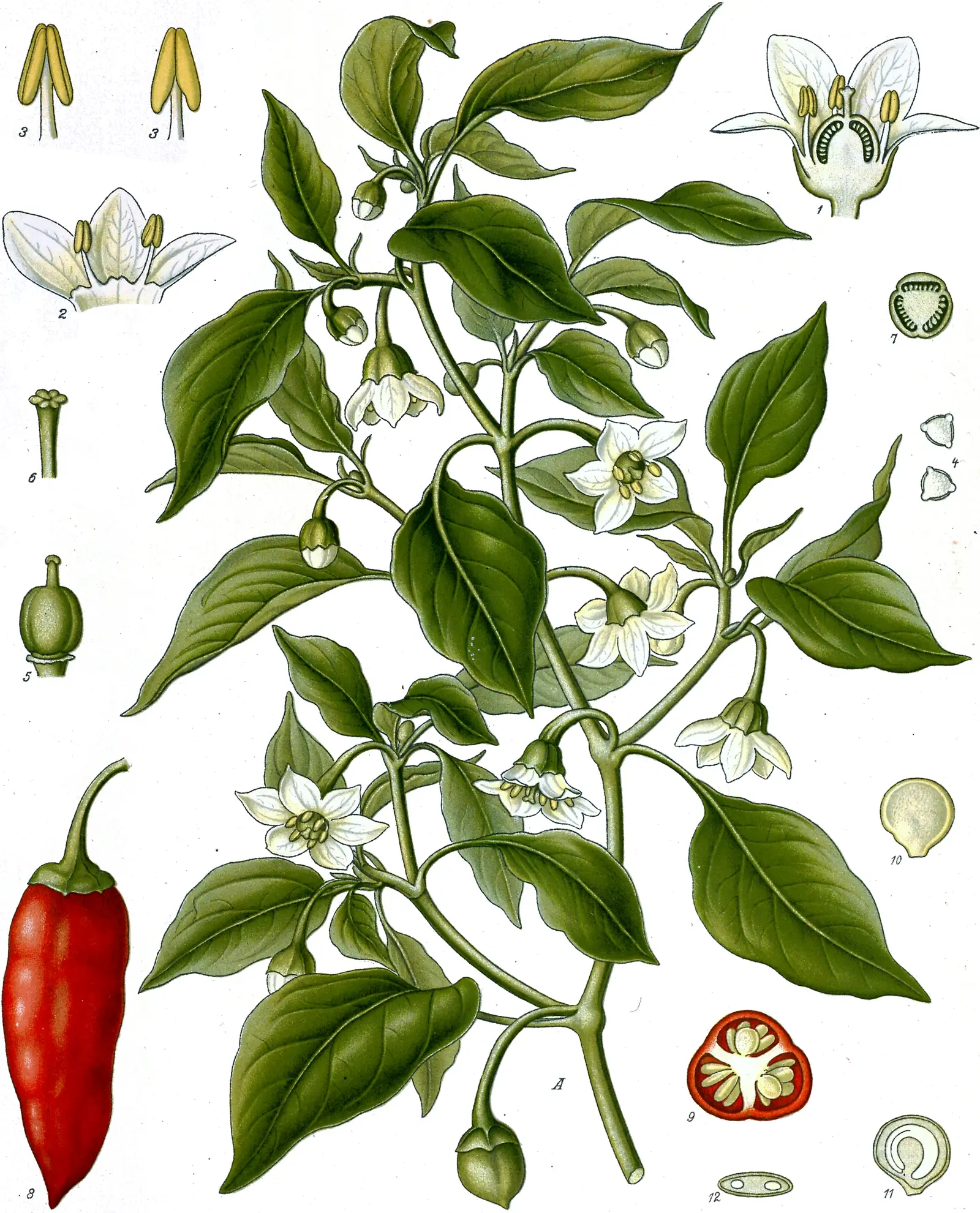
"Capsicum annuum (Spanischer Pfeffer), Köhler’s Medizinal-Pflanzen" by Franz Eugen Köhler, Köhler's Medizinal-Pflanzen — https://commons.wikimedia.org/wiki/File:Capsicum_annuum_-_K%C3%B6hler%E2%80%93s_Medizinal-Pflanzen-027.jpg — Public domain (Public domain in the US (Köhler's Medizinal-Pflanzen, published in Germany in 1887-1898, this plate in 1897, before 1931) and in the EU (Commons tags the plate PD-old, life plus 70 years, and marks it with the Public Domain Mark; this basis rests on those two tags and the 1887-1898 publication, not on any artist's or editor's death year))