Eggs Benedict History: An 1894 Cookbook Spelled It Benedick
Short answer
The earliest eggs Benedict record this page could read is an 1894 recipe spelled Eggs à la Benedick. It closes recipe No. 2925 on page 858 of Charles Ranhofer’s cookbook The Epicurean, published in New York: toasted muffin halves, a round of cooked ham, a poached egg, and Hollandaise sauce. Two well-known stories name a person behind the dish, one set at Delmonico’s and one at the Waldorf. This page could not trace either one to a dated source it could read.
Course list · 4 sections
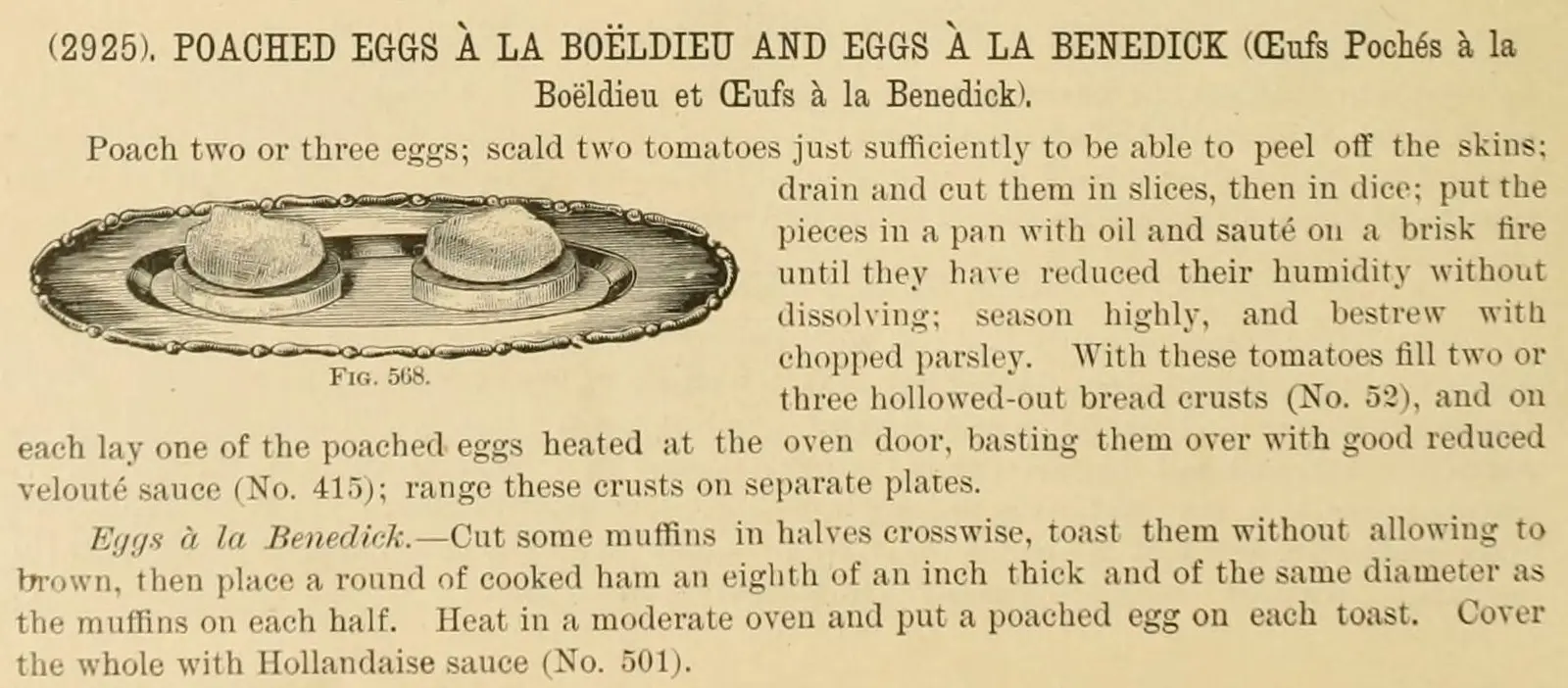
Recipe No. 2925 on page 858 of Charles Ranhofer’s The Epicurean (New York, 1894). The Benedick version is the last paragraph; the engraving, Fig. 568, sits beside the Boëldieu half of the recipe.
“The Epicurean (1894), page 858, recipe No. 2925” by Charles Ranhofer — PD
Full credit
"The Epicurean (1894), page 858, recipe No. 2925" by Charles Ranhofer — https://archive.org/details/epicureancomplet00ranh/page/n873/mode/1up — Public domain (US: published 1894, before 1931; EU: author Charles Ranhofer died 1899 (Commons category for Charles Ranhofer: 1836 births, 1899 deaths), more than 70 years ago; Boston Public Library scan, marked NOT_IN_COPYRIGHT on the Internet Archive); modified: cropped from the full page to recipe No. 2925
A cookbook published in New York printed the dish as Eggs à la Benedick. The name sits in small italic type at the start of a short paragraph, after a longer recipe for a different egg dish, and nothing on the page says who Benedick was.
That page is the anchor for the rest of this article, because it is dated, it can be read line by line, and it shows that the dish existed by 1894. It cannot show who made the dish first, which is the question the famous stories try to answer.
What the 1894 cookbook printed
The Epicurean is a large cookbook by Charles Ranhofer, published in New York in 1894; the library catalog names Ranhofer himself as publisher. Its recipes are numbered in one long sequence through the book. Number 2925, on page 858, is headed “POACHED EGGS À LA BOËLDIEU AND EGGS À LA BENEDICK,” with the French name, Œufs à la Benedick, printed beside it.
Most of the entry describes the Boëldieu version: poached eggs set on hollowed-out bread crusts filled with diced tomato, under a velouté sauce. The Benedick version follows in three sentences. The muffins are cut “in halves crosswise” and toasted “without allowing to brown.” Each half gets “a round of cooked ham an eighth of an inch thick and of the same diameter as the muffins.”
The last two sentences put “a poached egg on each toast” and end: “Cover the whole with Hollandaise sauce (No. 501).” The number points to the book’s own Hollandaise recipe, printed elsewhere in the volume. The wording is quoted here as evidence of what was printed, not as instructions to follow.
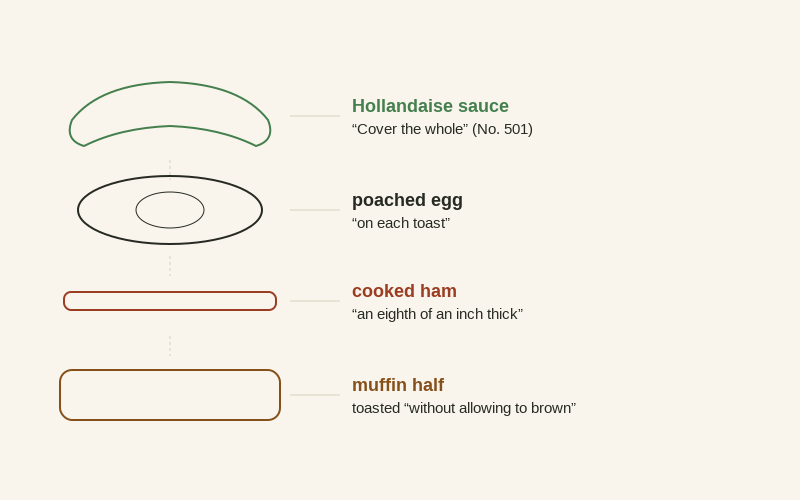
The Benedick part of recipe No. 2925 as four layers, bottom to top, labeled with the 1894 wording. Schematic drawing, not to scale.
"Eggs à la Benedick in 1894: four layers" by Molecule & Menu, https://moleculeandmenu.com/historical-dining/eggs-benedict-history/, licensed under CC BY 4.0 (https://creativecommons.org/licenses/by/4.0/)
Data: Charles Ranhofer, The Epicurean (New York, 1894), p. 858 (public domain; Boston Public Library scan), retrieved 2026-11-13
Read from the bottom up, the 1894 version has four layers: bread, ham, egg and sauce. Two details are worth keeping exact. The book says muffins and gives no further description, so whether they match the bread now sold as English muffins is not something the page settles. And the ham is a cooked round, cut to the same width as the muffin.
Who wrote it down, and why Benedick?
The book’s engraved title page reads The Epicurean, by Charles Ranhofer, with a banner lettered Delmonico’s under his name. The library catalog title of the scanned copy adds that the book includes “a selection of interesting bills of fare of Delmonico’s,” the New York restaurant. So the earliest printing this page could read comes from a book that ties its author, by its own title page, to Delmonico’s.
That tie is easy to over-read. Recipe No. 2925 names no person, gives no date for the dish, and does not say the restaurant served it. A cookbook shows that someone wrote a dish down in a certain way by a certain year. It is not a menu, and it is not a record of who asked for the dish.
The page itself shows how ordinary a name on a dish was in this book. Page 858 is a run of egg dishes, and it opens with eggs on a dish Plumerey and eggs on a dish Rossini, then a Venetian style, before the Boëldieu and Benedick pair at the foot. The book does not stop to explain who any of these names belonged to.
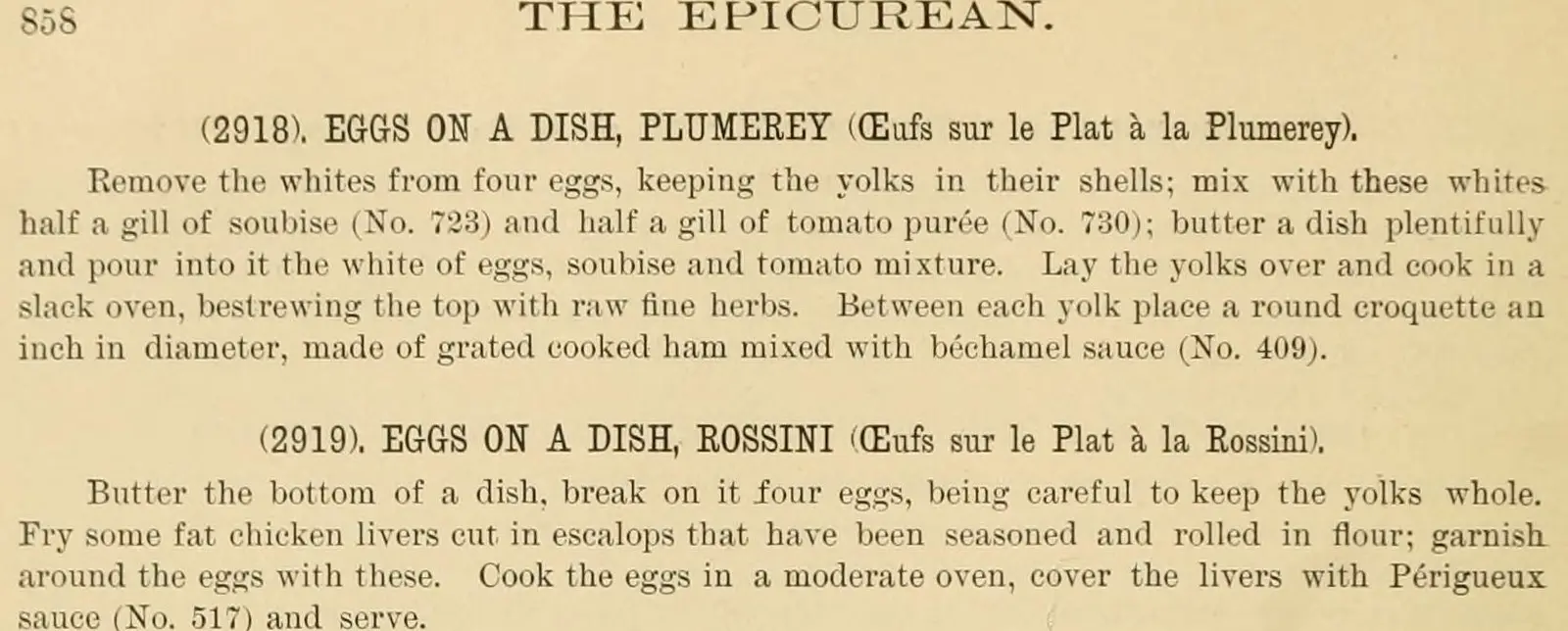
The head of the same page 858, with recipes No. 2918 and No. 2919. Like the Benedick eggs at the foot of the page, both carry a name the book does not explain.
“The Epicurean (1894), page 858, recipes No. 2918…” by Charles Ranhofer — PD
Full credit
"The Epicurean (1894), page 858, recipes No. 2918 and No. 2919" by Charles Ranhofer — https://archive.org/details/epicureancomplet00ranh/page/n873/mode/1up — Public domain (US: published 1894, before 1931; EU: author Charles Ranhofer died 1899 (Commons category for Charles Ranhofer: 1836 births, 1899 deaths), more than 70 years ago; Boston Public Library scan, marked NOT_IN_COPYRIGHT on the Internet Archive); modified: cropped from the full page to the page head and recipes No. 2918 and No. 2919
The spelling is a second limit. The recipe says Benedick, with a k, while the two stories are about people named Benedict. The page does not explain the name, and nothing else read for this article does either. Whether Ranhofer’s Benedick refers to any of the Benedicts in those stories is left open here rather than guessed.
Recipe No. 2925 prints no price. Without a price, hours on the plate, this site’s wage-equivalent measure, cannot be calculated for the dish, so the menu card below marks it as not applicable.
Two stories about who invented it
Two stories explain the name with a person called Benedict. Each sets the dish in a different New York dining room and credits a different customer. Neither could be checked here against a dated menu, receipt or kitchen record.
The first story is set at Delmonico’s. In that account, the dish was made for Mrs. LeGrand Benedict, a customer of the restaurant. This page found no dated source for the story that it could read, so it is given here without a year and without the name of whoever first told it.
The second story was told by Lemuel Benedict himself, according to an interview published in The New Yorker. In his account, the dish grew out of a breakfast he ordered at the Waldorf, the New York hotel. The interview itself could not be read for this page, so only that outline is given, without quotation and without details of the order.
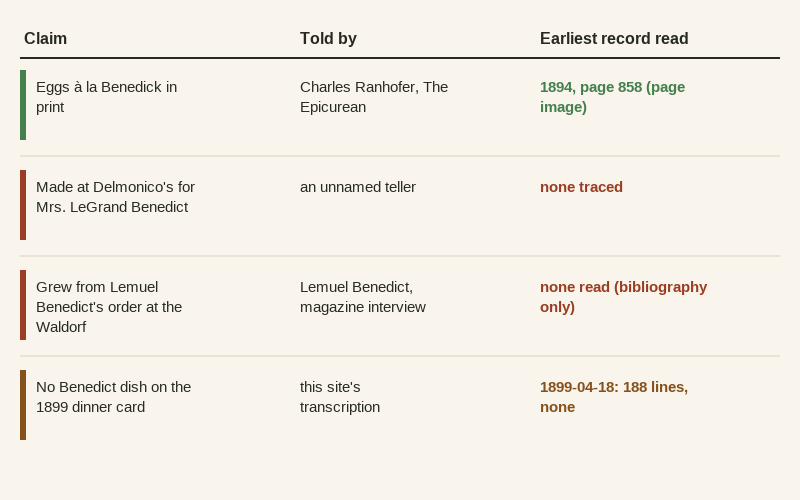
Four claims about eggs Benedict, who made each one, and the earliest dated record this page could read for it.
"Eggs Benedict: claims and the earliest record read" by Molecule & Menu, https://moleculeandmenu.com/historical-dining/eggs-benedict-history/, licensed under CC BY 4.0 (https://creativecommons.org/licenses/by/4.0/)
Data: Charles Ranhofer, The Epicurean (1894), p. 858 (public domain); dinner menu of April 18, 1899 (Wikimedia Commons scan, public domain); retrieved 2026-11-13
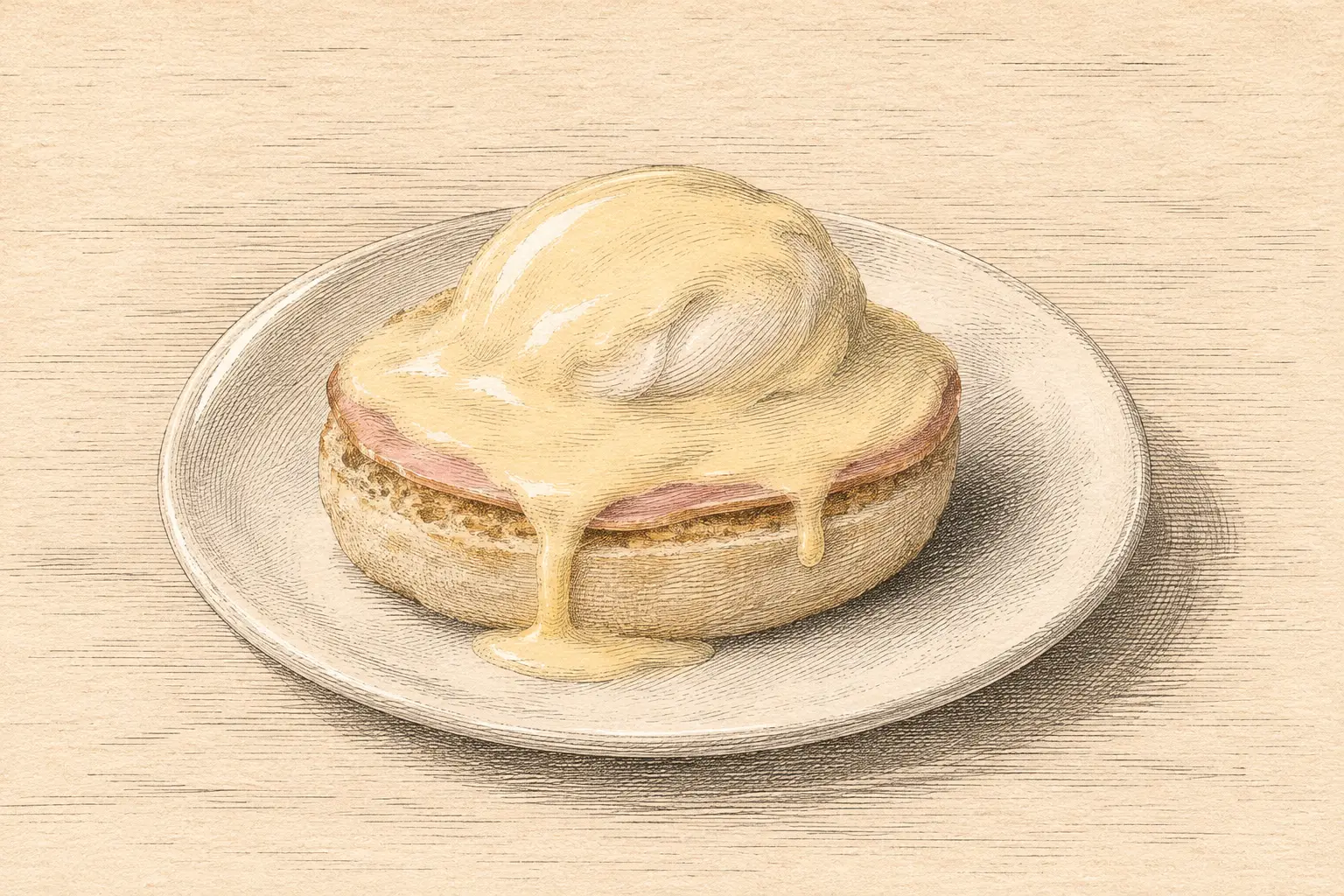
An illustration of the dish as four layers: a toasted muffin half, a round of cooked ham, a poached egg and Hollandaise sauce covering the whole.
Illustration: Molecule & Menu. Generated schematic illustration — not a photograph or historical record. Reuse: CC BY 4.0 (https://creativecommons.org/licenses/by/4.0/), to the extent Molecule & Menu holds rights in this image.
| Claim | Told by | Earliest dated record read here | What it shows |
|---|---|---|---|
| Eggs à la Benedick was in print | Charles Ranhofer, The Epicurean | 1894, page 858 (page image) | muffin, ham, poached egg, Hollandaise; no person named |
| Made at Delmonico’s for Mrs. LeGrand Benedict | an unnamed teller | none traced | a story; no dated source read |
| Grew out of Lemuel Benedict’s breakfast order at the Waldorf | Lemuel Benedict, according to a magazine interview | none read (bibliography only) | a story told by the man it credits |
| No dish named Benedict on the 1899 Delmonico’s dinner card | this site’s transcription | 1899-04-18: 188 priced lines, none | one dinner card only |
Download the claims table (CSV) (source and license notes) Data: Charles Ranhofer, The Epicurean (1894) (public domain); dinner menu of April 18, 1899 (Wikimedia Commons scan, public domain); retrieved 2026-11-13
Both stories do the same job: they explain a name. Neither story, in the outline given here, explains why an 1894 cookbook already printed the dish, spelled differently, with no customer attached. A dated printing shows the dish existed by that year. It does not show where the dish began, and a story, however often it is told, does not move that date.
Weighing the two stories against each other is difficult. A story told by the man it credits is first-hand in one sense, yet its teller is also the person who gets the credit. A story about a customer at Delmonico’s fits the restaurant named on Ranhofer’s title page, yet a fit with the setting is not evidence that the event took place. Without a dated menu, letter or kitchen book from the time, neither story can be ranked above the other on this page, and both stay labeled as stories.
What the record can and cannot show
Put in order, the dated records read for this page are few. The 1894 cookbook comes first. A Delmonico’s dinner card from five years later comes next. The two stories cannot be placed on that line, because no dated source for either could be read here.
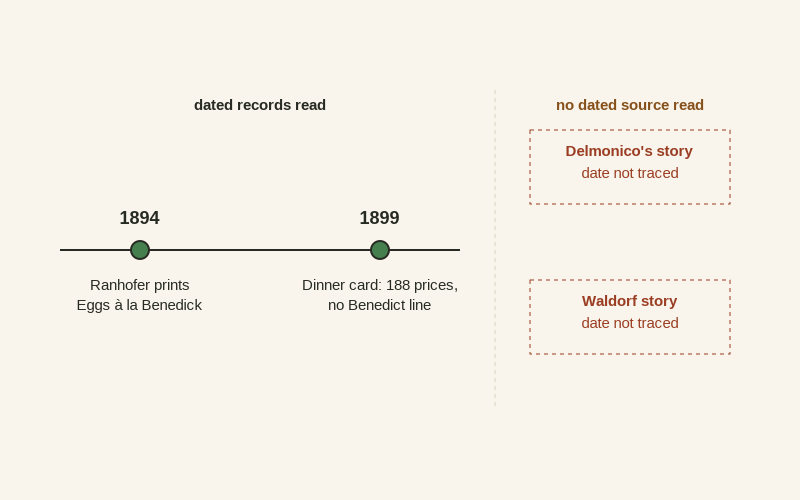
Dated records read for this page, in order, on the left. The two stories sit apart on the right, because no dated source for either could be read.
"Eggs Benedict: dated records and two stories with no dated source read" by Molecule & Menu, https://moleculeandmenu.com/historical-dining/eggs-benedict-history/, licensed under CC BY 4.0 (https://creativecommons.org/licenses/by/4.0/)
Data: Charles Ranhofer, The Epicurean (1894), p. 858 (public domain); dinner menu of April 18, 1899 (Wikimedia Commons scan, public domain); retrieved 2026-11-13
The dinner card is the one analyzed in Delmonico’s menu of April 18, 1899. Its 188 priced lines include no dish named Benedict or Benedick, although the fish section does offer halibut with hollandaise sauce. That absence proves little, because it is one dinner card for one Tuesday evening, and the restaurant name on it is itself a collector’s handwritten note rather than print. A dish served at breakfast or lunch, or on another day, would not be expected to appear on it.
What the 1894 page does show:
- A dish called Eggs à la Benedick was in print in New York by 1894.
- Its four parts were muffin halves, cooked ham, a poached egg and Hollandaise sauce.
- It appeared in a book whose title page links its author with Delmonico’s.
Left open by the same page:
- Who made the dish first, or in what year.
- Whether the Benedick of the recipe is any of the Benedicts in the two stories.
- Whether Delmonico’s, the Waldorf or any other dining room ever served it under that name.
The safest summary, then, follows the order of the evidence rather than the order of the stories. As of this page’s reading, the dish is in print by 1894, under a spelling that the stories do not use, and neither account that names an inventor could be traced to a dated source. If a dated record of either story turns up, it belongs on the timeline above, and the article will say so in a correction.
Old cookbooks raise this kind of question again and again. Mrs Beeton’s Book of Household Management is another nineteenth-century cookbook where the question of where a recipe came from has to be asked one entry at a time.
Sources
- Charles Ranhofer, The Epicurean: A Complete Treatise of Analytical and Practical Studies on the Culinary Art (New York: C. Ranhofer, 1894), p. 858, recipe No. 2925, and engraved title page. Boston Public Library copy, Internet Archive item epicureancomplet00ranh. https://archive.org/details/epicureancomplet00ranhRead: page 858 (recipes No. 2918 to No. 2925) and the engraved title page, checked against the page images.
- "Talk of the Town" item on Lemuel Benedict, The New Yorker, December 19, 1942. https://www.newyorker.com/Read: bibliography only; not read, paraphrased only; the link is the magazine's home page, not the item.
- Dinner menu, Tuesday, April 18, 1899 (English side; French side headed Mardi 18 avril 1899), attributed by a collector's handwritten note to Delmonico's, Beaver St., New York. New York Public Library, Rare Book Division, Buttolph collection of menus, image 467783; scan on Wikimedia Commons. https://commons.wikimedia.org/wiki/File:DINNER_(held_by)_DELMONICO%27S_(at)_BEAVER_ST._NY_(REST;)_(NYPL_Hades-271623-467783).jpgRead: full scan of both sides; every price on the English side transcribed; library catalog record not consulted.

Cite this page
“Eggs Benedict History: An 1894 Cookbook Spelled It Benedick.” Molecule & Menu. Published November 14, 2026. https://moleculeandmenu.com/historical-dining/eggs-benedict-history/. Accessed on the date you read it.
How pages here are checked · All corrections · Report an error on this page (contact@moleculeandmenu.com)
Second helping:
- Apicius: a Roman cookbook carries a famous gourmet’s name, and when it was put together is a separate question.
- Why does bread rise: the 1894 dish starts with a muffin, and how a dough rises in the oven is its own piece of chemistry.
More from Historical Dining
Historical Dining
An 1899 Menu Marked Delmonico’s: Sirloin in Hours of Pay
An 1899 menu attributed to Delmonico’s priced sirloin at 75 cents: about 3.6 hours of New York State hod carriers’ pay, with a 6-day week assumed.
Picture credit
"Delmonico’s: Fifth Avenue, Broadway and 26th Street (King’s Handbook of New York City, p. 244)" by Unknown author — https://commons.wikimedia.org/wiki/File:244_DELMONICO%27S_FIFTH_AVENUE,_BROADWAY_AND_26TH_STREET.jpg — Public domain (US: published 1893, before 1931 (PD-US-expired on the file page); EU: illustrator not named, published 1893, more than 70 years ago (PD-old-70-expired on the file page); presumed, illustrator not traced; British Library scan marked Public Domain Mark); modified: cropped to remove the printed caption below the picture
Historical Dining
Apicius: Vehling Dated the Roman Cookbook Long After Apicius
Apicius carries the name of a gourmet who, by its 1936 translator’s dates, died in A.D. 40; he judged the book probably completed late in the third century.
Picture credit (illustration)
Illustration: Molecule & Menu. Generated schematic illustration — not a photograph or historical record. Reuse: CC BY 4.0 (https://creativecommons.org/licenses/by/4.0/), to the extent Molecule & Menu holds rights in this image.
Historical Dining
Book of Household Management: 3 Recipes Credit Eliza Acton
Mrs Beeton’s 1861 book credits Eliza Acton under three recipes. A check of three Acton books finds 19 paragraphs that are a tenth or more in her words.
Picture credit
"Modern Mode of Serving Dishes: the center dish of fruit from Mrs Beeton’s 1861 color plate of dessert dishes" by Wellcome Collection — https://commons.wikimedia.org/wiki/File:The_book_of_household_management_by_Mrs_Beeton_Wellcome_L0045070.jpg — CC BY 4.0 (https://creativecommons.org/licenses/by/4.0/); modified: cropped to the center dish of fruit; the printed title, plate letters and caption text left out