An 1899 Menu Marked Delmonico’s: Sirloin in Hours of Pay
Short answer
A sirloin of beef priced at 75 cents equaled about 3.6 hours of a hod carrier’s pay. The menu is dated Tuesday, April 18, 1899, and a collector’s handwritten note places it at Delmonico’s on Beaver Street. The wage is the 1899 average for New York State hod carriers in report No. 18 of the 1900 Commissioner of Labor wage tables: $1.69 a day for a 49-hour week, with a 6-day week assumed by this page. The result is a wage equivalent, not a record of what anyone paid.
Course list · 5 sections
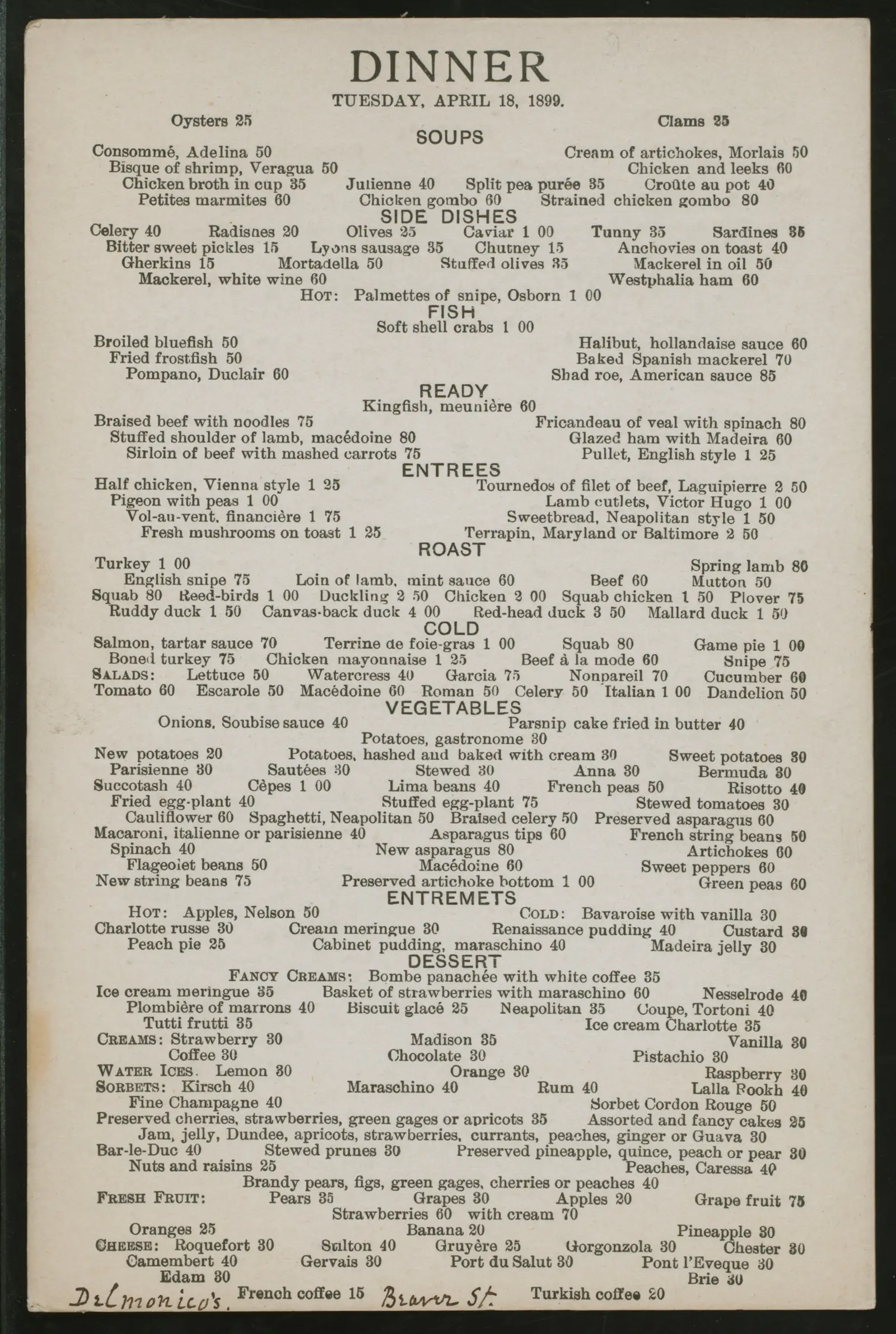
The English side of a priced dinner menu dated Tuesday, April 18, 1899, with 188 priced lines and no currency sign. The handwriting at the foot reads Delmonico’s and Beaver St.
"Dinner menu, Tuesday, April 18, 1899 (English side), attributed by a handwritten note to Delmonico’s, Beaver St." by Unknown author — https://commons.wikimedia.org/wiki/File:DINNER_(held_by)_DELMONICO%27S_(at)_BEAVER_ST._NY_(REST;)_(NYPL_Hades-271623-467783).jpg — Public domain (US: published 1899, before 1931 (PD-US-expired on the file page); EU: anonymous menu made available in 1899, more than 70 years ago; the scan adds no new copyright (PD-scan))
A third of the way down a Delmonico’s dinner menu, a sirloin of beef is priced at 75. The card prints no dollar or cent sign, so the figure reads as 75 cents, the same as the braised beef with noodles two lines above it. This page sets that price and seven others beside what one named group of New York State workers earned in 1899, and it states each assumption along the way.
What the menu lists
The card is headed DINNER and dated TUESDAY, APRIL 18, 1899. The English side runs through soups, side dishes, fish, ready dishes, entrées, roasts, cold dishes and salads, vegetables, entremets (sweet side dishes), and a long dessert section of ices, fruit and cheese. Counting every priced line gives 188 prices.
No price carries a currency sign. A lone number such as 75 means cents, while in a price such as 1 25 a space separates the dollars from the cents.
The cheapest lines are 15 cents: bitter sweet pickles, chutney, gherkins and French coffee. The most expensive is canvas-back duck at 4 00, followed by red-head duck at 3 50. The median line costs 40 cents, and 153 of the 188 prices are 75 cents or less.
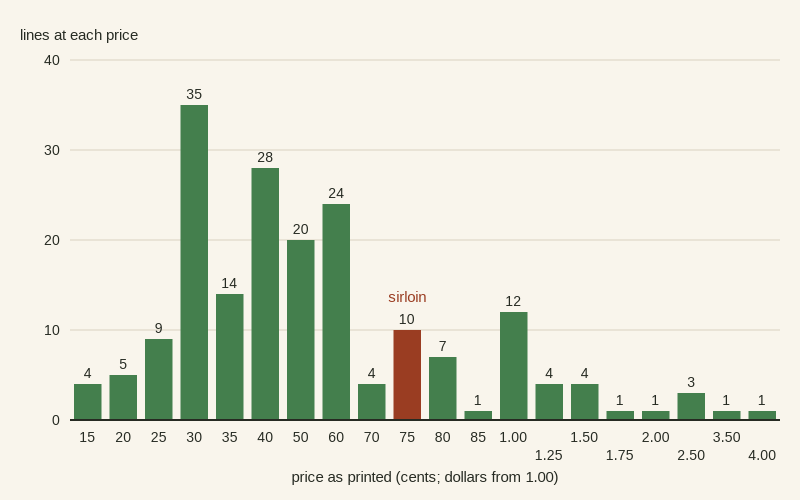
Number of priced lines at each price on the menu of April 18, 1899. The most common price is 30 cents; the sirloin shares its 75-cent price with nine other lines.
"Prices on the Delmonico’s menu of April 18, 1899" by Molecule & Menu, https://moleculeandmenu.com/historical-dining/delmonicos-menu-1899/, licensed under CC BY 4.0 (https://creativecommons.org/licenses/by/4.0/)
Data: Menu of April 18, 1899 (New York Public Library, Buttolph collection; Wikimedia Commons scan, public domain), transcribed by Molecule & Menu, retrieved 2026-11-13
The other side of the card repeats the dinner in French, headed MARDI 18 AVRIL, 1899, with matching prices for the dishes compared. The sirloin appears there as Contre-filet de boeuf, purée de carottes 75, and the French coffee as Café noir 15. Where a digit on the English side is broken in the print, as in Mallard duck 1 50, the French side was used to confirm it, and the transcription file flags each such line.
| Menu section | Priced lines | Lowest | Highest |
|---|---|---|---|
| Top line (oysters, clams) | 2 | $0.25 | $0.25 |
| Soups | 11 | $0.35 | $0.80 |
| Side dishes | 17 | $0.15 | $1.00 |
| Fish | 7 | $0.50 | $1.00 |
| Ready | 7 | $0.60 | $1.25 |
| Entrées | 8 | $1.00 | $2.50 |
| Roast | 16 | $0.50 | $4.00 |
| Cold dishes and salads | 20 | $0.40 | $1.25 |
| Vegetables | 35 | $0.20 | $1.00 |
| Entremets | 9 | $0.25 | $0.50 |
| Dessert, fruit and cheese | 54 | $0.20 | $0.75 |
| Foot line (coffee) | 2 | $0.15 | $0.20 |
Download the full menu transcription (CSV) (source and license notes) Data: Menu of April 18, 1899 (New York Public Library, Buttolph collection; Wikimedia Commons scan, public domain), retrieved 2026-11-13
Whose menu is it?
Nothing printed on either side names the restaurant. The name comes from handwriting at the foot of the English side: “Delmonico’s.” to the left of the coffee line and “Beaver St.” to the right. The description on the scan’s Wikimedia Commons file page, which credits the New York Public Library’s Buttolph collection of menus, reads: “PRICED MENU, FRENCH ON ONE SIDE, ENGLISH ON THE OTHER; LOCATION OF RESTAURANT HANDWRITTEN BY FNB”.
So the attribution is a collector’s note, added after printing, not a printed heading. The library’s own catalog record could not be consulted for this page, so the trail stops at the file page and the handwriting. Nothing on the card contradicts the note, but nothing printed confirms it either. This page still uses the name because the note is the only evidence of where the card came from, and the menu card at the end of the page repeats that qualification.
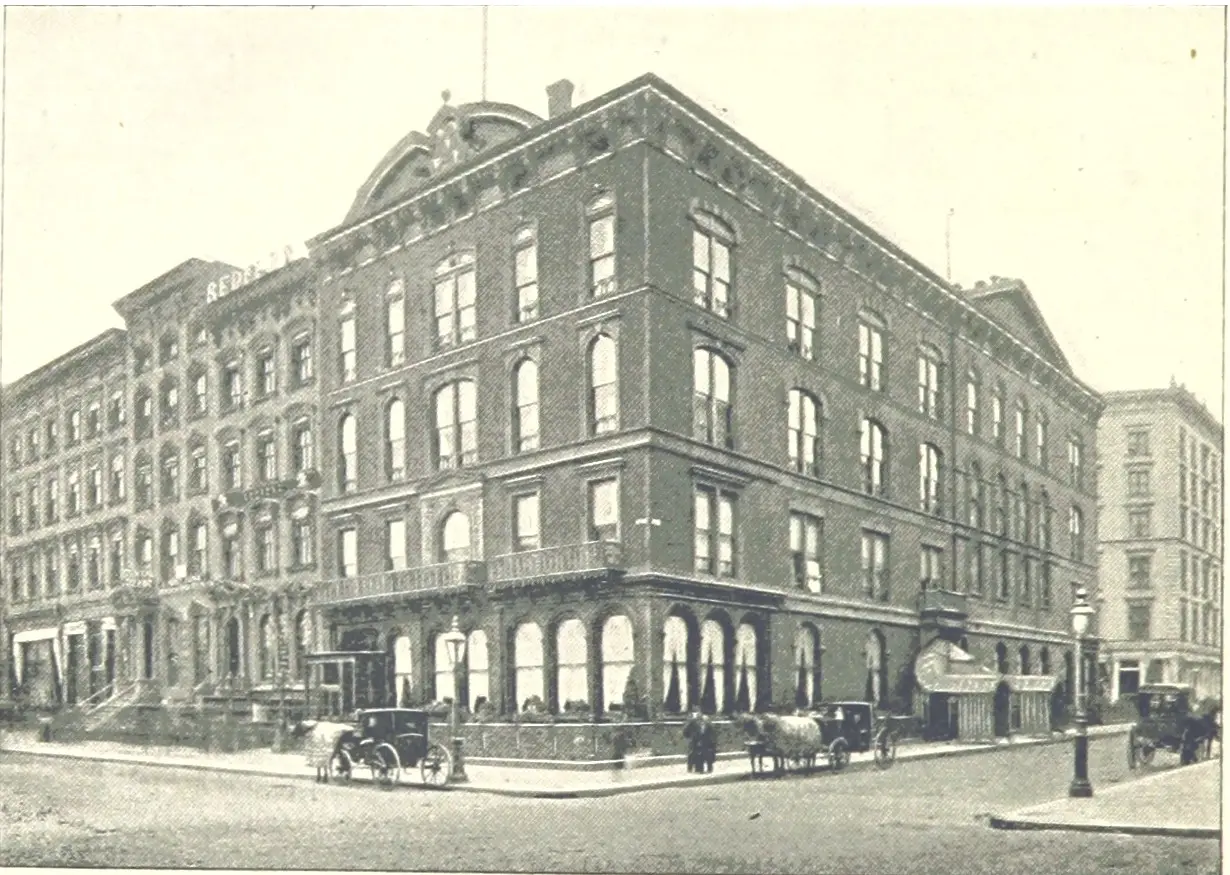
Delmonico’s at Fifth Avenue, Broadway and 26th Street, as pictured in King’s Handbook of New York City (1893). This is a different Delmonico’s building from the Beaver Street address in the menu’s handwritten note.
“Delmonico’s: Fifth Avenue, Broadway and 26th Street (King’s…” by Unknown author — PD
Full credit
"Delmonico’s: Fifth Avenue, Broadway and 26th Street (King’s Handbook of New York City, p. 244)" by Unknown author — https://commons.wikimedia.org/wiki/File:244_DELMONICO%27S_FIFTH_AVENUE,_BROADWAY_AND_26TH_STREET.jpg — Public domain (US: published 1893, before 1931 (PD-US-expired on the file page); EU: illustrator not named, published 1893, more than 70 years ago (PD-old-70-expired on the file page); presumed, illustrator not traced; British Library scan marked Public Domain Mark); modified: cropped to remove the printed caption below the picture
The address matters for one more reason: the menu belongs to a street in Manhattan, but the wage figures below cover New York State as a whole, and the gap between the two is part of the result.
What a laborer earned in 1899 New York State
The wages come from the Fifteenth Annual Report of the Commissioner of Labor (1900), a federal compilation of wage tables from official reports. On page 794, under HOD CARRIERS, the row for 1899 and N.Y. lists 445 men, weekly hours of 44 to 54 with an average of 49, and daily wages of $1.20 to $2.42 with an average of $1.69. Hod carriers were building laborers who carried bricks and mortar up to the bricklayers in a hod, a trough on a long handle.
The column heading reads “Year and State or country,” so N.Y. here is the state. The row’s report number, 18, leads to the list of sources on page 21: “United States: Department of Labor—Bulletin No. 29. (1900.)” The report’s introduction, on page 11, says the wage data in the Department’s own reports “have almost invariably been secured from the pay rolls of the establishments in which the individuals concerned have been employed.”
The same page has a second 1899 N.Y. row, from report No. 339, at $3.00 a day. It gives no working hours, so it cannot yield an hourly wage, and this page leaves it out. For comparison, page 185 lists bricklayers from report No. 18: 287 men in 1899 New York State, averaging 47 hours a week and $3.50 a day.
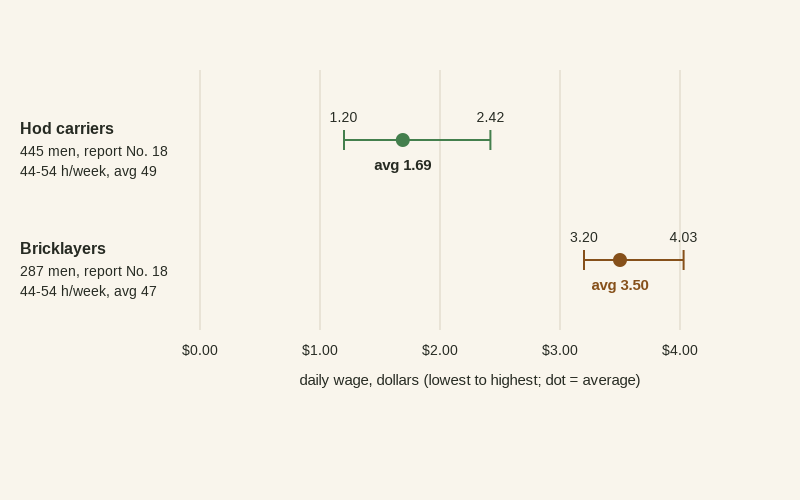
Daily wages for 1899 New York State hod carriers and bricklayers in report No. 18, from lowest to highest, with the average marked. Weekly hours appear under each name.
"Daily wages of hod carriers and bricklayers, New York State, 1899" by Molecule & Menu, https://moleculeandmenu.com/historical-dining/delmonicos-menu-1899/, licensed under CC BY 4.0 (https://creativecommons.org/licenses/by/4.0/)
Data: Fifteenth Annual Report of the Commissioner of Labor, 1900: Wages in Commercial Countries, pp. 185 and 794 (US federal publication, public domain), retrieved 2026-11-13
| Group | Role | Men | Hours per week (low–high, avg) | Daily wage (low–high, avg) | Page |
|---|---|---|---|---|---|
| Hod carriers | Primary | 445 | 44–54, 49 | $1.20–$2.42, $1.69 | 794 |
| Bricklayers | Comparison | 287 | 44–54, 47 | $3.20–$4.03, $3.50 | 185 |
Download the 1899 wage rows (CSV) (source and license notes) Data: Fifteenth Annual Report of the Commissioner of Labor, 1900: Wages in Commercial Countries (US federal publication, public domain), retrieved 2026-11-13
Hours on the plate
Hours on the plate is this site’s name for a wage equivalent: a menu price divided by the hourly wage of a named group of workers in the same place and period. It shows how a price compares with a wage, not whether those workers ate the dish.
The wage table gives a daily wage and weekly hours, but not days per week. This page assumes a 6-day week, so the hod carriers’ 49 hours become about 8.17 hours a day, and $1.69 a day becomes about 20.69 cents an hour. At that rate, the 75-cent sirloin equals 3.62 hours of a New York State hod carrier’s pay. For the comparison group, $3.50 a day over 47 hours and 6 days gives about 44.68 cents an hour, and the sirloin equals 1.68 hours of a bricklayer’s pay.
At the top of the price range, the canvas-back duck at $4.00 equals 19.33 hours of hod-carrier pay under the same 6-day assumption, or more than two of those working days. French coffee at 15 cents equals 0.72 hours.
The day count moves the answer. Spread the same 49 hours over 5 days, and the hod carrier’s hourly wage drops to about 17.24 cents, so the sirloin equals 4.35 hours. Spread them over 7 days, and it rises to about 24.14 cents, so the sirloin equals 3.11 hours. The report does not say which is right, so the 6-day assumption is printed beside every figure, and the two alternatives are in the CSV file.
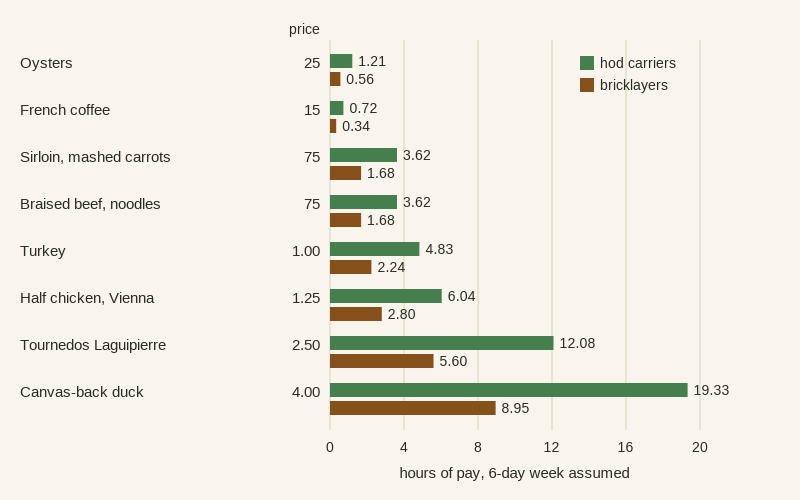
Eight menu prices converted to hours of pay for 1899 New York State hod carriers and, as a comparison, bricklayers, with a 6-day week assumed.
"Hours on the plate, Delmonico’s menu of April 18, 1899" by Molecule & Menu, https://moleculeandmenu.com/historical-dining/delmonicos-menu-1899/, licensed under CC BY 4.0 (https://creativecommons.org/licenses/by/4.0/)
Data: Menu of April 18, 1899 (Wikimedia Commons scan, public domain); wages from the Fifteenth Annual Report of the Commissioner of Labor, 1900, pp. 185 and 794 (public domain); 6 working days per week assumed; retrieved 2026-11-13
Every figure in the table assumes 6 working days a week and treats each price as one dish, as listed.
| Item | Menu price | Hod carriers, hours | Bricklayers, hours | Days per week assumed |
|---|---|---|---|---|
| Oysters | $0.25 | 1.21 | 0.56 | 6 |
| French coffee | $0.15 | 0.72 | 0.34 | 6 |
| Sirloin of beef with mashed carrots | $0.75 | 3.62 | 1.68 | 6 |
| Braised beef with noodles | $0.75 | 3.62 | 1.68 | 6 |
| Turkey | $1.00 | 4.83 | 2.24 | 6 |
| Half chicken, Vienna style | $1.25 | 6.04 | 2.80 | 6 |
| Tournedos of filet of beef, Laguipierre | $2.50 | 12.08 | 5.60 | 6 |
| Canvas-back duck | $4.00 | 19.33 | 8.95 | 6 |
Download the hours-on-the-plate table (CSV) (source and license notes) Data: Menu of April 18, 1899 (Wikimedia Commons scan, public domain); Fifteenth Annual Report of the Commissioner of Labor, 1900 (public domain); retrieved 2026-11-13
What a menu cannot tell you
A menu is close to the market, but it is not a receipt. This card shows what one dining room listed and priced on one Tuesday in April 1899. It does not show what anyone ordered, how large the portions were, or whether a hod carrier ever ate there.
The conversion carries four limits of its own:
- The wage is a statewide average for the men in one report. It is not a figure for Manhattan alone, and it is not the pay of any single worker.
- The 6-day week is this page’s assumption, not the report’s. A different number of days would change every hourly wage and every hours figure.
- Each price is for one dish as listed. A dinner of several courses would add up to more.
- The card survived because a collector kept it. A collection gathered that way is not a sample of where New Yorkers ate, and one card is not a price index.
Cookbooks raise a different problem. A source with no prices, such as Apicius, cannot be converted at all. Mrs Beeton’s Book of Household Management prints an “Average cost” beside its recipes, but that is the cook’s outlay for ingredients, not a price charged to a diner.
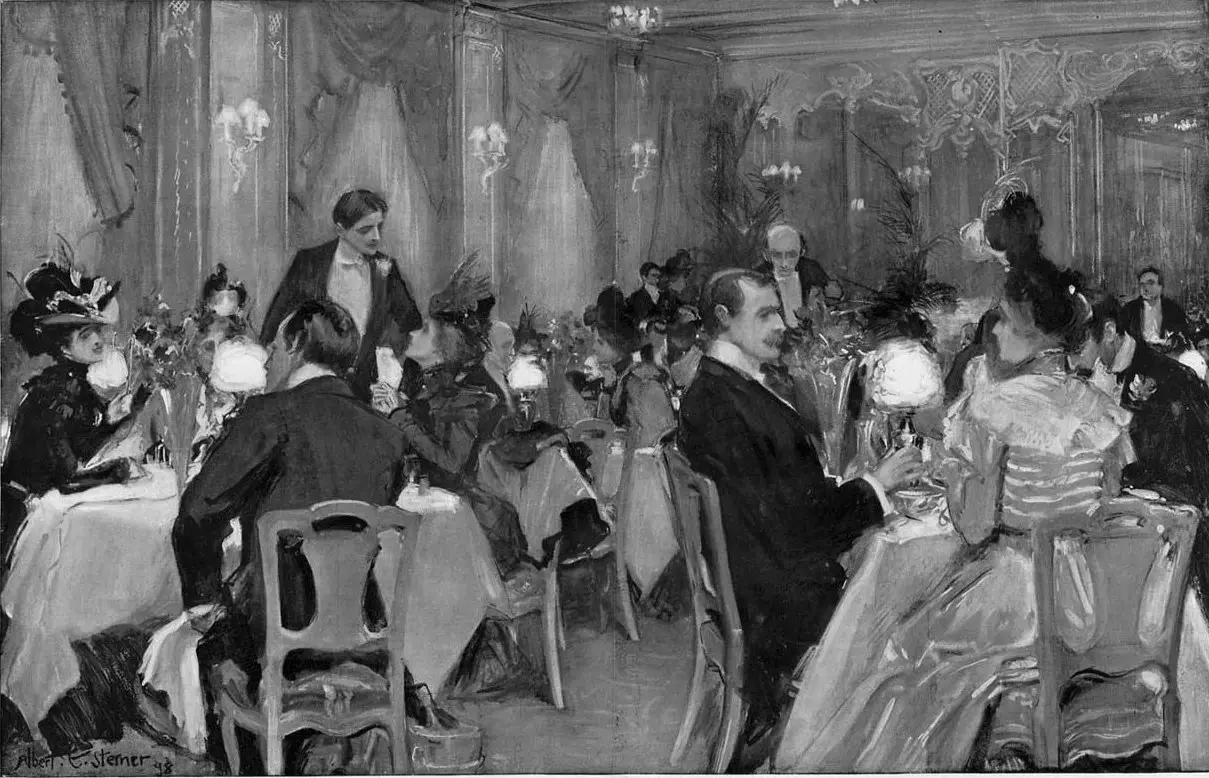
Albert E. Sterner’s drawing of supper at Delmonico’s, signed “Albert E. Sterner 98.” The file page calls it Supper after the Opera at Delmonico’s; where it was first printed could not be traced.
“Supper after the Opera at Delmonico’s” by Albert Edward Sterner — PD
Full credit
"Supper after the Opera at Delmonico’s" by Albert Edward Sterner — https://commons.wikimedia.org/wiki/File:Supper_at_Delmonico%27s,_New_York_1898.jpg — Public domain (EU: Albert Edward Sterner died 16 December 1946, more than 70 years ago (PD-old-100 on the file page); US: dated 1898; public domain if published before 1931, and if unpublished because the author died more than 70 years ago (the file page gives PD-old-100 but no separate US tag); presumed, first publication and upstream source (a sale listing) not traced)
Sources
- Dinner menu, Tuesday, April 18, 1899 (English side; French side headed Mardi 18 avril 1899), attributed by a collector's handwritten note to Delmonico's, Beaver St., New York. New York Public Library, Rare Book Division, Buttolph collection of menus, image 467783; scan on Wikimedia Commons. https://commons.wikimedia.org/wiki/File:DINNER_(held_by)_DELMONICO%27S_(at)_BEAVER_ST._NY_(REST;)_(NYPL_Hades-271623-467783).jpgRead: full scan of both sides; every price on the English side transcribed; library catalog record not consulted.
- Commissioner of Labor, Fifteenth Annual Report of the Commissioner of Labor, 1900: Wages in Commercial Countries (Washington: Government Printing Office, 1900). https://archive.org/details/annualreportofco1511unitRead: pages 11, 21, 185 and 794, checked against the page images.
- Moses King, King's Handbook of New York City (1893), p. 244, illustration "Delmonico's: Fifth Avenue, Broadway and 26th Street"; British Library scan on Wikimedia Commons. https://commons.wikimedia.org/wiki/File:244_DELMONICO%27S_FIFTH_AVENUE,_BROADWAY_AND_26TH_STREET.jpgRead: page 244 only: the illustration and its printed caption.


Cite this page
“An 1899 Menu Marked Delmonico’s: Sirloin in Hours of Pay.” Molecule & Menu. Published November 14, 2026. https://moleculeandmenu.com/historical-dining/delmonicos-menu-1899/. Accessed on the date you read it.
How pages here are checked · All corrections · Report an error on this page (contact@moleculeandmenu.com)
Second helping:
- Eggs Benedict history: the same restaurant name turns up again, this time in one of two stories about where a breakfast dish began.
- Coffee processing: before the 15-cent French coffee on this menu could be roasted, its beans had to be taken out of the coffee fruit.
More from Historical Dining
Historical Dining
Apicius: Vehling Dated the Roman Cookbook Long After Apicius
Apicius carries the name of a gourmet who, by its 1936 translator’s dates, died in A.D. 40; he judged the book probably completed late in the third century.
Picture credit (illustration)
Illustration: Molecule & Menu. Generated schematic illustration — not a photograph or historical record. Reuse: CC BY 4.0 (https://creativecommons.org/licenses/by/4.0/), to the extent Molecule & Menu holds rights in this image.
Historical Dining
Book of Household Management: 3 Recipes Credit Eliza Acton
Mrs Beeton’s 1861 book credits Eliza Acton under three recipes. A check of three Acton books finds 19 paragraphs that are a tenth or more in her words.
Picture credit
"Modern Mode of Serving Dishes: the center dish of fruit from Mrs Beeton’s 1861 color plate of dessert dishes" by Wellcome Collection — https://commons.wikimedia.org/wiki/File:The_book_of_household_management_by_Mrs_Beeton_Wellcome_L0045070.jpg — CC BY 4.0 (https://creativecommons.org/licenses/by/4.0/); modified: cropped to the center dish of fruit; the printed title, plate letters and caption text left out
Historical Dining
Eggs Benedict History: An 1894 Cookbook Spelled It Benedick
The earliest eggs Benedict record this page could read: Eggs à la Benedick in Ranhofer’s 1894 cookbook. Neither inventor story has a dated source read here.
Picture credit (illustration)
Illustration: Molecule & Menu. Generated schematic illustration — not a photograph or historical record. Reuse: CC BY 4.0 (https://creativecommons.org/licenses/by/4.0/), to the extent Molecule & Menu holds rights in this image.