Apicius: Vehling Dated the Roman Cookbook Long After Apicius
Short answer
The Roman cookbook called Apicius bears the name of a gourmet who died long before it was finished. Joseph Dommers Vehling, its 1936 English translator, dated that gourmet, M. Gabius Apicius, to 80 B.C. to A.D. 40. Vehling judged that the book in its present state was probably completed about the latter part of the third century. The two oldest surviving copies are ninth-century manuscripts, and one of them, made apparently at Fulda, is now at the New York Academy of Medicine.
Course list · 7 sections
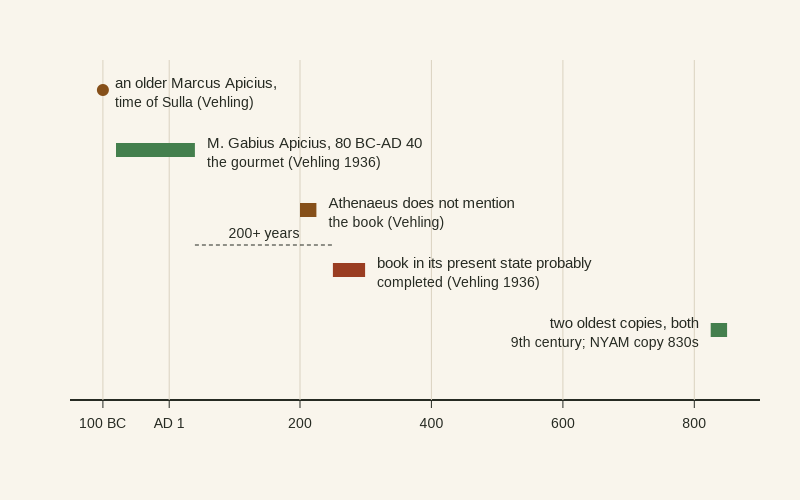
The name, the book and the copies on one time line. Dates for the gourmet and the book follow Vehling’s 1936 translation; the date of the New York copy follows its library catalog record.
"Apicius: the gourmet, the book and the oldest copies" by Molecule & Menu, https://moleculeandmenu.com/historical-dining/apicius/, licensed under CC BY 4.0 (https://creativecommons.org/licenses/by/4.0/)
Data: J. D. Vehling (trans.), Apicius: Cookery and Dining in Imperial Rome (Chicago, 1936), public domain, retrieved 2026-11-13; Digital Scriptorium catalog record DS11402 (New York Academy of Medicine, MS 01), catalog facts (data offered for reuse, no license named), retrieved 2026-11-13
Both the 1922 Latin edition and Vehling use the Latin title De re coquinaria, “on cooking.” Vehling called it “the most ancient of European cookery books.” This page follows his 1936 reading of the evidence, checks his statements about the manuscripts against a modern catalog record, and counts what the Latin text contains.
Who was Apicius, and who wrote the book?
According to Vehling, Apicius was “the surname of several renowned gastronomers of old Rome.” He counts two for certain. An older Marcus Apicius lived at the time of Sulla, about 100 B.C., and M. Gabius Apicius lived under the emperors Augustus and Tiberius, from 80 B.C. to A.D. 40. Roman writers told stories about the younger man’s spending, which Vehling himself found “thoroughly unreliable.”
The book itself points past him. Vehling noted that many dishes in it “are named for various celebrities who flourished at a later date than the second Apicius,” and that Vitellius, “a later glutton, is well represented.” In the 1922 Latin edition, three dishes carry the adjective Vitellian: two of peas or beans and one of suckling pig.
From this he drew his conclusion: “the author or collector of our present Apicius lived long after the second Apicius, or, at least, that the book was augmented by persons posterior to M. Gabius A.”
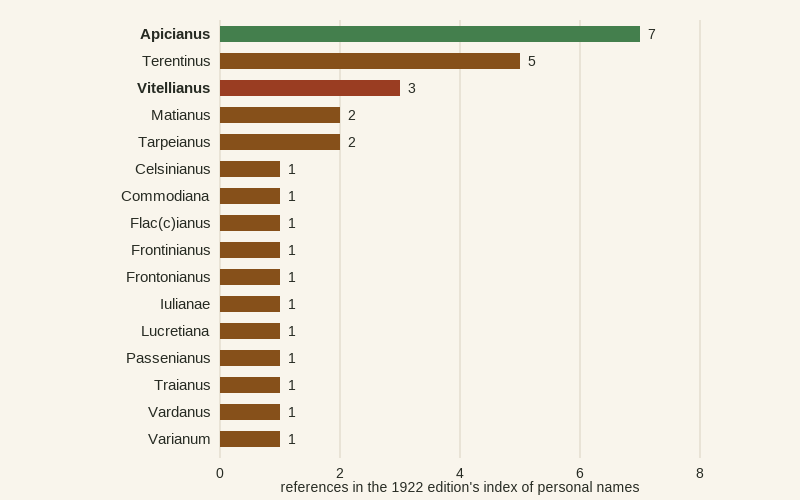
Personal-name adjectives listed in the 1922 Latin edition’s index of names, counted by reference. Dishes and sauces called Apician lead with 7; three dishes are named for Vitellius.
"Personal names on dishes in the Latin Apicius" by Molecule & Menu, https://moleculeandmenu.com/historical-dining/apicius/, licensed under CC BY 4.0 (https://creativecommons.org/licenses/by/4.0/)
Data: Apicii librorum X qui dicuntur De re coquinaria quae extant, ed. C. Giarratano and F. Vollmer (Leipzig: Teubner, 1922), public domain in the US, retrieved 2026-11-13
An illustration of a Roman-style table with fish, bread and fruit, the kind of food a Roman cookbook deals with; it shows no particular recipe.
Illustration: Molecule & Menu. Generated schematic illustration — not a photograph or historical record. Reuse: CC BY 4.0 (https://creativecommons.org/licenses/by/4.0/), to the extent Molecule & Menu holds rights in this image.
How late was the book put together?
Vehling weighed two kinds of evidence. One is the named dishes above. The other is a silence: in Vehling’s words, Athenaeus, a Greek writer of the early third century who collected stories about Apicius, “makes no mention of the Apicius book.”
From the named dishes, Vehling’s 1936 translation concludes that “The book in its present state was probably completed about the latter part of the third century.” He reads the silence two ways. Some Roman cooks may have kept the recipes secret, Vehling suggests, or works on single branches of cookery, most of Greek origin, may have been collected after the first quarter of the third century and “adorned with the name of Apicius merely because his fame as a gourmet had endured.” He offers both as possibilities, not findings.
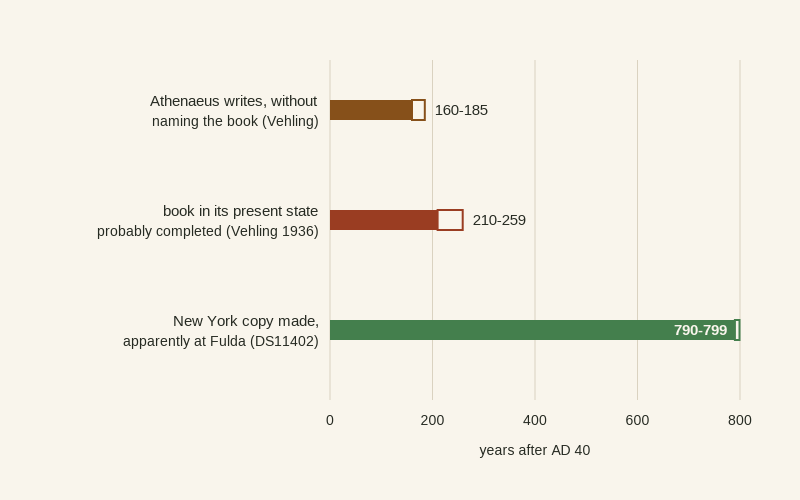
How long after A.D. 40, the end of the gourmet’s life in Vehling’s dates, each later point falls. This page reads Vehling’s “beginning of the third century” as 200–225 and his “latter part of the third century” as 250–299; the New York copy is dated to the 830s by its catalog record.
"Years after A.D. 40: Athenaeus, the book, the New York copy" by Molecule & Menu, https://moleculeandmenu.com/historical-dining/apicius/, licensed under CC BY 4.0 (https://creativecommons.org/licenses/by/4.0/)
Data: J. D. Vehling (trans.), Apicius: Cookery and Dining in Imperial Rome (Chicago, 1936), public domain, retrieved 2026-11-13; Digital Scriptorium catalog record DS11402 (New York Academy of Medicine, MS 01), catalog facts (data offered for reuse, no license named), retrieved 2026-11-13
Vehling did not close the question. Later in the same review he sides with the German editor Friedrich Vollmer, writing that M. Gabius Apicius may have been “the real author, or collector, or sponsor” of at least the major part, with recipes named for later gourmets “added from time to time.” Read together, the two passages say the core may be old, but the book as it survives was finished long after the man.
Two later critical editions exist, by Jacques André (1965) and by Christopher Grocock and Sally Grainger (2006). Neither was read for this page, so what they say about the date is not reported here.
| Claim | Who made it | Date proposed |
|---|---|---|
| M. Gabius Apicius lived under Augustus and Tiberius | Vehling, 1936 | 80 B.C. to A.D. 40 |
| Athenaeus does not mention the book | Vehling, 1936 | early third century A.D. |
| The book in its present state was probably completed | Vehling, 1936 | latter part of the third century A.D. |
| The New York copy was made, apparently at Fulda | Library catalog record | 830s |
Download the dating claims (CSV) (source and license notes) Data: J. D. Vehling (trans.), Apicius: Cookery and Dining in Imperial Rome (Chicago, 1936), public domain, retrieved 2026-11-13; Digital Scriptorium catalog record DS11402 (New York Academy of Medicine, MS 01), catalog facts (data offered for reuse, no license named), retrieved 2026-11-13
The two ninth-century manuscripts
The text survives in two manuscripts from the ninth century. The catalog record for the New York Academy of Medicine’s copy, MS 01, gives the place as Fulda, in Germany, and the date as “Second quarter of the ninth century.” Its provenance note is more careful: the book was “Produced apparently at Fulda.” The same note puts the copying in the 830s, and the record gives the extent as “ff. 57; parchment; 224 x 168.”
The other copy is in the Vatican Library as Urb. lat. 1146. According to Vehling’s appendix, it is ninth-century work on 58 sheets of heavy parchment, and “Traube, Vollmer and others believe that this manuscript was written in or in the vicinity of Tours.” The library’s own record was not consulted for this page.
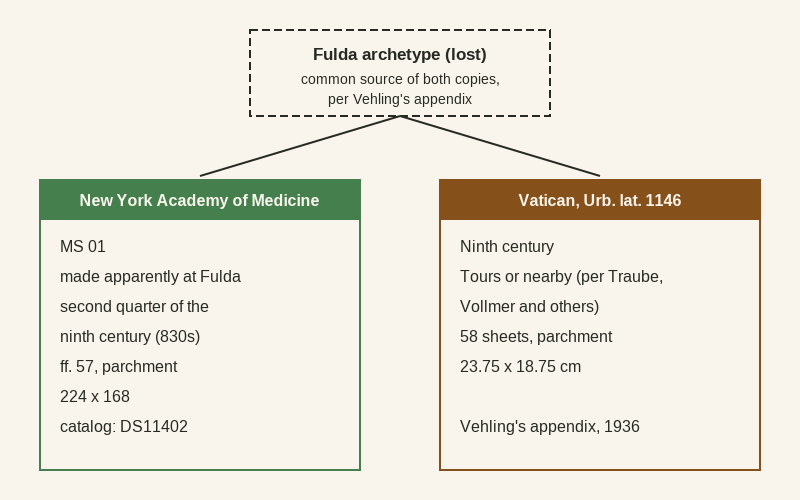
The two oldest copies and their lost common source. The New York details come from its catalog record, DS11402; the Vatican details come from Vehling’s 1936 appendix.
"The two ninth-century manuscripts of Apicius" by Molecule & Menu, https://moleculeandmenu.com/historical-dining/apicius/, licensed under CC BY 4.0 (https://creativecommons.org/licenses/by/4.0/)
Data: J. D. Vehling (trans.), Apicius: Cookery and Dining in Imperial Rome (Chicago, 1936), public domain, retrieved 2026-11-13; Digital Scriptorium catalog record DS11402 (New York Academy of Medicine, MS 01), catalog facts (data offered for reuse, no license named), retrieved 2026-11-13
Both copies go back to one lost book. Vehling reports Vollmer’s view that an archetype kept at the monastery of Fulda “in the ninth century was copied twice,” and states that “The common source at Fulda of these two manuscripts has been established by Traube.” So the oldest full copies of the text are about 800 years younger than the gourmet.
| New York Academy of Medicine, MS 01 | Vatican, Urb. lat. 1146 | |
|---|---|---|
| Made at | Apparently Fulda (catalog record) | Tours or nearby (per Traube, Vollmer) |
| Date | Second quarter of the ninth century (830s) | Ninth century |
| Leaves | ff. 57 | 58 sheets |
| Size | 224 x 168 | 23.75 x 18.75 cm |
| Where the details come from | Catalog record DS11402 | Vehling’s appendix, 1936 |
Download the manuscript details (CSV) (source and license notes) Data: J. D. Vehling (trans.), Apicius: Cookery and Dining in Imperial Rome (Chicago, 1936), public domain, retrieved 2026-11-13; Digital Scriptorium catalog record DS11402 (New York Academy of Medicine, MS 01), catalog facts (data offered for reuse, no license named), retrieved 2026-11-13
From Fulda to New York
The New York copy has moved through famous hands. Its catalog record says the humanist Poggio Bracciolini may have seen it at Fulda in 1417, and that Enoch of Ascoli brought it to Italy in 1455. Owners listed after that include Cardinal Bessarion and, from 1824, the English collector Sir Thomas Phillipps.
About a century later, Phillipps’s grandson sold it to Dr. Margaret Barclay Wilson. According to the record, she gave her collection of some 4,000 items on cooking to the Academy in 1928, donated the Apicius a year later, and the book was formally accessioned in 1934. Vehling’s 1936 appendix gives another year: it says she presented it in 1931.
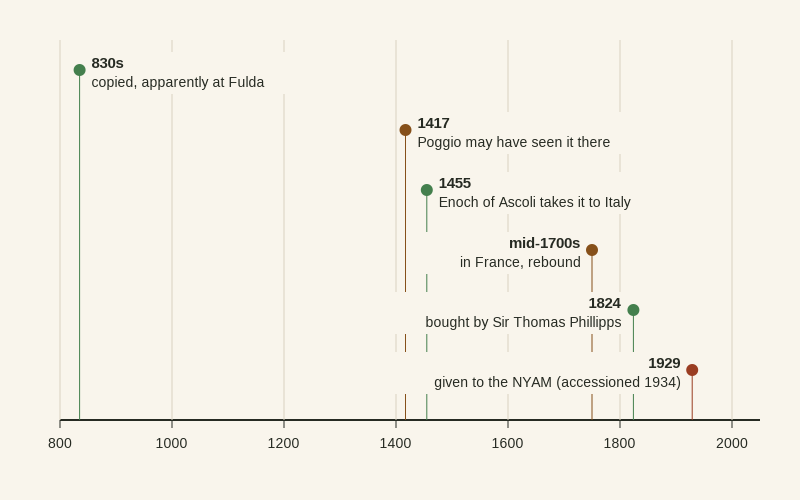
Stops on the New York copy’s route, as given in its catalog record. The 1417 stop is marked in the record as possible, not certain.
"The New York Apicius manuscript, from Fulda to New York" by Molecule & Menu, https://moleculeandmenu.com/historical-dining/apicius/, licensed under CC BY 4.0 (https://creativecommons.org/licenses/by/4.0/)
Data: Digital Scriptorium catalog record DS11402 (New York Academy of Medicine, MS 01), catalog facts (data offered for reuse, no license named), retrieved 2026-11-13
Something was lost on the way. Vehling notes that the New York copy has no title page and that the Vatican copy’s title page reads only “INCP API CÆ.” The title printed in the 1922 Latin edition is partly the editors’ reconstruction, and they mark the words they supplied.
Ten books under one name
The text is divided into ten books with Greek titles. The 1922 Latin edition by Caesar Giarratano and Friedrich Vollmer heads them Epimeles, Sarcoptes, Cepuros, Pandecter, Ospreon, Aeropetes, Polyteles, Tetrapus, Thalassa and Halieus. In their list of the ten books, the editors mark the first six names as their own supplement. The New York copy’s list of book names now begins at Book VII, because its first leaf was already missing in the 1400s.
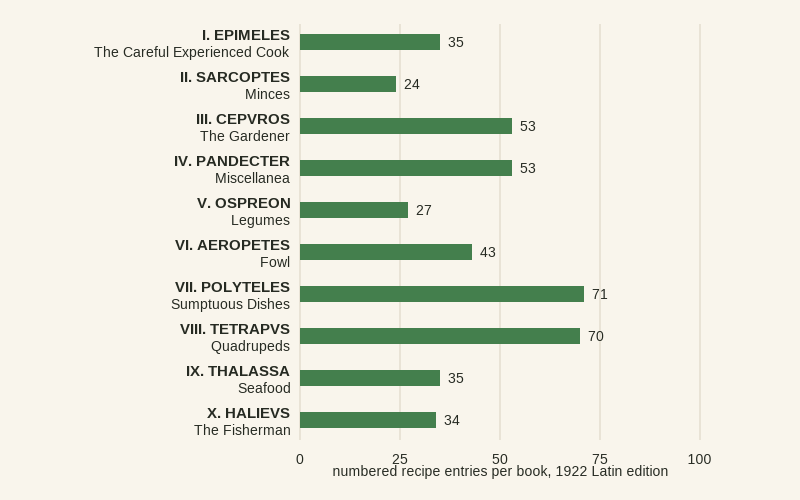
Recipe entries per book in the 1922 Latin edition, counting the numbers in parentheses in its online transcription: Schuch’s paragraph numbers, which the 1922 editors added in the margin; 445 in all. Three numbers missing from the transcription (114, 115 and 117) are not counted. English titles are Vehling’s.
"Numbered recipe entries in the ten books of Apicius" by Molecule & Menu, https://moleculeandmenu.com/historical-dining/apicius/, licensed under CC BY 4.0 (https://creativecommons.org/licenses/by/4.0/)
Data: Apicii librorum X qui dicuntur De re coquinaria quae extant, ed. C. Giarratano and F. Vollmer (Leipzig: Teubner, 1922), public domain in the US, retrieved 2026-11-13; J. D. Vehling (trans.), Apicius: Cookery and Dining in Imperial Rome (Chicago, 1936), public domain, retrieved 2026-11-13
| Book | Latin title | Vehling’s English title | Numbered entries |
|---|---|---|---|
| I | Epimeles | The Careful Experienced Cook | 35 |
| II | Sarcoptes | Minces | 24 |
| III | Cepuros | The Gardener | 53 |
| IV | Pandecter | Miscellanea | 53 |
| V | Ospreon | Legumes | 27 |
| VI | Aeropetes | Fowl | 43 |
| VII | Polyteles | Sumptuous Dishes | 71 |
| VIII | Tetrapus | Quadrupeds | 70 |
| IX | Thalassa | Seafood | 35 |
| X | Halieus | The Fisherman | 34 |
Download the ten-book counts (CSV) (source and license notes) Data: Apicii librorum X qui dicuntur De re coquinaria quae extant, ed. C. Giarratano and F. Vollmer (Leipzig: Teubner, 1922), public domain in the US, retrieved 2026-11-13; J. D. Vehling (trans.), Apicius: Cookery and Dining in Imperial Rome (Chicago, 1936), public domain, retrieved 2026-11-13
Book VII, Polyteles, has the most entries, and Book II, Sarcoptes, the fewest. The recipes are records of Roman cooking, not instructions to follow, and nothing on this page is offered as a recipe.
Liquamen: the word in 313 of 445 recipes
One word runs through the whole text. In the 1922 Latin edition, liquamen appears in 313 of the 445 numbered recipe entries, or 70.3 percent. Book X, on fish, has the highest share, 31 of 34; Book I, on spiced wines and keeping food, has the lowest, 7 of 35.
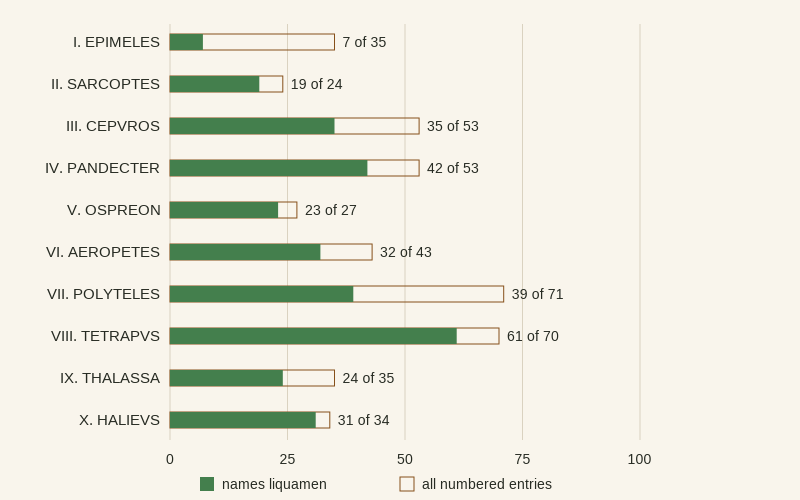
How many numbered entries in each book name liquamen, out of all numbered entries. Counted in the recipe text of the 1922 Latin edition, not in the editors’ notes.
"Recipe entries naming liquamen in each book of Apicius" by Molecule & Menu, https://moleculeandmenu.com/historical-dining/apicius/, licensed under CC BY 4.0 (https://creativecommons.org/licenses/by/4.0/)
Data: Apicii librorum X qui dicuntur De re coquinaria quae extant, ed. C. Giarratano and F. Vollmer (Leipzig: Teubner, 1922), public domain in the US, retrieved 2026-11-13
What liquamen was is a translation problem. Vehling wrote that it “may stand for broth, sauce, stock, gravy, drippings,” and in Book I he renders a recipe for fixing liquamen with a bad smell as “To Improve a Broth.” His own footnote to that recipe records two other readings: Lister’s “Liquamen, id est, garum,” and Gollmer’s “Fish sauce.”
Garum, in Vehling’s description, was a fish sauce made from small fish that were “spiced, pounded, fermented, salted, strained and bottled.” He compared the best of it to modern anchovy sauce. The Latin alone cannot settle which of these the cooks behind each recipe meant.
What a Roman table looked like
The book has no pictures, but Roman floors do. A mosaic in the Archaeological Museum of Sousse, in Tunisia, sets small round panels of food inside a pattern of circles and vines. Its file page describes the motifs as xenia, “welcome gifts for guests”: fish, game birds, poultry and fruit.
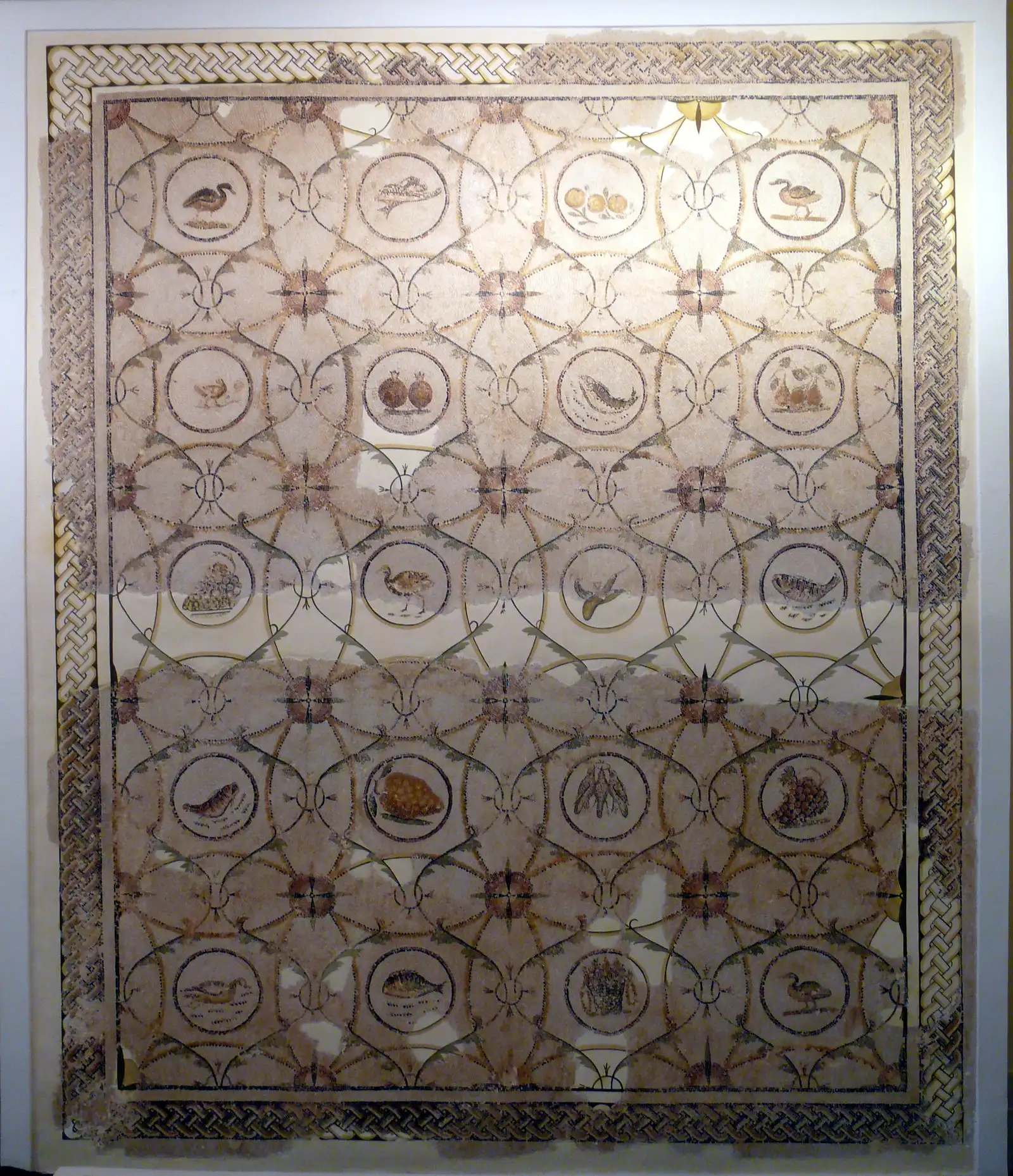
A xenia mosaic in the Archaeological Museum of Sousse, Tunisia. Its roundels show birds, fish and fruit; the cookbook has whole books on fowl, seafood and fish.
"Sousse mosaic xenia patterns" by Ad Meskens — https://commons.wikimedia.org/wiki/File:Sousse_mosaic_xenia_patterns.JPG — CC BY-SA 3.0 (https://creativecommons.org/licenses/by-sa/3.0/)
The mosaic is floor decoration, not an illustration of the cookbook, and nothing ties its pictures to any recipe in the text. It shows only that birds, fish and fruit were subjects worth setting into a Roman floor.
A menu like Delmonico’s menu of 1899 can be set against wages, because it prints prices. The Apicius text prints none, so the menu card below gives hours on the plate, a menu price turned into hours of pay, as not applicable. The gap between the name on the cover and the hands that wrote the recipes comes up again in a later cookbook, Mrs Beeton’s Book of Household Management.
Sources
- Apicius, Cookery and Dining in Imperial Rome: A Bibliography, Critical Review and Translation of the Ancient Book Known as Apicius de re Coquinaria, translated by Joseph Dommers Vehling, introduction by Frederick Starr (Chicago, 1936). https://gutenberg.pglaf.org/cache/epub/29728/Read: full text, including the critical review and the appendix on manuscripts.
- Apicii librorum X qui dicuntur De re coquinaria quae extant, edited by Caesar Giarratano and Friedrich Vollmer (Leipzig: B. G. Teubner, 1922). https://gutenberg.pglaf.org/cache/epub/16439/Read: full text; book headings, recipe numbers, index of personal names and the word liquamen counted.
- Digital Scriptorium, catalog record DS11402: New York Academy of Medicine, MS 01, Apicius, De re coquinaria. https://search.digital-scriptorium.org/catalog/DS11402Read: full catalog record.
Cite this page
“Apicius: Vehling Dated the Roman Cookbook Long After Apicius.” Molecule & Menu. Published November 14, 2026. https://moleculeandmenu.com/historical-dining/apicius/. Accessed on the date you read it.
How pages here are checked · All corrections · Report an error on this page (contact@moleculeandmenu.com)
Second helping:
- Eggs Benedict history: another name on a dish whose origin is told in more than one story.
- Umami: the savory taste, and MSG, a modern seasoning the FDA says is now made by fermenting starch, sugar beets, sugar cane or molasses.
More from Historical Dining
Historical Dining
An 1899 Menu Marked Delmonico’s: Sirloin in Hours of Pay
An 1899 menu attributed to Delmonico’s priced sirloin at 75 cents: about 3.6 hours of New York State hod carriers’ pay, with a 6-day week assumed.
Picture credit
"Delmonico’s: Fifth Avenue, Broadway and 26th Street (King’s Handbook of New York City, p. 244)" by Unknown author — https://commons.wikimedia.org/wiki/File:244_DELMONICO%27S_FIFTH_AVENUE,_BROADWAY_AND_26TH_STREET.jpg — Public domain (US: published 1893, before 1931 (PD-US-expired on the file page); EU: illustrator not named, published 1893, more than 70 years ago (PD-old-70-expired on the file page); presumed, illustrator not traced; British Library scan marked Public Domain Mark); modified: cropped to remove the printed caption below the picture
Historical Dining
Book of Household Management: 3 Recipes Credit Eliza Acton
Mrs Beeton’s 1861 book credits Eliza Acton under three recipes. A check of three Acton books finds 19 paragraphs that are a tenth or more in her words.
Picture credit
"Modern Mode of Serving Dishes: the center dish of fruit from Mrs Beeton’s 1861 color plate of dessert dishes" by Wellcome Collection — https://commons.wikimedia.org/wiki/File:The_book_of_household_management_by_Mrs_Beeton_Wellcome_L0045070.jpg — CC BY 4.0 (https://creativecommons.org/licenses/by/4.0/); modified: cropped to the center dish of fruit; the printed title, plate letters and caption text left out
Historical Dining
Eggs Benedict History: An 1894 Cookbook Spelled It Benedick
The earliest eggs Benedict record this page could read: Eggs à la Benedick in Ranhofer’s 1894 cookbook. Neither inventor story has a dated source read here.
Picture credit (illustration)
Illustration: Molecule & Menu. Generated schematic illustration — not a photograph or historical record. Reuse: CC BY 4.0 (https://creativecommons.org/licenses/by/4.0/), to the extent Molecule & Menu holds rights in this image.