Book of Household Management: 3 Recipes Credit Eliza Acton
Short answer
Mrs Beeton’s Book of Household Management names Eliza Acton as the source of three recipes. The bound edition appeared in 1861, when Isabella Beeton was about 25, and prints “(Miss Acton’s Recipe.)” under two ways of boning a fowl and one home-made bread. This page compared 2,549 of the book’s numbered paragraphs with three of Acton’s books and found 19 in which at least a tenth of the wording is hers, each checked on the page images of both books. Three of the 19 carry no credit line.
Course list · 5 sections
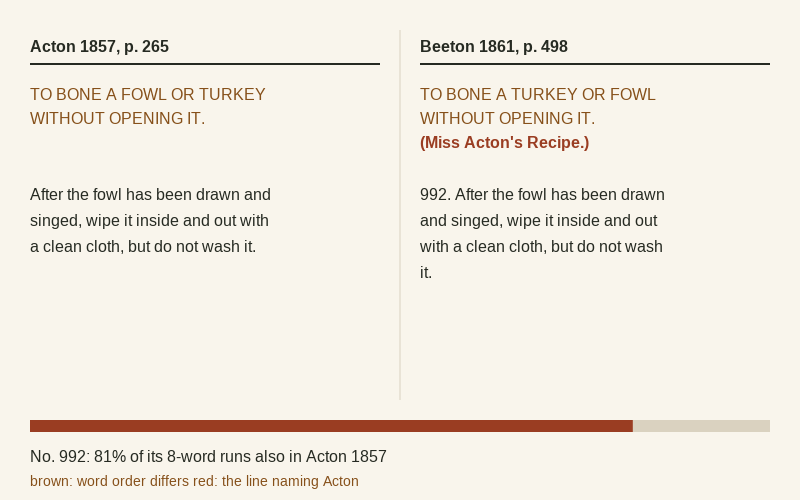
The opening of No. 992 in Beeton’s 1861 book, beside the same recipe on page 265 of Acton’s Modern Cookery (1857 edition). Beeton’s heading turns Acton’s fowl or turkey into turkey or fowl and adds a line naming Acton; the first sentence matches word for word.
"The boning recipe in Acton (1857) and Beeton (1861), side by side" by Molecule & Menu, https://moleculeandmenu.com/historical-dining/book-of-household-management/, licensed under CC BY 4.0 (https://creativecommons.org/licenses/by/4.0/)
Data: Acton, Modern Cookery (1857), Internet Archive b21531894 (University of Leeds scan, Public Domain Mark), retrieved 2026-11-13; Beeton 1861, Internet Archive b20392758 (Wellcome Library scan, Public Domain Mark), page images retrieved 2026-11-13
Many of the recipes in Mrs Beeton’s book end with a line giving their average cost. A few carry a second line, set just under the heading, that names another writer. This page counts both kinds of line and then asks a harder question: how much of Acton’s wording travelled with her name, and how much travelled without it.
The book and the woman behind it
The Book of Household Management was published in London by S. O. Beeton. The transcription of the 1861 edition used here says it first came out in 24 monthly parts from 1859 to 1861, and as a bound book in 1861. Its title page addresses the mistress, the housekeeper, the cook, the butler, the nurse and a long list of other servants.
The Internet Archive records for the scans used here give Isabella Mary Beeton as 1836–1865. Her birth date was not checked for this page, so her age at the bound edition is given only as about 25. The same records give Eliza Acton as 1799–1859; the earliest edition of her Modern Cookery read for this page is dated 1845.
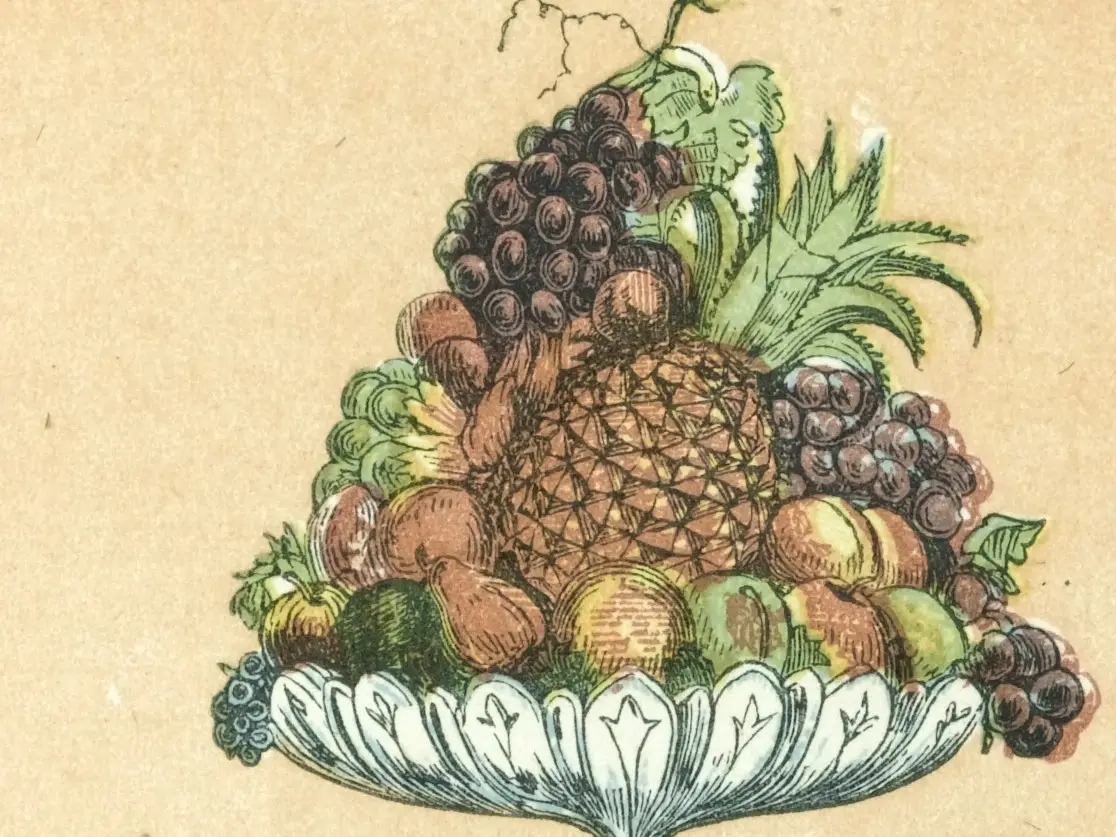
The center dish of fruit from a color plate of dessert dishes in the 1861 edition. The plate is headed Modern Mode of Serving Dishes; its title and caption are cropped out here.
"Modern Mode of Serving Dishes: the center dish of fruit from Mrs Beeton’s 1861 color plate of dessert dishes" by Wellcome Collection — https://commons.wikimedia.org/wiki/File:The_book_of_household_management_by_Mrs_Beeton_Wellcome_L0045070.jpg — CC BY 4.0 (https://creativecommons.org/licenses/by/4.0/); modified: cropped to the center dish of fruit; the printed title, plate letters and caption text left out
The book runs to 2,751 numbered paragraphs. Many are recipes, but the numbering also covers the duties of servants, bills of fare and, at the very end, notes on wills. The recipes quoted on this page are read as historical text, not as instructions to follow.
The “Average cost” line
A count of the Project Gutenberg transcription of the 1861 edition finds 1,046 recipe lines that give an “Average cost.” In 1,044 of them the transcription prints exactly those two words; the other two are set with different italics or split across a line. Six page images of the 1861 printing, covering nine recipes, were checked against the transcription, and each carried the line as transcribed. Roast turkey poults give “Average cost, 7s. to 8s. each.” on page 498, and cocoa-nut soup gives 1s. 3d. per quart on page 66.
Beeton explains the line herself. At the head of the soup chapter, where the recipes begin, a note says that “an entirely original and most intelligible system has been pursued in explaining the preparation of each dish,” and names its parts in order: ingredients, mode, time, season and average cost. The claim of originality is made for this layout, not for every recipe set out in it. At the head of the fish chapter, another note warns that after a few hours of bad weather at sea, a turbot bought one day for six or seven shillings might be worth almost as many pounds the next. “The average costs, therefore, which will be found appended to each recipe, must be understood as about the average price,” it goes on, for a market supplied as usual with fish of average size.
The lines cluster where the recipes do. Puddings and pastry carry the most, 167, followed by creams, jellies and sweet dishes with 100. Beverages carry 12.
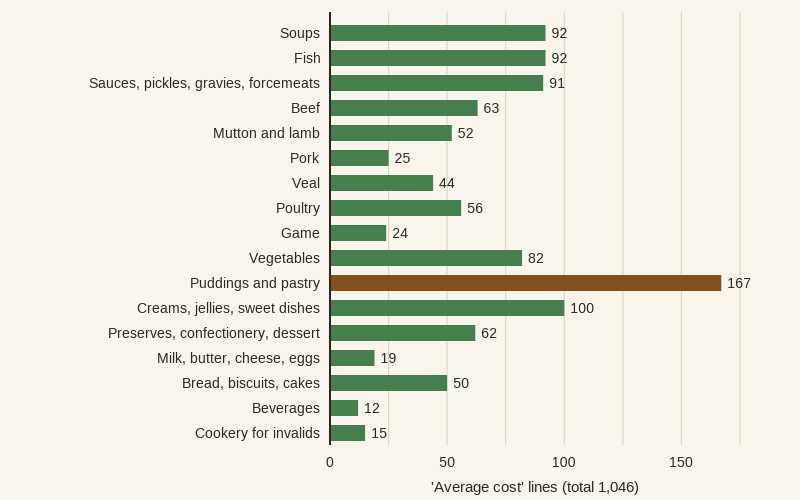
Recipe lines giving an “Average cost” in each recipe section of the 1861 edition, counted in the Project Gutenberg transcription. Section names are shortened from the chapter titles.
"'Average cost' lines by section, Book of Household Management (1861)" by Molecule & Menu, https://moleculeandmenu.com/historical-dining/book-of-household-management/, licensed under CC BY 4.0 (https://creativecommons.org/licenses/by/4.0/)
Data: The Book of Household Management (1861), Project Gutenberg eBook 10136 text (public domain), retrieved 2026-11-13
| Section | Chapter | “Average cost” lines |
|---|---|---|
| Soups | VI | 92 |
| Fish | VIII | 92 |
| Sauces, pickles, gravies, forcemeats | X | 91 |
| Beef | XIII | 63 |
| Mutton and lamb | XV | 52 |
| Pork | XVII | 25 |
| Veal | XIX | 44 |
| Poultry | XXI | 56 |
| Game | XXIII | 24 |
| Vegetables | XXV | 82 |
| Puddings and pastry | XXVII | 167 |
| Creams, jellies, sweet dishes | XXIX | 100 |
| Preserves, confectionery, dessert | XXXI | 62 |
| Milk, butter, cheese, eggs | XXXIII | 19 |
| Bread, biscuits, cakes | XXXV | 50 |
| Beverages | XXXVII | 12 |
| Cookery for invalids | XXXIX | 15 |
Download the “Average cost” counts (CSV) (source and license notes) Data: The Book of Household Management (1861), Project Gutenberg eBook 10136 text (public domain), retrieved 2026-11-13
An average cost is what the cook would spend on ingredients. It is not a price charged to anyone, which is what a restaurant card such as Delmonico’s menu of 1899 prints. For that reason the menu card below does not convert these costs into hours on the plate: the figures are not menu prices, and no wage table for the same place and years was read.
Three recipes with Acton’s name
The credit “(Miss Acton’s Recipe.)” appears three times in the 1861 book, each time on its own line under a recipe heading:
- No. 992, To Bone a Turkey or Fowl without Opening It, page 498.
- No. 994, Another Mode of Boning a Turkey or Fowl, page 499.
- No. 1718, To Make Good Home-made Bread, page 839.
Other headings name cooks such as Soyer and Ude, but two more notices matter for the comparison below. On page 835, No. 1692 says that “The following observations are extracted from a valuable work on Bread-making,” and its footnote names “The English Bread-Book.” By Eliza Acton. Earlier, on page 378, three paragraphs on curing bacon carry the heading Cobbett’s Recipe.
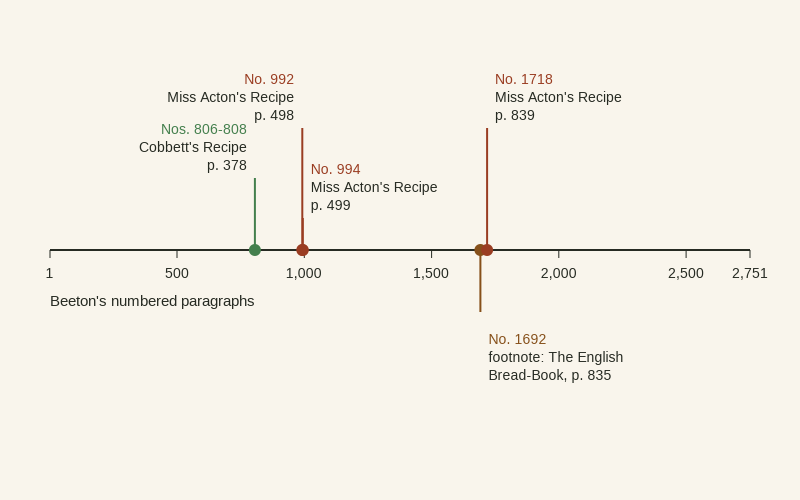
Where the credits sit in the run of 2,751 numbered paragraphs, with the page of the 1861 edition. Red marks the three “Miss Acton’s Recipe” lines.
"Where the Acton and Cobbett credits sit in Beeton's numbered paragraphs" by Molecule & Menu, https://moleculeandmenu.com/historical-dining/book-of-household-management/, licensed under CC BY 4.0 (https://creativecommons.org/licenses/by/4.0/)
Data: The Book of Household Management (1861), Project Gutenberg eBook 10136 text (public domain), retrieved 2026-11-13; Beeton 1861, Internet Archive b20392758 (Wellcome Library scan, Public Domain Mark), page images retrieved 2026-11-13
| Paragraph | Heading in Beeton | Credit as printed | Page (1861) |
|---|---|---|---|
| Nos. 806–808 | For Curing Bacon, and Keeping It Free from Rust | Cobbett’s Recipe | 378–379 |
| No. 992 | To Bone a Turkey or Fowl without Opening It | Miss Acton’s Recipe | 498 |
| No. 994 | Another Mode of Boning a Turkey or Fowl | Miss Acton’s Recipe | 499 |
| No. 1692 | (bread-making notes) | footnote: The English Bread-Book, by Eliza Acton | 835 |
| No. 1718 | To Make Good Home-made Bread | Miss Acton’s Recipe | 839 |
A name on a recipe does not settle where the rest of a book came from. The Roman cookbook called Apicius carries a famous name too, and its text took shape long after the man it is named for.
Beeton and Acton side by side
To see how far Acton’s wording reaches, this page compared Beeton’s text with three of Acton’s books: Modern Cookery in its 1857 edition, the 1845 edition as a check, and The English Bread-Book of 1857. All three are University of Leeds scans on the Internet Archive. Each of Beeton’s numbered paragraphs with at least 12 words was cut into overlapping runs of 8 words, and each run was looked up in each Acton text. A paragraph counts as near-verbatim when half or more of its runs match, and as sharing passages when at least 10 but under 50 percent match.
Of 2,549 paragraphs compared, 19 share wording with Acton at that level: 14 near-verbatim and 5 sharing passages. Another 225 paragraphs share at least one run but fall below a tenth; they are not counted here and were not checked on the page images. For every one of the 19, the matching passage was found on the page images of both books, and the page numbers are in the table below.
The credit lines account for most of them. Four paragraphs sit under the headings marked “Miss Acton’s Recipe,” including No. 993, the second paragraph under No. 992’s heading. Nine more follow the No. 1692 notice that names The English Bread-Book, though the book does not mark where that extract ends. Three are the Cobbett bacon paragraphs, which Acton also prints, in quotation marks, as Cobbett’s receipt; the overlap cannot show whether Beeton took them from Acton or from Cobbett.
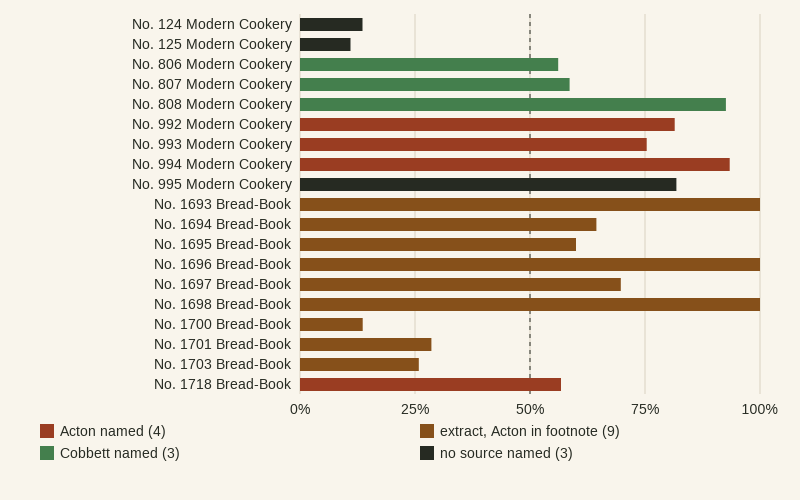
Share of each paragraph’s 8-word runs found in Acton’s text, for the 19 paragraphs where a tenth or more matched. Color shows whose name, if any, Beeton prints with the paragraph; the dashed line marks half.
"Beeton paragraphs sharing wording with Acton, by share of 8-word runs" by Molecule & Menu, https://moleculeandmenu.com/historical-dining/book-of-household-management/, licensed under CC BY 4.0 (https://creativecommons.org/licenses/by/4.0/)
Data: The Book of Household Management (1861), Project Gutenberg eBook 10136 text (public domain), retrieved 2026-11-13; Acton, Modern Cookery (1857), Internet Archive b21531894 (University of Leeds scan, Public Domain Mark), retrieved 2026-11-13; Acton, Modern Cookery (1845), Internet Archive b21531857 (University of Leeds scan, Public Domain Mark), retrieved 2026-11-13; Acton, The English Bread-Book (1857), Internet Archive b21531006 (University of Leeds scan, Public Domain Mark), retrieved 2026-11-13
Three paragraphs with no name attached
Three paragraphs carry no credit line. No. 995, To Bone Fowls for Fricassees, Curries, and Pies, follows the credited No. 994 and matches Acton’s page 266 almost word for word, down to “work the knife as directed in the receipt above,” which Beeton prints as “the recipe above.” Two soups share shorter passages. Acton’s cocoa-nut soup on page 19 begins “Pare the dark rind from a very fresh cocoa-nut, and grate it down small on an exceedingly clean, bright grater”; Beeton’s No. 125 on page 66 reads “Take the dark rind from the cocoa-nut, and grate it down small on a clean grater,” and sets it between an ingredients list and the time and average cost lines of her own format.
The credited bread recipe shows the same trimming. Acton’s English Bread-Book tells the learner not to set the rising batter “upon the kitchen fender in front of it, as servants often do, for it will become too much heated there” (page 130). Beeton’s No. 1718 keeps “upon the kitchen fender, for it will become too much heated there” and drops the servants. The boning recipe was not new in 1857 either: it already appears on page 305 of the 1845 edition.
| Beeton paragraph | Page (1861) | Acton book and page | 8-word runs matched | Credit in Beeton |
|---|---|---|---|---|
| No. 124, Chestnut (Spanish) Soup | 65–66 | Modern Cookery 1857, p. 19 | 14% | none |
| No. 125, Cocoa-nut Soup | 66 | Modern Cookery 1857, p. 19 | 11% | none |
| Nos. 806–808, curing bacon | 378–379 | Modern Cookery 1857, pp. 252–253 | 56–93% | Cobbett’s Recipe |
| Nos. 992–993, boning without opening | 498–499 | Modern Cookery 1857, p. 265 | 75–81% | Miss Acton’s Recipe |
| No. 994, another mode of boning | 499–500 | Modern Cookery 1857, pp. 265–266 | 93% | Miss Acton’s Recipe |
| No. 995, boning for fricassees | 500 | Modern Cookery 1857, p. 266 | 82% | none |
| Nos. 1693–1698, bread-making notes | 835 | English Bread-Book, pp. 122–127 | 60–100% | No. 1692 notice |
| Nos. 1700, 1701, 1703, bread-making notes | 836 | English Bread-Book, pp. 91, 108, 128 | 14–29% | No. 1692 notice (end of extract not marked) |
| No. 1718, home-made bread | 839–840 | English Bread-Book, pp. 129–130 | 57% | Miss Acton’s Recipe |
Download the Beeton–Acton comparison (CSV) (source and license notes) Data: The Book of Household Management (1861), Project Gutenberg eBook 10136 text (public domain), retrieved 2026-11-13; Acton, Modern Cookery (1857), Internet Archive b21531894 (University of Leeds scan, Public Domain Mark), retrieved 2026-11-13; Acton, Modern Cookery (1845), Internet Archive b21531857 (University of Leeds scan, Public Domain Mark), retrieved 2026-11-13; Acton, The English Bread-Book (1857), Internet Archive b21531006 (University of Leeds scan, Public Domain Mark), retrieved 2026-11-13
The method has limits that bound every number above:
- It finds only shared runs of 8 or more words. A recipe Beeton rewrote in her own words would not show up, even if the method were the same.
- It checks three Acton books and nothing else, so it says nothing about borrowing from other writers.
- Acton’s text was read from the scans’ recognized text to find the passages; every match counted here was then confirmed on the page images.
The color plates
The 1861 edition also printed color plates headed Modern Mode of Serving Dishes, showing finished dishes on their platters. The dessert plate, cropped above to its dish of fruit, also shows a jelly of two colours, a raspberry cream, a trifle and strawberries in an ornamental flowerpot. Another plate, below, shows three fish dishes.
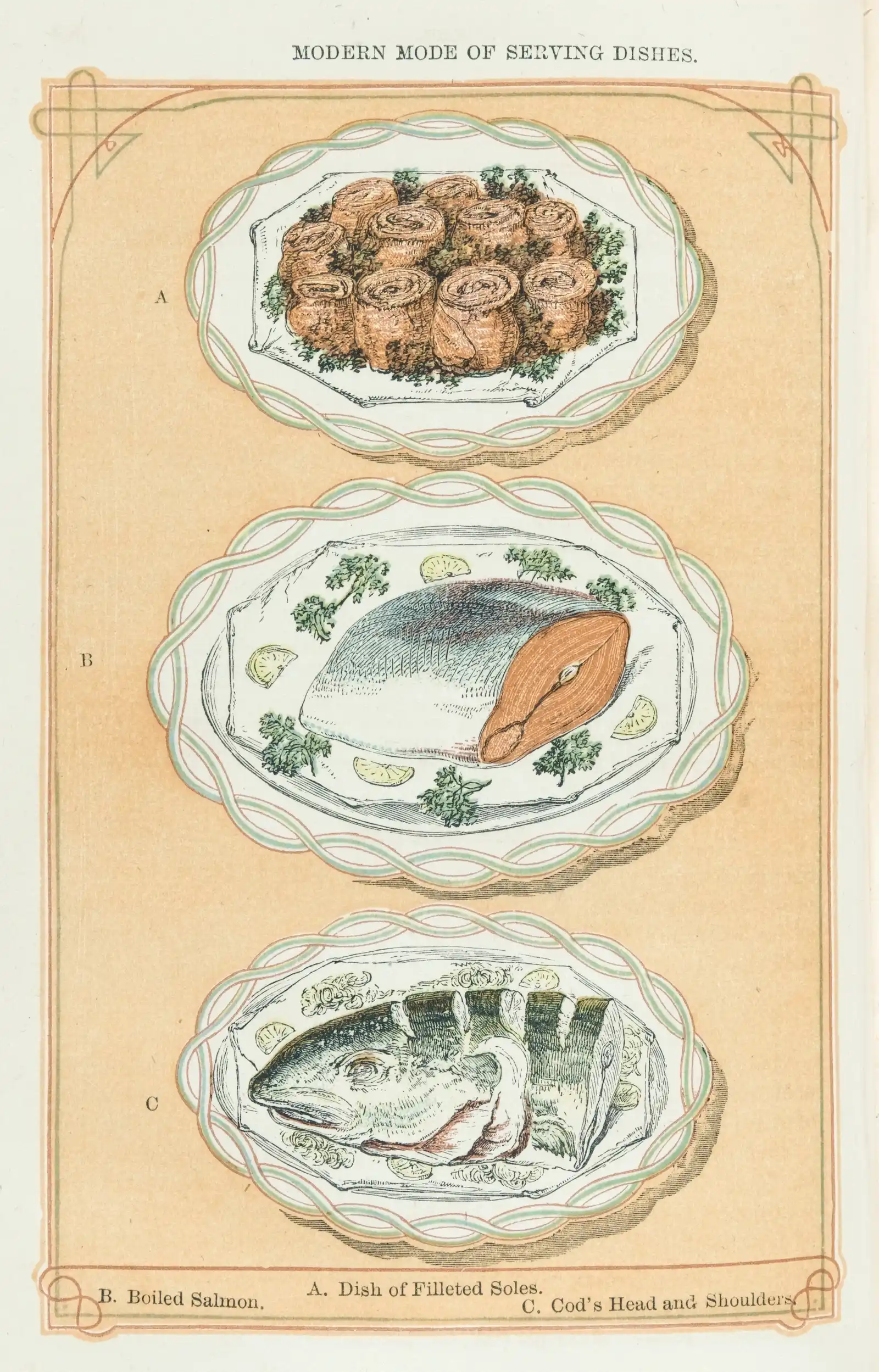
A color plate of fish dishes from the 1861 edition, captioned Dish of Filleted Soles, Boiled Salmon, and Cod’s Head and Shoulders. The printmaker is not named.
"Modern Mode of Serving Dishes: fish dishes (The Book of Household Management, 1861)" by Wellcome Collection — https://commons.wikimedia.org/wiki/File:The_book_of_household_management_by_Mrs_Beeton_Wellcome_L0045062.jpg — CC BY 4.0 (https://creativecommons.org/licenses/by/4.0/)
The plates show dishes as finished and served. They do not show how the dishes were cooked. Each carries plate letters, such as A, B and C here, rather than recipe numbers.
Sources
- Isabella Beeton, The Book of Household Management (London: S. O. Beeton, 1861). https://archive.org/details/b20392758Read: full text searched and counted; pages 60, 65, 66, 378, 379, 381, 484, 498, 499, 500, 835, 836 and 839 and the openings of chapters VI and VIII checked against the page images.
- Eliza Acton, Modern Cookery, for Private Families (London: Longman, Brown, Green, Longmans, and Roberts, 1857). https://archive.org/details/b21531894Read: full text compared with Beeton's; pages 19, 250, 252, 253, 265 and 266 checked against the page images.
- Eliza Acton, Modern Cookery, in All Its Branches (London: Longman, Brown, Green, and Longmans, 1845). https://archive.org/details/b21531857Read: full text compared with Beeton's as a check; pages 305 and 315 checked against the page images.
- Eliza Acton, The English Bread-Book for Domestic Use (London: Longman, Brown, Green, Longmans, & Roberts, 1857). https://archive.org/details/b21531006Read: full text compared with Beeton's; pages 91, 106, 107, 108, 122, 123, 127, 128, 129 and 130 checked against the page images.
- Wellcome Collection, colour plates 'Modern Mode of Serving Dishes' from The Book of Household Management (1861), photographs L0045070 and L0045062, on Wikimedia Commons. https://commons.wikimedia.org/wiki/File:The_book_of_household_management_by_Mrs_Beeton_Wellcome_L0045070.jpgRead: file pages and original images of both plates.

Cite this page
“Book of Household Management: 3 Recipes Credit Eliza Acton.” Molecule & Menu. Published November 14, 2026. https://moleculeandmenu.com/historical-dining/book-of-household-management/. Accessed on the date you read it.
How pages here are checked · All corrections · Report an error on this page (contact@moleculeandmenu.com)
Second helping:
- Eggs Benedict history: a later cookbook, and a dish name whose origin stories disagree.
- Caramelization: Beeton’s No. 1514 judges sugar boiled to caramel by dropping a little into cold water, with no temperature given. Sugar boiled that far burns skin on contact.
More from Historical Dining
Historical Dining
An 1899 Menu Marked Delmonico’s: Sirloin in Hours of Pay
An 1899 menu attributed to Delmonico’s priced sirloin at 75 cents: about 3.6 hours of New York State hod carriers’ pay, with a 6-day week assumed.
Picture credit
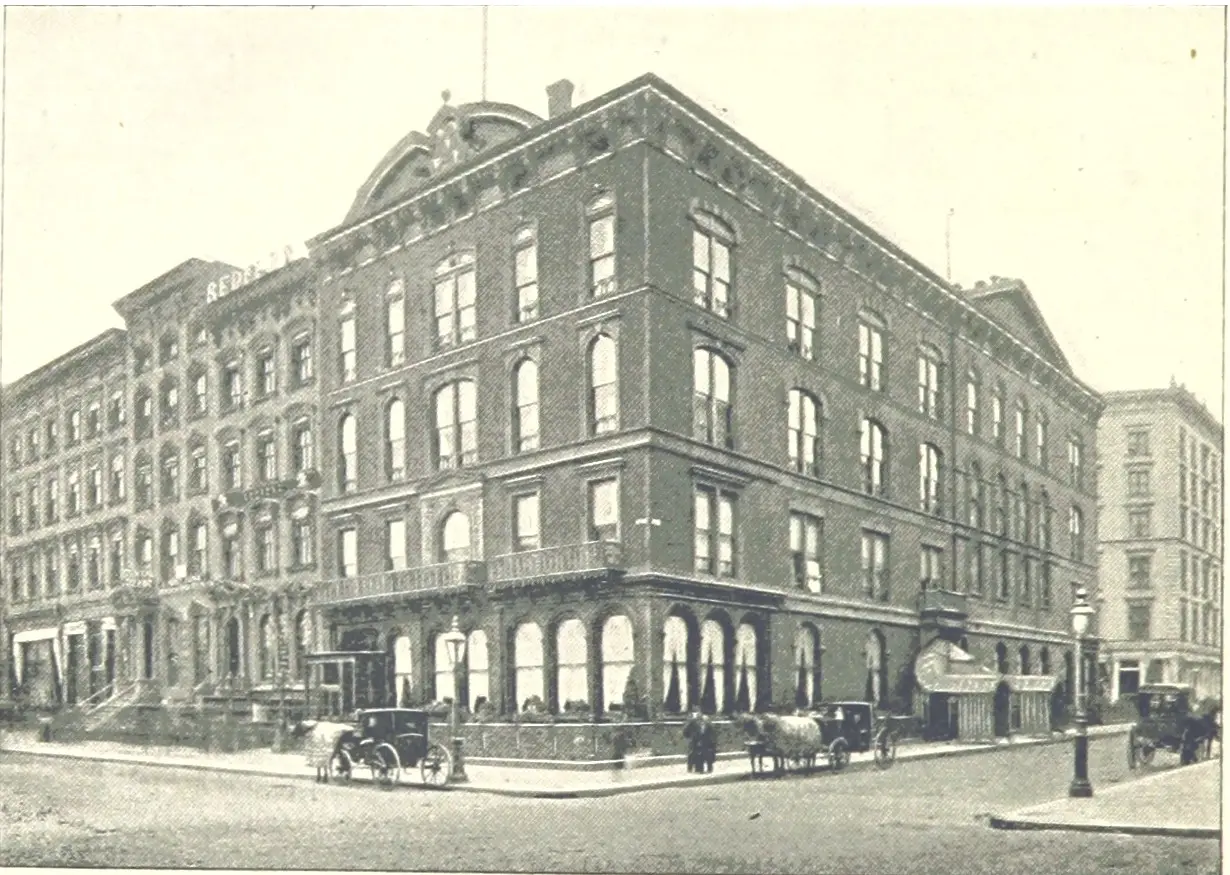
"Delmonico’s: Fifth Avenue, Broadway and 26th Street (King’s Handbook of New York City, p. 244)" by Unknown author — https://commons.wikimedia.org/wiki/File:244_DELMONICO%27S_FIFTH_AVENUE,_BROADWAY_AND_26TH_STREET.jpg — Public domain (US: published 1893, before 1931 (PD-US-expired on the file page); EU: illustrator not named, published 1893, more than 70 years ago (PD-old-70-expired on the file page); presumed, illustrator not traced; British Library scan marked Public Domain Mark); modified: cropped to remove the printed caption below the picture
Historical Dining
Apicius: Vehling Dated the Roman Cookbook Long After Apicius
Apicius carries the name of a gourmet who, by its 1936 translator’s dates, died in A.D. 40; he judged the book probably completed late in the third century.
Picture credit (illustration)
Illustration: Molecule & Menu. Generated schematic illustration — not a photograph or historical record. Reuse: CC BY 4.0 (https://creativecommons.org/licenses/by/4.0/), to the extent Molecule & Menu holds rights in this image.
Historical Dining
Eggs Benedict History: An 1894 Cookbook Spelled It Benedick
The earliest eggs Benedict record this page could read: Eggs à la Benedick in Ranhofer’s 1894 cookbook. Neither inventor story has a dated source read here.
Picture credit (illustration)
Illustration: Molecule & Menu. Generated schematic illustration — not a photograph or historical record. Reuse: CC BY 4.0 (https://creativecommons.org/licenses/by/4.0/), to the extent Molecule & Menu holds rights in this image.